

TL;DR:
- Messaging platforms significantly improve real estate communication speed with open rates of 90-98%.
- Security features like encryption and audit trails are essential for compliance and data protection.
- AI automation saves property teams nearly 12 hours weekly by streamlining routine tasks.
Real estate moves fast. A delayed message can mean a lost deal, a frustrated client, or a missed showing. Yet many enterprise teams still rely on email as their primary communication channel, even though SMS open rates reach 90-98% compared to just 15-25% for email. That gap is not a minor inconvenience. It is a competitive liability. This guide walks real estate professionals and corporate teams through the core reasons messaging platforms have become essential, what security and AI features to prioritize, and how to select the right solution for your organization.
Table of Contents
- Why messaging platforms are essential in real estate today
- Critical features: Security, compliance, and auditability
- AI-powered messaging: Transforming team efficiency
- Choosing the right messaging platform for your real estate business
- Perspective: What most real estate teams get wrong about messaging transformation
- Move forward: Secure enterprise messaging for real estate
- Frequently asked questions
Key Takeaways
| Point | Details |
|---|---|
| Faster response rates | Messaging platforms deliver instant client and team connectivity, outperforming traditional email. |
| Enterprise-level security | Secure messaging tools protect sensitive business and client data with advanced privacy features. |
| AI saves time | Artificial intelligence in messaging platforms reduces manual communications, freeing up staff for high-value work. |
| Right platform matters | Choosing a fully integrated, secure solution ensures adoption, compliance, and long-term efficiency. |
Why messaging platforms are essential in real estate today
Property transactions involve dozens of moving parts: client approvals, agent coordination, legal reviews, and time-sensitive offers. When communication lags, deals stall. Messaging platforms solve this by delivering information instantly, to the right person, on the device they already use.
The numbers make the case clearly. SMS open rates in real estate sit between 90-98%, while email averages just 15-25%. That means nearly every text message gets read, often within minutes. Email, by contrast, frequently gets buried, filtered, or ignored entirely. For a team coordinating a multi-property transaction across time zones, that difference is enormous.
Modern clients also expect speed. A buyer who submits an offer wants confirmation quickly. A tenant waiting on a lease renewal needs a fast answer. When your team cannot respond in real time, clients lose confidence. Messaging platforms close that gap by enabling instant, visible communication that keeps everyone aligned.
90-98% of real estate SMS messages are opened, compared to just 15-25% of emails. Fast responses are no longer optional — they are expected.
Here are the core real estate activities that benefit most from messaging platforms:
- Lead nurturing: Automated follow-ups keep prospects warm without manual effort
- Showing coordination: Instant confirmations and reminders reduce no-shows
- Deal status updates: Teams stay aligned without lengthy email threads
- Document requests: Quick nudges accelerate paperwork completion
- Client onboarding: Structured message sequences guide new clients smoothly
Understanding what messaging platforms do at the enterprise level helps teams move beyond basic texting and toward structured, scalable communication. Combined with digital transformation in real estate, these tools are reshaping how firms compete and close.
Critical features: Security, compliance, and auditability
Real estate transactions involve sensitive data. Client financials, contract terms, property valuations, and negotiation details all flow through your communication channels. If those channels are not secure, your firm is exposed.

Consumer apps like WhatsApp or standard SMS lack the controls that enterprise real estate teams require. Enterprises increasingly prioritize security and auditability over consumer apps precisely because the stakes are too high to risk a data breach or compliance failure. Regulatory requirements vary by region, but most jurisdictions expect firms to retain and produce communication records when disputes arise.
Here is how consumer platforms compare to enterprise solutions on the features that matter most:
| Feature | Consumer apps (e.g., WhatsApp) | Enterprise messaging platforms |
|---|---|---|
| End-to-end encryption | Partial | Bank-grade, always on |
| Audit trails | None | Immutable, searchable logs |
| Access controls | Basic | Role-based, granular |
| Compliance certifications | None | SOC 2, GDPR, HIPAA options |
| Admin oversight | Minimal | Full visibility and control |
| Data retention policies | Limited | Customizable by regulation |
The practical implications are significant. Without audit trails, your team cannot prove what was communicated during a contested deal. Without access controls, a departing agent could take client conversations with them. Without encryption, sensitive financial details travel unprotected.
Key security features every real estate enterprise should require:
- Immutable message logs that cannot be altered or deleted
- Role-based access so only authorized staff see sensitive threads
- End-to-end encryption protecting data in transit and at rest
- Remote wipe capability for lost or stolen devices
- Compliance reporting tools for audits and legal requests
Pro Tip: Always choose platforms that offer immutable message logs. When a transaction goes to dispute, your communication record becomes your legal evidence. Platforms without this feature put your firm at serious risk.
Exploring secure agent messaging examples gives your team a concrete benchmark for what good looks like. You can also review secure messaging benefits and dig into corporate chat security to build a full picture of what your platform must deliver.
AI-powered messaging: Transforming team efficiency
Security protects your firm. AI-powered messaging accelerates it. For large real estate operations managing dozens of listings, hundreds of tenants, and multiple agent teams, manual communication quickly becomes a bottleneck. AI changes that equation dramatically.
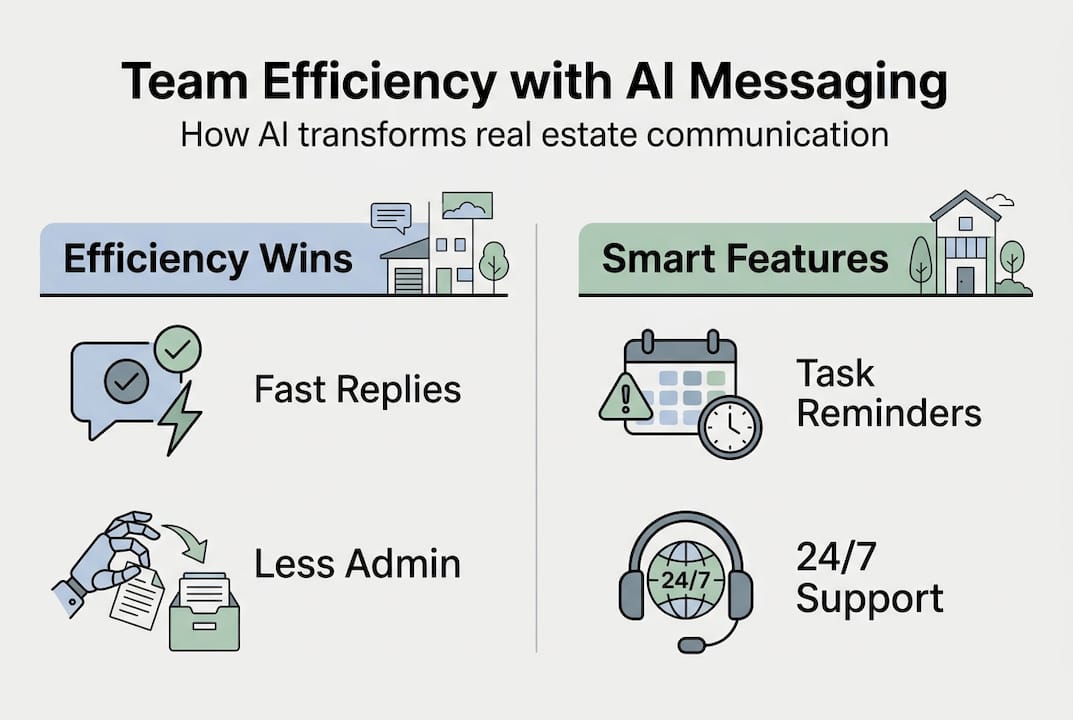
The data is striking. AI-enhanced messaging platforms like AppFolio Realm-X save property managers an average of 11.9 hours per week by automating repetitive tasks. That is nearly a full workday returned to your team every single week, redirected toward higher-value work like closing deals and building client relationships.
Here is what those time savings look like across common real estate workflows:
| Task | Manual time per week | With AI automation | Time saved |
|---|---|---|---|
| Appointment reminders | 3 hours | 15 minutes | 2 hrs 45 min |
| Payment follow-ups | 2.5 hours | 10 minutes | 2 hrs 20 min |
| Listing update notifications | 2 hours | 5 minutes | 1 hr 55 min |
| Tenant inquiry responses | 4 hours | 30 minutes | 3 hrs 30 min |
AI messaging capabilities your team should prioritize:
- Automated appointment scheduling that syncs with calendar systems and sends confirmations without agent involvement
- Smart reply suggestions that draft responses based on conversation context, reducing typing time
- Instant reply templates customized for common scenarios like showing requests, lease renewals, and price updates
- AI-powered conversation summaries that condense long threads into key action points for busy managers
- Proactive follow-up triggers that automatically nudge prospects who have gone quiet
Pro Tip: Start your AI automation rollout with the highest-volume repetitive tasks first. Payment reminders and appointment confirmations deliver the fastest ROI because they are predictable, frequent, and easy to template. Once those run smoothly, expand to more complex workflows.
For teams ready to go deeper, AI messaging collaboration and AI-powered team communication resources provide step-by-step implementation guidance. You can also review AI messaging use cases specific to enterprise environments.
Choosing the right messaging platform for your real estate business
Selecting an enterprise messaging platform is not a feature-shopping exercise. It is a strategic decision that affects your team's daily operations, your clients' experience, and your firm's legal standing. Approach it with the same rigor you apply to any major technology investment.
Start with a clear requirements checklist before evaluating any vendor:
- Security and encryption: Does it meet your regulatory requirements?
- Audit and compliance tools: Can you produce message records for legal review?
- AI automation capabilities: Does it reduce manual communication overhead?
- Integration depth: Does it connect with your CRM, property management software, and digital signage?
- User experience: Will your agents and staff actually use it daily?
- Scalability: Can it handle your growth over the next three to five years?
"Messaging platforms integrated with property management and notice tools like digital signage can decrease tenant inquiries by up to 40%, dramatically reducing administrative overhead for enterprise teams."
That 40% reduction is not a small efficiency gain. For a firm managing 500 units, it could mean dozens of hours saved each week across your admin team. Integration is where the real operational leverage lives.
Follow this selection framework to move from evaluation to deployment:
- Define your communication gaps by auditing current workflows and identifying where delays, errors, or security risks occur
- Shortlist platforms that meet your non-negotiable security and compliance requirements first
- Run a pilot with one team or property portfolio before full rollout
- Measure adoption and outcomes after 30 days, tracking response times, inquiry volume, and team satisfaction
- Expand and optimize based on pilot results, adding integrations and AI features incrementally
Reviewing messaging must-have features gives your IT and operations leaders a structured evaluation framework. Pairing that with guidance on building a secure messaging workflow ensures your rollout is both effective and protected from day one.
Perspective: What most real estate teams get wrong about messaging transformation
Here is an uncomfortable truth: most real estate firms that struggle with messaging adoption did not choose the wrong platform. They chose the right platform and then failed to integrate it into how their teams actually work.
The instinct is to chase features. More AI tools, more integrations, more channels. But feature-rich platforms with poor onboarding and no workflow alignment produce the same result as no platform at all: fragmented communication and frustrated teams.
Real transformation happens when messaging tools are mapped directly to existing business processes. Which tasks are currently done by email that should move to instant messaging? Which client touchpoints need automation? Which conversations require an audit trail? Answer those questions first.
We have seen firms invest significantly in enterprise platforms only to watch agents default back to personal WhatsApp groups within two weeks. The platform was not the problem. The rollout was.
Pro Tip: Prioritize seamless integration with your core enterprise systems and invest in structured user onboarding before activating advanced AI features. Adoption drives ROI, not the feature list.
Looking at practical messaging solutions used by real estate teams gives you a realistic picture of what successful implementation actually looks like.
Move forward: Secure enterprise messaging for real estate
Your team now understands why messaging platforms outperform email, what security features are non-negotiable, and how AI automation can recover nearly 12 hours per week per manager. The next step is putting that knowledge into action.
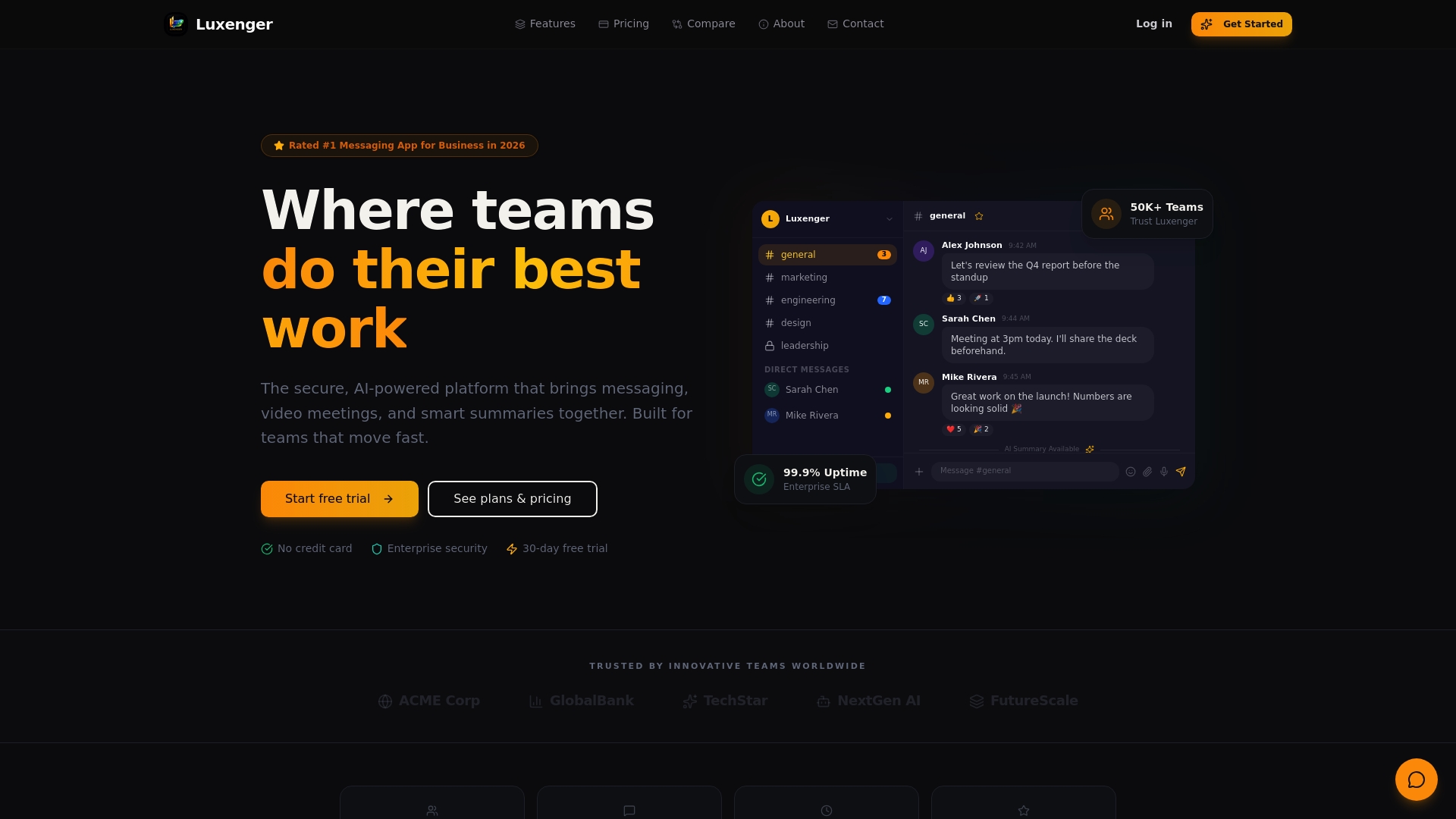
Luxenger is built for exactly this challenge. As an enterprise messaging platform with bank-grade security, AI-powered conversation summaries, voice huddles, and real-time translation, it gives real estate teams the tools to communicate faster, safer, and smarter. Explore real estate messaging pricing to find the right plan for your team size and workflow, or visit the Luxenger platform overview to see how it compares to the tools you use today. Your next deal should not wait on a slow email thread.
Frequently asked questions
Why are messaging platforms preferred over email for real estate communications?
Messaging platforms, especially SMS, deliver instant visibility with 90-98% open rates, ensuring clients and teams respond far faster than email allows.
How does AI in messaging platforms benefit property managers?
AI automates routine tasks like appointment and payment reminders, saving property managers nearly 12 hours weekly and freeing them for higher-value work.
What makes an enterprise messaging platform secure?
Enterprise platforms provide encryption, immutable audit trails, and role-based access controls that protect sensitive client data far beyond what consumer apps offer.
Can messaging platforms reduce tenant inquiries and admin workload?
Yes. Platforms integrated with digital signage and property management tools can cut tenant inquiries by 40%, significantly reducing your team's daily administrative burden.
What feature is most important when choosing a messaging platform for real estate?
Security and compliance top the list. Given the sensitivity of property and client data, your platform must meet enterprise security standards before any other feature is considered.