

Digital transformation fails when organizations treat it purely as a technology upgrade. You can deploy cutting-edge platforms and cloud infrastructure, but if your teams can't communicate securely and effectively, transformation stalls. The reality is that messaging platforms enable secure collaboration by providing the real-time, encrypted communication channels that hybrid enterprises need to coordinate complex organizational changes. This article explores how messaging platforms function as foundational infrastructure for transformation, the technical mechanics that balance security with compliance, and the strategic considerations you need to evaluate platforms that truly support your enterprise's journey.
Table of Contents
- Why messaging platforms are foundational to digital transformation
- Technical mechanics: balancing security, compliance, and scalability
- Challenges and nuances: encryption, SMS fallback, and evolving threats
- Strategic considerations: evaluating platforms for your enterprise's digital transformation
Key takeaways
| Point | Details |
|---|---|
| Messaging reduces silos | Real-time platforms connect hybrid teams and eliminate communication barriers that slow transformation projects. |
| Encryption creates tradeoffs | End-to-end encryption enhances security but complicates compliance archiving and governance requirements. |
| SMS provides critical fallback | Text messaging ensures delivery of urgent alerts during platform outages with 98% reliability rates. |
| Technology needs organizational change | Successful transformation requires both platform capabilities and structured change management approaches. |
| ROI focuses on engagement | Measure success through user adoption metrics and process improvements rather than simple deployment numbers. |
Why messaging platforms are foundational to digital transformation
Email dominated enterprise communication for decades, but its asynchronous nature creates delays that undermine transformation initiatives. You need immediate feedback loops when coordinating system migrations, training distributed teams, or responding to security incidents. Enterprise messaging platforms provide real-time collaboration with encryption, role-based access controls, and compliance features that email simply cannot match.
These platforms address the communication failures that cause 70% of digital transformation projects to miss objectives. When your development team in Singapore needs instant clarification from compliance officers in Frankfurt, waiting hours for email responses creates bottlenecks. Messaging platforms collapse these delays to seconds while maintaining security standards.
The global enterprise messaging market reflects this critical role, growing at compound annual rates exceeding 12% as organizations recognize that transformation depends on communication infrastructure. Security features differentiate enterprise platforms from consumer tools:
- End-to-end encryption protects confidential data in transit and at rest
- Role-based access ensures only authorized personnel view sensitive conversations
- Audit logging provides compliance documentation for regulated industries
- Integration APIs connect messaging to existing ITSM and ERP systems
Hybrid work models amplify messaging's importance. Your teams span offices, homes, and client sites, requiring consistent communication channels regardless of location. Messaging platforms create persistent conversation threads that new team members can review, preserving institutional knowledge that vanishes in email chains.
"Enterprise messaging platforms bridge the gap between legacy communication tools and modern collaboration needs, providing the secure, real-time infrastructure that enables organizations to execute complex transformation initiatives across distributed workforces."
The reduction of communication silos directly impacts transformation success rates. When marketing, IT, and operations teams use the same platform with shared channels, cross-functional coordination improves dramatically. You eliminate the information asymmetries that emerge when departments rely on separate tools.

Technical mechanics: balancing security, compliance, and scalability
Understanding how messaging platforms achieve real-time performance while maintaining security helps you evaluate options effectively. WebSocket protocol enables persistent connections between clients and servers, allowing instant message delivery without constant polling that would overwhelm networks. This bidirectional communication channel maintains low latency even during high-volume periods.
End-to-end encryption presents both opportunities and challenges. E2EE ensures that only conversation participants can decrypt messages, protecting against interception by malicious actors or even platform providers. However, this same protection creates compliance obstacles for organizations requiring message archiving or content monitoring.
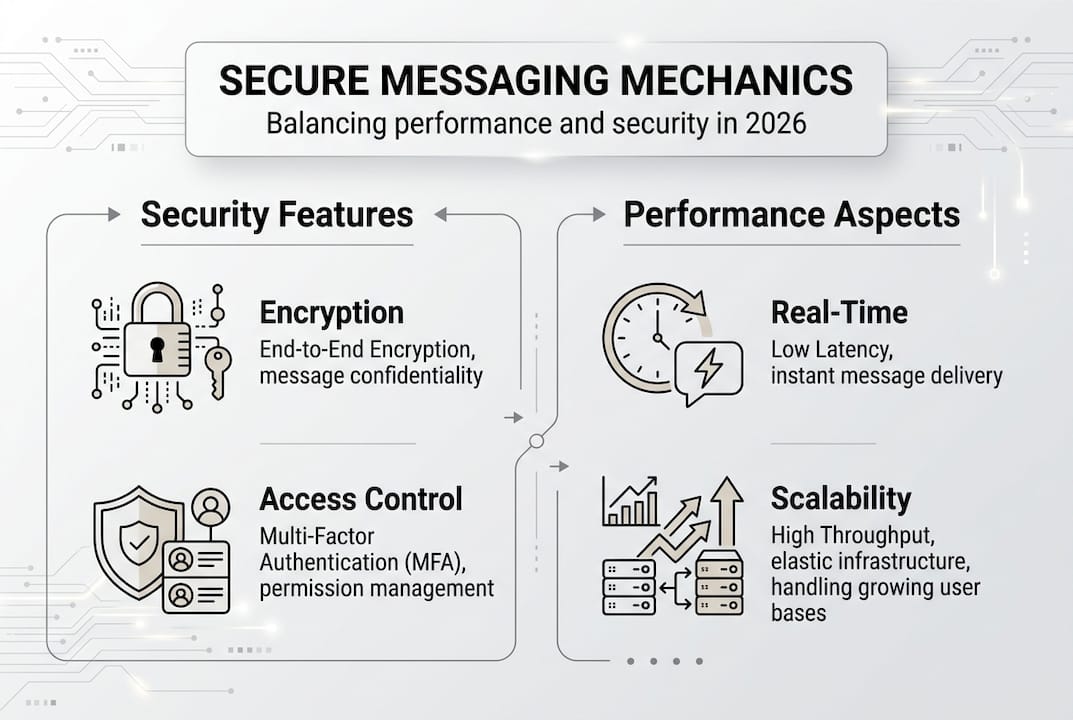
Some platforms implement cryptographic isolation techniques that allow selective governance. These systems use key escrow or split-key architectures where compliance officers hold decryption capabilities for specific channels without compromising general encryption. You gain regulatory compliance without sacrificing security for routine communications.
Scalability demands sophisticated architecture. Enterprise platforms serving thousands of concurrent users implement:
- Multi-tier caching that stores frequently accessed data in memory layers
- Asynchronous message processing that queues delivery during traffic spikes
- Geographic distribution with regional data centers reducing latency
- Database sharding that partitions conversation data across multiple servers
- Load balancing algorithms that distribute connections across available resources
These technical approaches enable platforms to maintain sub-second message delivery even during peak usage. Your IT team needs to verify that prospective platforms document their scalability architecture and provide performance guarantees in service level agreements.
The following table compares core messaging technologies:
| Technology | Security Level | Compliance Support | Performance | Best Use Case |
|---|---|---|---|---|
| WebSocket with E2EE | High | Limited | Excellent | Real-time secure collaboration |
| HTTPS REST APIs | Medium | Good | Good | System integrations and bots |
| SMS Gateway | Low | Excellent | Fair | Critical alerts and fallback |
| XMPP Protocol | Medium | Good | Good | Federated enterprise networks |
| Proprietary Encrypted | High | Variable | Excellent | Platform-specific features |
Pro Tip: Require prospective vendors to provide detailed architecture diagrams showing how their platform handles encryption key management, message routing, and compliance logging. Vague security claims without technical documentation should raise concerns about actual implementation quality.
Compliance requirements vary dramatically across industries and regions. Healthcare organizations need HIPAA-compliant archiving, financial services require SEC and FINRA message retention, and government contractors face FedRAMP certification demands. Your platform selection must align with specific regulatory obligations rather than generic security promises.
Challenges and nuances: encryption, SMS fallback, and evolving threats
End-to-end encryption creates a fundamental tension with compliance needs. Regulators and legal teams require the ability to archive and retrieve communications for audits, investigations, and litigation holds. When messages are encrypted such that only participants hold decryption keys, organizations cannot fulfill these obligations without participant cooperation.
This challenge becomes acute during employee departures or disputes. If a terminated employee possessed the only decryption key for critical business communications, you face potential data loss. Some platforms address this through corporate key management where IT administrators maintain master decryption capabilities, but this approach reduces the security benefits that make E2EE valuable.
SMS provides essential fallback during platform outages or network failures. When your primary messaging infrastructure experiences downtime, text messages still reach recipients through cellular networks. This redundancy proves critical for incident response and crisis communications.
"SMS achieves 98% delivery rates even during infrastructure failures, making it indispensable for critical alerts when primary messaging platforms become unavailable due to outages, cyberattacks, or network disruptions."
The reliability advantage comes with limitations. SMS lacks encryption by default, character counts restrict message length, and multimedia support remains basic. You should reserve SMS for urgent notifications rather than detailed discussions, using it as a bridge to restore primary platform access.
Post-quantum cryptography introduces new complexity. Current encryption algorithms face potential vulnerabilities from quantum computers that could break widely-used methods like RSA and elliptic curve cryptography. Transitioning to quantum-resistant algorithms requires:
- Larger key sizes that increase bandwidth consumption
- Protocol updates across entire messaging ecosystems
- Backward compatibility during multi-year migration periods
- Performance testing to ensure acceptable latency
Messaging protocol fragmentation persists despite standardization efforts. Organizations often run multiple platforms simultaneously because different vendors excel at specific use cases. This fragmentation creates security gaps when employees share sensitive information across platforms with varying protection levels.
Pro Tip: Implement a unified threat modeling framework that maps communication flows across all messaging platforms your organization uses. Identify where sensitive data crosses security boundaries and establish policies that route conversations to appropriate channels based on content classification.
Emerging threats require continuous monitoring. Social engineering attacks increasingly target messaging platforms because users trust messages from known contacts. Attackers who compromise one account can pivot to others by sending malicious links through legitimate conversation threads. Your security team needs behavioral analytics that detect anomalous messaging patterns indicating account compromise.
The human factor remains the weakest link. Technical security measures fail when users share credentials, click phishing links, or discuss confidential matters in inappropriate channels. Effective messaging security requires ongoing training that helps employees recognize threats and follow established protocols.
Strategic considerations: evaluating platforms for your enterprise's digital transformation
No universal best platform exists because organizational needs vary dramatically. A healthcare provider prioritizing HIPAA compliance has different requirements than a manufacturing company focused on operational technology integration. Your evaluation process must align platform capabilities with specific business and regulatory contexts.
Start by assessing encryption implementations. Some platforms offer E2EE as an optional feature that users can enable per conversation, while others enforce it universally. Determine whether your compliance obligations permit E2EE or require message archiving that necessitates different encryption approaches. Platforms balancing encryption with governance provide cryptographic isolation allowing selective compliance access.
Omnichannel capabilities extend platform value beyond internal messaging. Integration with SMS, email, and voice channels creates resilient communication that adapts to context. During system outages, automatic failover to SMS ensures critical messages reach recipients. For multilingual teams, platforms with real-time translation remove language barriers that slow collaboration.
API integration determines how effectively messaging connects with existing operational tools:
- ITSM integration for incident management and ticket creation from conversations
- ERP connectivity enabling order status updates and workflow notifications
- CRM linkage that surfaces customer context during support discussions
- Identity provider integration for single sign-on and access management
- Analytics platforms for conversation sentiment and engagement metrics
These integrations transform messaging from a standalone tool into central nervous system infrastructure that coordinates enterprise operations. Evaluate vendor API documentation quality and availability of pre-built connectors for your existing technology stack.
ROI measurement should focus on engagement and process improvements rather than simple adoption metrics. Track conversation response times, issue resolution speeds, and cross-functional collaboration frequency. Organizations typically see 25-40% reductions in email volume after implementing integrated messaging, indicating that teams find the platform more effective for coordination.
Change management frameworks like ADKAR structure the organizational transformation required for successful platform adoption. Technology deployment without addressing awareness, desire, knowledge, ability, and reinforcement leads to underutilization. Assign change champions within each department who can demonstrate platform value and assist colleagues during the transition.
The following comparison helps evaluate leading platforms:
| Platform Type | Security Approach | Compliance Features | Integration Strength | Ideal Use Case |
|---|---|---|---|---|
| Enterprise E2EE | End-to-end encryption | Limited archiving | Moderate APIs | Security-first organizations |
| Compliance-focused | Server-side encryption | Full archiving and DLP | Extensive APIs | Regulated industries |
| Collaboration suite | Hybrid encryption | Configurable retention | Native integrations | Cross-functional teams |
| Open source | Customizable security | Self-hosted control | Developer-friendly | Technical organizations |
| AI-enhanced | Advanced encryption | Smart archiving | Intelligent automation | Innovation-driven enterprises |
Pro Tip: Conduct a pilot program with 50-100 users from diverse departments before enterprise-wide rollout. Measure specific metrics like average response time, issue resolution speed, and user satisfaction scores. Use pilot results to refine implementation approach and build internal case studies that accelerate broader adoption.
Vendor evaluation should include security audits and penetration testing reports. Reputable platforms undergo regular third-party assessments and publish results transparently. Ask vendors about their vulnerability disclosure processes, patch deployment timelines, and incident response procedures. Organizations with mature security programs provide detailed documentation rather than marketing generalities.
Total cost of ownership extends beyond licensing fees. Factor in implementation services, training programs, integration development, and ongoing administration overhead. Platforms with intuitive interfaces and comprehensive self-service resources reduce training costs and accelerate time to value. Calculate costs over a three-year period to account for scaling as your organization grows.
Empower your digital transformation with Luxenger enterprise messaging
Your transformation success depends on communication infrastructure that balances security, compliance, and user experience. Luxenger provides enterprise messaging solutions designed specifically for organizations navigating complex regulatory environments while supporting hybrid workforces. The platform implements encryption architectures that maintain security without sacrificing the compliance controls you need for audits and legal holds.
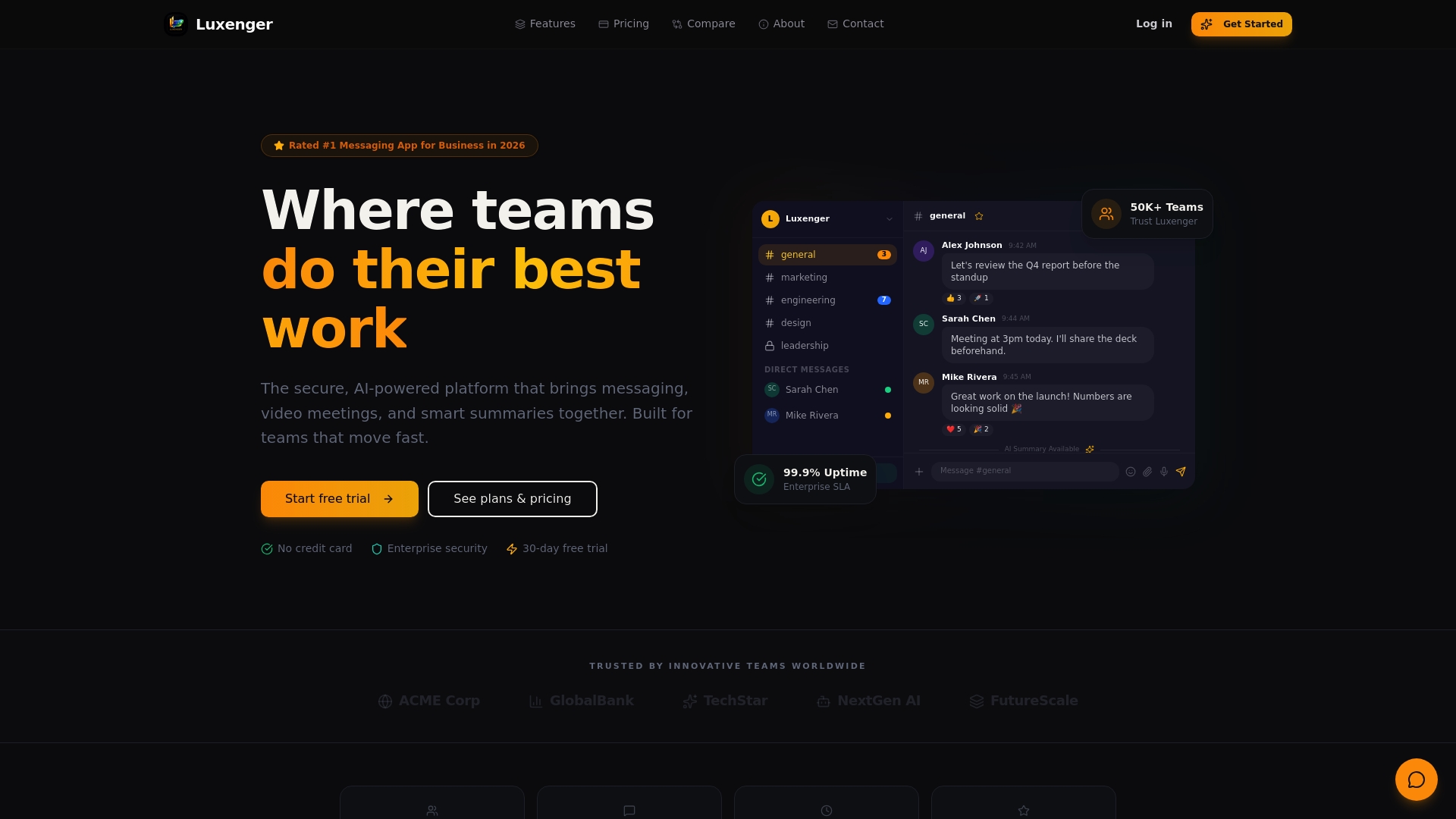
Advanced features including AI-powered conversation summaries help teams extract insights from lengthy discussions, while voice huddles enable quick synchronous coordination when text messaging proves insufficient. Real-time translation supports multilingual teams without requiring language training or external services. These capabilities integrate through comprehensive APIs that connect messaging with your existing ITSM, ERP, and CRM systems.
Measure your communication ROI through Luxenger's security and analytics dashboard, tracking engagement metrics that demonstrate platform value. Start with a focused pilot program in a single department to establish baseline metrics before expanding across your enterprise. This measured approach builds internal champions who can advocate for broader adoption based on demonstrated improvements in collaboration speed and effectiveness.
Frequently asked questions
What role do messaging platforms play in digital transformation success?
Messaging platforms provide the real-time, secure communication infrastructure that enables distributed teams to coordinate complex transformation initiatives effectively. They reduce the communication delays and silos that cause most digital transformation projects to miss objectives. Unlike email, messaging creates persistent conversation threads with instant notification that accelerates decision-making and problem resolution.
How does end-to-end encryption affect compliance requirements?
E2EE enhances security by ensuring only conversation participants can decrypt messages, but this creates challenges for organizations requiring message archiving for regulatory compliance. Some platforms implement cryptographic isolation techniques that allow compliance officers selective access without compromising general encryption. You need to evaluate whether your specific regulatory obligations permit E2EE or require alternative encryption approaches that support archiving.
Why is SMS important for enterprise messaging strategies?
SMS provides critical fallback communication during primary platform outages or network failures, achieving 98% delivery rates even when internet connectivity fails. This reliability makes text messaging essential for urgent alerts, incident response, and crisis communications. Organizations should maintain SMS capabilities as redundant infrastructure rather than replacing it entirely with app-based messaging.
What factors should guide enterprise messaging platform evaluation?
Evaluation should prioritize alignment between platform capabilities and your specific security, compliance, and integration requirements rather than seeking a universal best option. Assess encryption implementations, compliance features, API availability for connecting existing systems, and vendor security audit transparency. Include organizational change management capabilities in your assessment since technology alone does not ensure successful adoption.
How do you measure ROI for enterprise messaging platforms?
Focus on engagement and process improvement metrics rather than simple user adoption numbers. Track conversation response times, issue resolution speeds, cross-functional collaboration frequency, and email volume reduction. Organizations typically see 25-40% decreases in email usage after implementing effective messaging platforms, indicating improved communication efficiency. Establish baseline metrics before deployment to demonstrate measurable improvements.