

The enterprise messaging landscape has transformed dramatically. By 2026, the secure messaging market is projected to reach $8.9 billion, driven by remote work demands and AI capabilities that fundamentally reshape how teams collaborate. Traditional email and basic chat tools no longer meet the security, compliance, and productivity requirements of modern enterprises. Organizations now seek platforms that combine bank-grade encryption with intelligent automation, real-time translation, and agentic AI capabilities that actively manage workflows across systems. This shift represents more than incremental improvement. It signals a fundamental reimagining of enterprise communication infrastructure.
Table of Contents
- The evolving landscape: why secure messaging matters more than ever
- AI-driven productivity: transforming team collaboration in 2026
- Choosing the right messaging platform: key considerations for 2026
- Maximizing value: applying secure AI messaging platforms for enterprise success
- Explore Luxenger's secure enterprise messaging solutions
- Frequently asked questions about messaging platforms in 2026
Key takeaways
| Point | Details |
|---|---|
| Security is foundational | Modern platforms must meet compliance standards like FedRAMP, GDPR, and HIPAA while supporting BYOD policies through integrated mobile device management. |
| AI drives productivity | Agentic AI capabilities automate cross-functional tasks, synthesize enterprise knowledge, and reduce meeting fatigue through intelligent scheduling and summaries. |
| Integration matters most | Successful platforms seamlessly connect with existing CRM systems, project management tools, and data dashboards to create unified workflows. |
| Flexible AI models win | Leading platforms support multiple LLM options rather than locking organizations into single-vendor ecosystems, ensuring future adaptability. |
The evolving landscape: why secure messaging matters more than ever
Remote work has permanently altered enterprise communication requirements. Teams scattered across continents need secure channels that protect intellectual property, customer data, and strategic discussions from interception or unauthorized access. Cloud adoption compounds these challenges. When sensitive conversations traverse multiple networks and devices, traditional perimeter security approaches fail.
The shift towards BYOD policies necessitates robust mobile device management integration within messaging platforms. Employees accessing company channels from personal smartphones create potential data leakage points. Modern platforms address this through containerization, remote wipe capabilities, and granular access controls that separate personal and professional data on the same device.
Compliance requirements have intensified. Healthcare organizations must maintain HIPAA compliance for patient discussions. Financial services need SOC 2 certification. Government contractors require FedRAMP authorization. A messaging platform that cannot demonstrate appropriate certifications creates legal and financial liability.
Consider these critical security requirements:
- End-to-end encryption for all messages, files, and voice communications
- Granular permission controls allowing administrators to restrict features by role or department
- Comprehensive audit logs capturing all user actions for compliance reporting
- Secure guest access enabling external collaboration without compromising internal systems
"The question is not whether to invest in secure messaging, but which platform architecture best protects your specific data types and regulatory obligations while enabling rather than hindering collaboration."
Choosing the right platform reduces risk while enabling productivity. Poor choices create shadow IT problems as frustrated users adopt unauthorized tools. Explore enterprise messaging security best practices to understand how leading organizations balance security with usability.
AI-driven productivity: transforming team collaboration in 2026
Artificial intelligence has moved beyond simple chatbots. AI-powered features in messaging platforms are improving efficiency by 34% among early enterprise adopters. These gains come from intelligent automation that handles routine coordination tasks, freeing knowledge workers for strategic thinking.

The new generation of messaging AI operates differently than previous assistants. Slackbot now uses Large Language Models and vector search to index vast enterprise data, enabling it to answer complex questions by synthesizing information across channels, documents, and integrated systems. This represents a fundamental shift from keyword matching to contextual understanding.
Agentic AI takes this further by performing actions rather than simply providing information. These systems can schedule meetings by checking calendars across time zones, create project tasks based on conversation context, and update CRM records when deals progress. The AI acts as a proactive team member rather than a passive tool.
Key productivity improvements include:
- Automated meeting summaries that capture decisions, action items, and next steps without manual note-taking
- Intelligent message prioritization that surfaces urgent communications while filtering noise
- Real-time translation enabling seamless collaboration across language barriers
- Context-aware suggestions that recommend relevant documents, past conversations, or team members based on current discussion topics
- Voice-to-text transcription with speaker identification for huddles and audio messages
Pro Tip: Start with AI features that solve specific pain points rather than enabling everything at once. If your team struggles with meeting overload, begin with automated summaries and scheduling assistants. Build comfort and trust before expanding to more complex automations.
The productivity gains compound over time. As the AI learns your organization's terminology, workflows, and preferences, it becomes increasingly effective at anticipating needs and streamlining processes. Organizations implementing these capabilities report significant reductions in coordination overhead and faster project completion.
Discover proven strategies in our guide to AI-powered collaboration steps and explore predictions about the future of AI in communication.
Choosing the right messaging platform: key considerations for 2026
Selecting an enterprise messaging platform requires evaluating multiple dimensions simultaneously. Security certifications provide the foundation. Verify that candidates hold relevant compliance credentials for your industry. FedRAMP authorization matters for government work. HIPAA compliance is non-negotiable in healthcare. SOC 2 Type II demonstrates commitment to security controls.
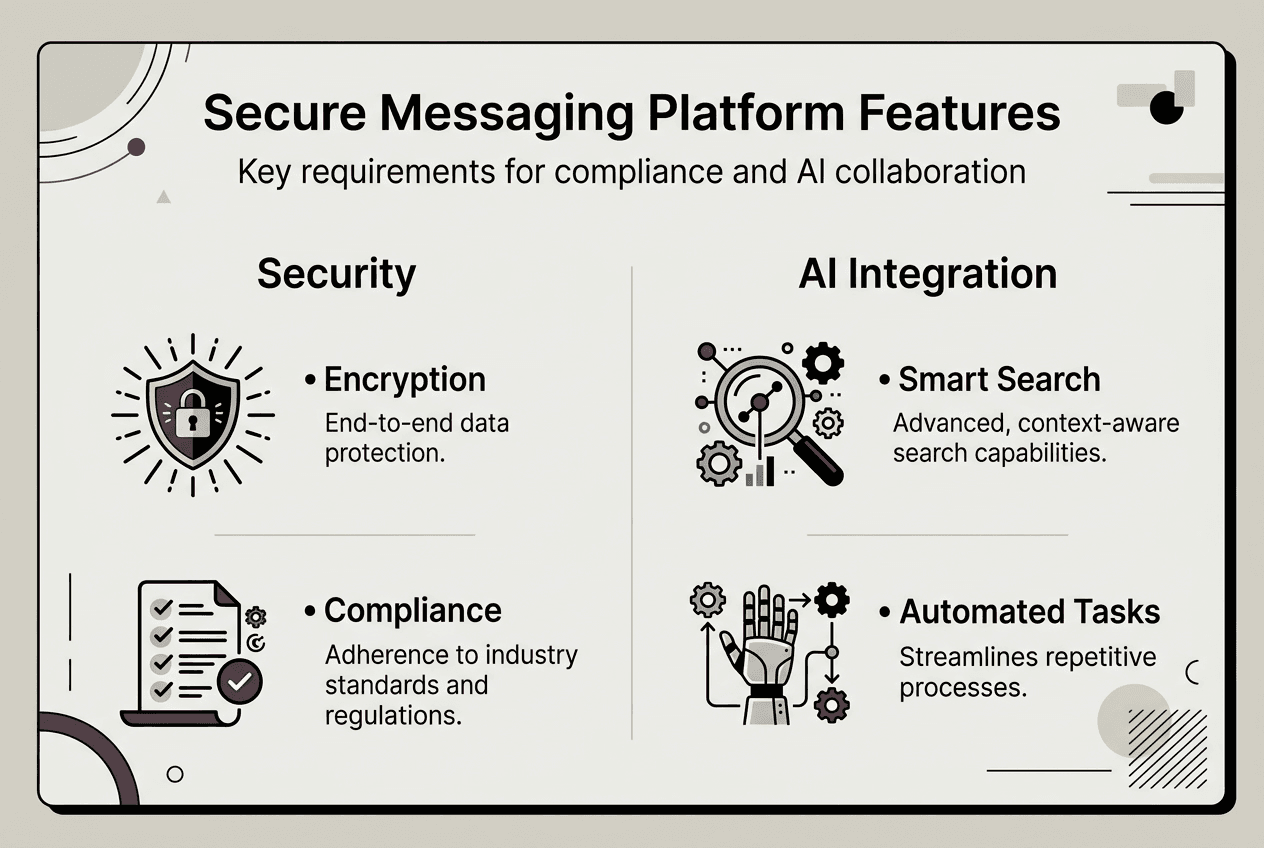
AI integration capabilities deserve careful scrutiny. Salesforce maintains model flexibility, offering Google's Gemini and OpenAI options rather than forcing single-vendor lock-in. This approach protects your investment as AI technology evolves. Platforms that support multiple LLM backends let you choose models optimized for specific use cases or switch providers if better options emerge.
| Feature Category | Essential Capabilities | Why It Matters |
|---|---|---|
| Security & Compliance | End-to-end encryption, FedRAMP/HIPAA certification, MDM integration, audit logging | Protects sensitive data and ensures regulatory compliance across industries |
| AI & Automation | Agentic AI, multi-LLM support, intelligent summaries, voice transcription | Reduces coordination overhead and enables productivity gains of 30% or more |
| Integration Ecosystem | Native CRM connectors, API flexibility, workflow automation, SSO support | Creates unified workflows that eliminate context switching between tools |
| Mobile Experience | Full feature parity, offline access, biometric authentication, remote wipe | Supports modern work patterns while maintaining security on personal devices |
Mobile device management support becomes critical with BYOD policies. The platform should integrate with your existing MDM solution, enabling IT to enforce security policies, remotely wipe corporate data if devices are lost, and maintain visibility into how employees access company resources.
Evaluate integration capabilities thoroughly:
- Does the platform offer pre-built connectors for your CRM, project management, and analytics tools?
- Can developers extend functionality through well-documented APIs?
- Does the vendor maintain an active ecosystem of third-party integrations?
- How easily can you migrate existing conversation history and files from current tools?
Pro Tip: Request a proof of concept focused on your three most critical integrations. Many platforms demo well in isolation but struggle when connecting to real enterprise systems with complex authentication and data synchronization requirements.
Agentic AI capabilities separate leading platforms from followers. Look for systems that can perform cross-functional actions like updating project status in your PM tool when conversations indicate milestone completion, or automatically creating support tickets when customers report issues in dedicated channels.
Compare options systematically using our detailed Luxenger vs Slack comparison to understand how different platforms address enterprise requirements.
Maximizing value: applying secure AI messaging platforms for enterprise success
Successful implementation requires more than selecting the right platform. IT and communications managers must orchestrate change management, training, and ongoing optimization to capture full value. Begin with comprehensive user education that goes beyond basic features to demonstrate how AI capabilities solve real workflow problems.
Leverage agentic AI to automate cross-functional tasks and synthesize data across integrated systems. Configure the AI to monitor project channels and automatically update dashboards when teams mention completed milestones. Set up intelligent routing that directs customer questions to appropriate specialists based on conversation content rather than manual assignment.
Follow these implementation steps for maximum impact:
- Conduct department-specific training sessions that demonstrate AI features solving actual pain points teams currently experience
- Create channel templates with pre-configured integrations and AI assistants for common use cases like customer onboarding or product launches
- Establish governance policies defining appropriate use of AI features, data retention requirements, and external collaboration guidelines
- Deploy security dashboards giving IT real-time visibility into authentication patterns, data access, and potential threats
- Schedule quarterly reviews to assess adoption metrics, gather user feedback, and identify opportunities for expanding AI automation
Integration with existing systems multiplies platform value. Connect your messaging platform to CRM systems so sales conversations automatically update opportunity records. Link project management tools to create tasks from action items identified in meeting summaries. Integrate analytics dashboards to surface key metrics in relevant channels.
Pro Tip: Identify power users in each department who can champion advanced features and provide peer support. These advocates accelerate adoption more effectively than top-down mandates by demonstrating practical value through real examples.
Monitor platform security continuously through dedicated dashboards and mobile management tools. Track authentication patterns to identify potential account compromises. Review data access logs to ensure employees only reach information appropriate for their roles. Configure alerts for unusual activity like bulk file downloads or access from unexpected locations.
Update user policies regularly as AI capabilities evolve. What constitutes appropriate AI use today may need refinement as new features emerge. Maintain clear guidelines about which data types can be processed by AI systems, how to handle sensitive information in AI-enabled channels, and when human review is required for AI-generated content.
Explore how Luxenger supports enterprise operations with industry-specific compliance features and integration capabilities designed for complex organizational requirements.
Explore Luxenger's secure enterprise messaging solutions
Modern enterprises need messaging platforms that combine robust security with intelligent automation. Luxenger delivers both through an AI-powered platform specifically designed for medium to large organizations requiring bank-grade data protection and advanced collaboration features.
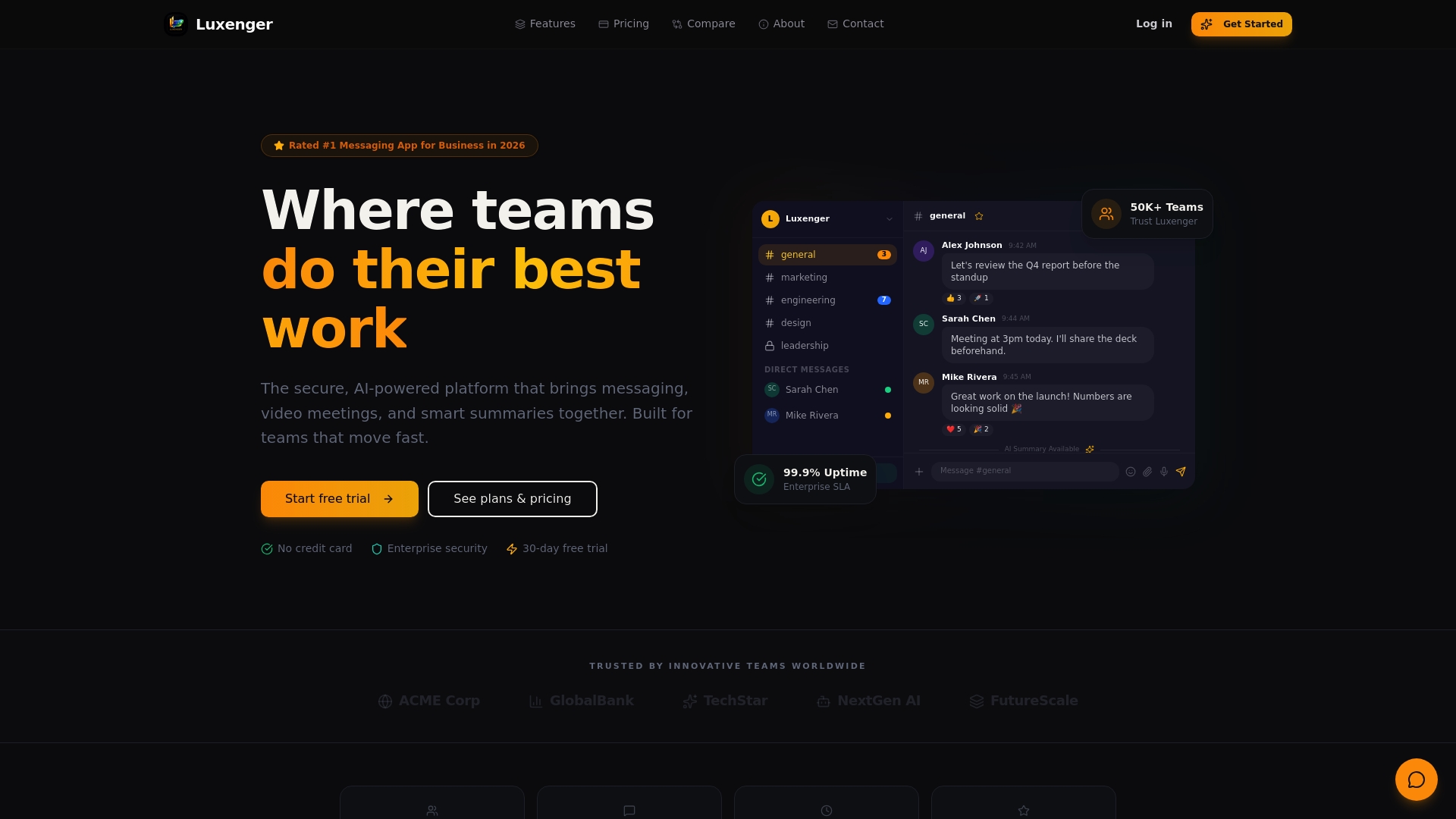
Our platform provides agentic AI capabilities that automate routine coordination tasks while maintaining strict compliance with industry regulations including HIPAA for healthcare, SOC 2 for technology companies, and FedRAMP for government contractors. Dedicated security dashboards give IT teams real-time visibility into authentication patterns, data access, and potential threats without compromising user productivity.
Luxenger integrates seamlessly with existing enterprise systems through pre-built connectors for leading CRM platforms, project management tools, and analytics dashboards. This unified approach eliminates context switching and creates workflows that span multiple systems while maintaining consistent security policies.
Explore our comprehensive enterprise operations capabilities, review our complete messaging features, and discover how our security dashboard empowers IT teams to protect sensitive data while enabling team collaboration.
Frequently asked questions about messaging platforms in 2026
What benefits does AI provide in messaging beyond basic chat functionality?
AI transforms messaging from simple text exchange into an intelligent collaboration hub. Agentic AI automates meeting scheduling across time zones, generates summaries capturing decisions and action items, and synthesizes information from across enterprise systems to answer complex questions. These capabilities reduce coordination overhead by 30% or more while improving decision quality through better access to organizational knowledge.
How can organizations ensure messaging platforms comply with data protection regulations?
Select platforms holding relevant certifications for your industry such as FedRAMP for government work, HIPAA for healthcare, or SOC 2 for general enterprise use. Implement granular access controls limiting data visibility by role and department. Enable comprehensive audit logging to track all user actions for compliance reporting. Configure data retention policies that automatically delete messages after required retention periods expire.
What distinguishes agentic AI from traditional chatbots in messaging platforms?
Traditional chatbots respond to direct questions with pre-programmed answers or simple database lookups. Agentic AI proactively monitors conversations, performs cross-functional actions across integrated systems, and learns organizational context to anticipate needs. It can update CRM records when deals progress, create project tasks based on discussion context, and synthesize information from multiple sources to provide comprehensive answers rather than simple keyword matches.
Which security features should enterprises prioritize when evaluating messaging platforms?
Prioritize end-to-end encryption for all communications including messages, files, and voice. Verify mobile device management integration supporting BYOD policies through containerization and remote wipe capabilities. Ensure granular permission controls allow restricting features by role or department. Confirm comprehensive audit logging captures all user actions for compliance and security investigations. Review our guide to must-have features for secure messaging for detailed evaluation criteria.
What steps ensure smooth integration between messaging platforms and existing enterprise tools?
Begin by identifying your three most critical integrations such as CRM, project management, or analytics systems. Request proof of concept deployments testing these specific connections with your actual data and authentication requirements. Verify the platform offers well-documented APIs enabling custom integrations for specialized tools. Assess the vendor's integration ecosystem to ensure active development and third-party support. Plan data migration carefully, testing conversation history and file transfers before full deployment.
Recommended
- Secure messaging platforms: must-have features for 2026
- What is secure messaging? A 2026 guide for enterprises
- Luxenger vs Slack: Which Messaging Platform Is Right for Your Team in 2026? | Luxenger Blog
- Efficient team messaging: 5 steps for AI-powered collaboration
- 7 Essential Document Collaboration Tools for Businesses -