

Selecting the right enterprise messaging platform demands balancing robust collaboration tools with stringent security and compliance standards. IT and communications managers face mounting pressure to protect sensitive organizational data while ensuring seamless team productivity. This guide breaks down the critical features your messaging platform must deliver in 2026 to safeguard communications and maintain regulatory compliance.
Table of Contents
- Essential security features for enterprise messaging platforms
- Advanced data loss prevention and compliance support
- Choosing the right messaging platform: Slack vs Microsoft Teams vs Luxenger
- How to decide the best messaging platform for your enterprise needs
- Discover Luxenger: secure messaging for enterprises
Key takeaways
| Point | Details |
|---|---|
| Security essentials | End-to-end encryption, multi-factor authentication, and data loss prevention are non-negotiable for enterprise platforms. |
| Compliance tools | Audit trails, data retention policies, and remediation capabilities reduce legal and financial risks. |
| Platform selection | Choose based on organizational size, existing tools, IT resources, and security priorities. |
| Feature evolution | Modern DLP now addresses data movement across APIs, GenAI tools, and cloud environments. |
Essential security features for enterprise messaging platforms
Enterprise messaging platforms must deliver layered security to protect confidential communications and meet evolving regulatory requirements. Three foundational capabilities form the core of enterprise-grade security: end-to-end encryption, multi-factor authentication, and data loss prevention.
End-to-end encryption prevents data breaches and ensures compliance with GDPR and ISO 27001 by making messages readable only to intended recipients. E2EE transforms messages into encrypted data that only authorized parties can decrypt, preventing interception during transmission. Organizations handling sensitive client information, financial data, or proprietary communications need E2EE as a baseline security standard. Learn more about end-to-end encryption explained simply to understand implementation details.
Multi-factor authentication significantly reduces the risk of account compromise by requiring multiple identity verification steps beyond passwords. MFA combines something you know (password), something you have (mobile device), or something you are (biometric data) to authenticate users. This layered approach stops unauthorized access even when credentials are stolen through phishing attacks or data breaches.
DLP tools scan messages and attachments to prevent data leaks and maintain compliance with regulations. Modern DLP capabilities include:
- Scanning for sensitive keywords, patterns, and data types (credit cards, social security numbers, proprietary codes)
- Blocking unauthorized data sharing before messages leave the platform
- Automated remediation actions when policy violations occur
- Real-time alerts for security teams when high-risk activities are detected
Pro Tip: Prioritize messaging platforms offering integrated E2EE, MFA, and granular DLP controls for defense in depth. This combination creates overlapping security layers that protect data even if one control fails.
Regulatory compliance benefits extend beyond avoiding fines. Platforms with robust security features demonstrate due diligence to clients, partners, and auditors. Review comprehensive security best practices for IT admins and explore enterprise messaging security best practices for implementation guidance.
Advanced data loss prevention and compliance support
Enterprise DLP has evolved from simple detection tools to proactive systems that identify risks and execute remediation automatically. Modern platforms must address data movement across diverse channels including APIs, GenAI integrations, chat applications, and cloud storage services.
Enterprise DLP solutions support remediation actions like revoke access, redact, and delete to reduce risks effectively. Key capabilities include:
- Revoke access to sensitive documents or conversations when policy violations occur
- Redact confidential information from shared messages while preserving context
- Apply security labels that trigger downstream protections in integrated systems
- Delete unauthorized copies of sensitive data across platforms
- Block transmission of high-risk content before it leaves your environment
Audit trails and data retention policies form the compliance foundation for enterprise messaging. Messaging platforms must offer features that support compliance, including data retention policies and audit trails that track user actions, message flows, and security events. These capabilities prove essential during regulatory audits, internal investigations, or legal discovery processes.
Cloud-first enterprises need DLP solutions that monitor data movement across SaaS applications, AI tools, and collaboration platforms to prevent sensitive information from leaving controlled environments through shadow IT channels.
Non-compliance risks extend beyond financial penalties. Organizations face reputational damage, lost customer trust, and competitive disadvantages when data breaches expose inadequate security practices. Regulatory fines under GDPR can reach 4% of annual global revenue, while sector-specific regulations impose additional requirements for healthcare, financial services, and government contractors.
Modern DLP addresses emerging risks from generative AI tools that may inadvertently expose proprietary data during training or query processes. Your messaging platform should integrate DLP controls that scan content before it reaches third-party AI services. Explore the enterprise messaging security guide for detailed implementation strategies and review secure business messaging solutions tailored for regulated industries. Understanding compliance in remote work environments helps teams maintain security across distributed operations.

Choosing the right messaging platform: Slack vs Microsoft Teams vs Luxenger
Three platforms dominate enterprise messaging conversations, each offering distinct advantages for security-conscious organizations. Understanding their security features, compliance support, and pricing helps IT managers make informed decisions.
| Feature | Slack | Microsoft Teams | Luxenger |
|---|---|---|---|
| End-to-end encryption | Enterprise Grid only | Limited scenarios | Standard across all tiers |
| Data retention controls | Paid plans | Included with Microsoft 365 | Granular policy management |
| Multi-factor authentication | Supported | Azure AD integration | Built-in with flexible options |
| Message history (free) | 90 days | Unlimited | Unlimited |
| Pricing (per user/month) | $7.25 - $12.50 | $4 - $12.50 | Custom enterprise pricing |
| Best for | Small teams, app integrations | Microsoft 365 users | Security-focused enterprises |
Slack's simple interface benefits smaller teams while Microsoft Teams integrates deeply with Microsoft 365 for larger enterprises already invested in the ecosystem. Slack's strength lies in its extensive app marketplace and intuitive user experience that requires minimal training. However, Slack's free tier restricts message history to 90 days, creating challenges for growing teams that need historical context for projects and compliance documentation.
Microsoft Teams benefits organizations standardized on Microsoft 365, offering seamless integration with Outlook, SharePoint, and OneDrive. The platform includes video conferencing, file storage, and collaboration tools within a single license. Teams' security inherits Azure Active Directory controls, providing centralized identity management for enterprises with complex IT environments.
Luxenger delivers enterprise-focused features prioritizing security and compliance from the ground up. Key advantages include:
- Bank-grade encryption standard across all plans, not restricted to premium tiers
- AI-powered conversation summaries that maintain privacy while improving productivity
- Real-time translation supporting multilingual teams without third-party integrations
- Voice huddles for quick audio meetings without video conference overhead
- Advanced DLP with granular policy controls and automated remediation
Pro Tip: Evaluate platforms within your existing tool ecosystem. Organizations heavily invested in Microsoft 365 gain efficiency from Teams integration, while those prioritizing security flexibility may prefer platforms like Luxenger built specifically for enterprise data protection.
Security and compliance capabilities should drive platform selection for regulated industries and enterprises handling sensitive data. Compare detailed features in the Luxenger vs Slack comparison, review Luxenger pricing tailored to organizational needs, and explore comprehensive Luxenger features designed for enterprise security.
How to decide the best messaging platform for your enterprise needs
Selecting the optimal messaging platform requires evaluating multiple factors specific to your organizational context. Start by assessing these critical decision criteria:
- Organizational size and growth trajectory over the next 3-5 years
- Existing software ecosystem and integration requirements
- Industry-specific compliance obligations (HIPAA, GDPR, SOC 2, ISO 27001)
- IT team capacity for platform management and user support
- Security posture maturity and risk tolerance
- Budget constraints and total cost of ownership considerations
Small to mid-sized organizations should prioritize ease of use and vendor support availability. Platforms with intuitive interfaces reduce training costs and accelerate adoption across teams. Responsive customer support becomes crucial when internal IT resources are limited. Evaluate vendor documentation quality, community forums, and support response times during the selection process.
Large enterprises must prioritize deep compliance tools and advanced security capabilities that scale across thousands of users. Look for platforms offering centralized administration, granular permission controls, and audit capabilities that satisfy regulatory requirements. The choice between Slack and Microsoft Teams depends on existing toolset and organizational structure, particularly Microsoft 365 investment levels and user familiarity with either ecosystem.
Pro Tip: Pilot messaging platforms with critical teams before committing to enterprise-wide deployment. Real-world testing reveals integration challenges, user experience issues, and security gaps that specifications alone cannot predict. Involve end users, IT security, and compliance stakeholders in evaluation to ensure all requirements are addressed.
Leverage vendor resources including demos, proof-of-concept deployments, and security documentation to make informed decisions. Request detailed security architecture reviews and compliance certifications relevant to your industry. Explore Luxenger for enterprise operations and review remote team communication tips for implementation best practices.
Discover Luxenger: secure messaging for enterprises
Luxenger delivers enterprise messaging built specifically to meet rigorous security and compliance standards demanded by medium and large organizations. The platform combines advanced data loss prevention, end-to-end encryption, and compliance support with productivity features like AI-powered summaries and real-time translation.
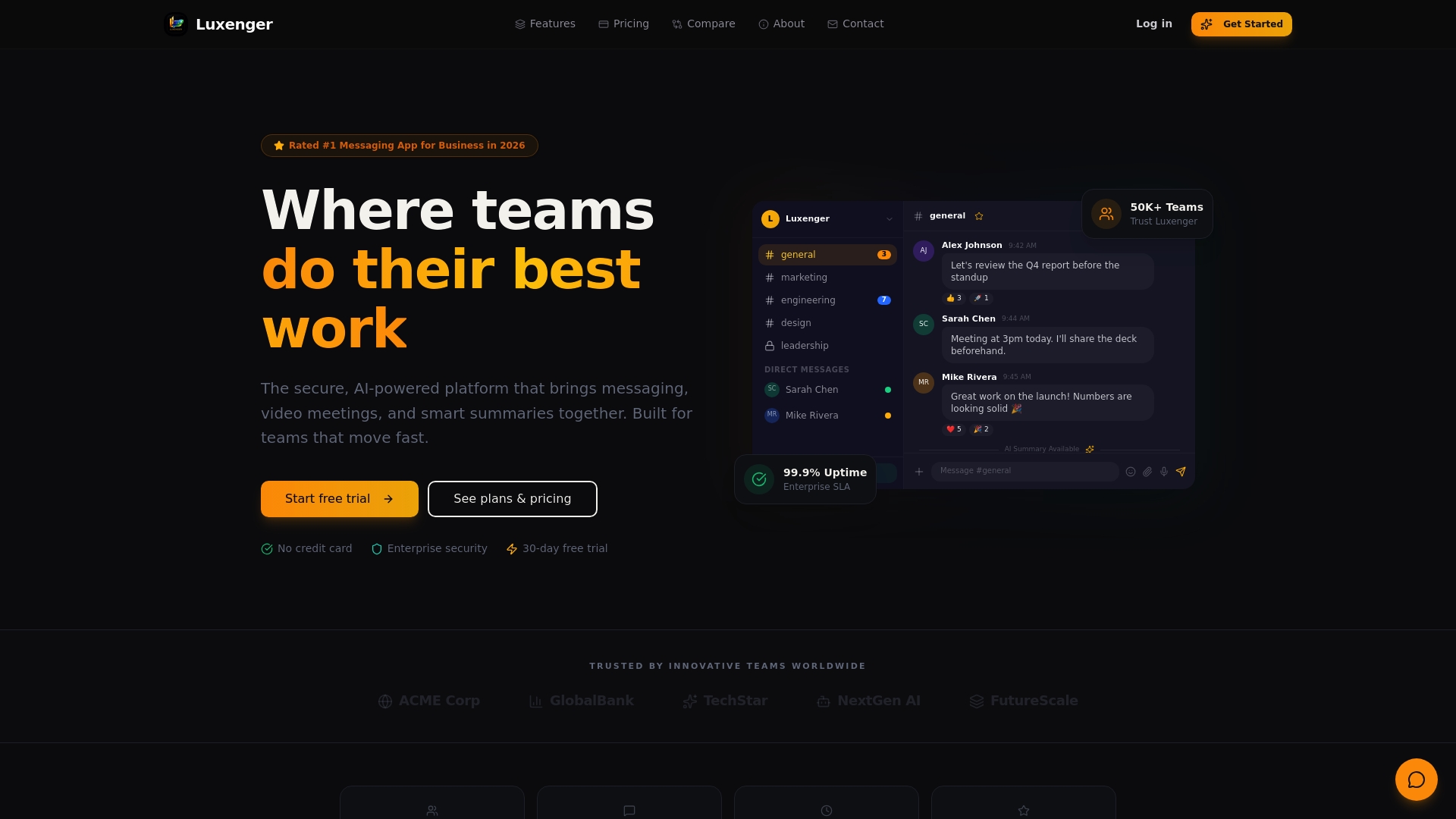
Organizations choosing Luxenger gain bank-grade security without sacrificing collaboration efficiency. Features include voice huddles for quick team sync-ups, conversation summaries that distill lengthy discussions into actionable insights, and multilingual support that breaks down communication barriers across global teams. Explore detailed Luxenger for enterprise operations capabilities, review comprehensive Luxenger messaging features designed for security-conscious teams, and discover flexible Luxenger pricing tailored to your organizational needs. Start your secure messaging journey today.
FAQ
What is end-to-end encryption and why is it important?
End-to-end encryption ensures only communicating parties can read messages by encrypting data on the sender's device and decrypting only on the recipient's device. This prevents interception during transmission, protects sensitive enterprise information from unauthorized access, and supports compliance with data protection regulations like GDPR and ISO 27001. E2EE serves as a fundamental security control for organizations handling confidential communications.
How does multi-factor authentication enhance messaging security?
Multi-factor authentication requires users to verify their identity through multiple independent credentials before accessing messaging platforms. MFA dramatically reduces account compromise risk by combining passwords with secondary factors like mobile device codes or biometric verification. Even when passwords are stolen through phishing attacks or data breaches, unauthorized users cannot access accounts without the additional authentication factors.
What features help ensure compliance with regulations like GDPR in messaging platforms?
Compliance features include data retention policies that automatically archive or delete messages according to regulatory requirements, audit trails tracking user actions and data access, and data loss prevention capabilities that prevent unauthorized sharing. These tools help enterprises demonstrate due diligence during regulatory audits, support legal discovery processes, and meet sector-specific requirements under GDPR, ISO 27001, HIPAA, and other frameworks.
What should enterprises consider when choosing between Slack and Microsoft Teams?
Consider existing Microsoft 365 usage levels, IT support team capacity and expertise, organizational size, and integration requirements with current business applications. Slack offers simplicity, flexibility, and extensive third-party integrations favored by smaller teams and organizations without Microsoft commitments. Microsoft Teams benefits enterprises deeply invested in the Microsoft ecosystem through seamless integration with Outlook, SharePoint, OneDrive, and Azure Active Directory for centralized identity management.