

TL;DR:
- Effective internal communications require aligning goals with stakeholder needs and implementing feedback mechanisms. Selecting and managing channels thoughtfully prevents overload and enhances security, engagement, and accessibility. Continuous measurement and adaptation build trust, ensuring communication strategies evolve effectively within organizational culture.
Managing internal communications in a large enterprise often feels like trying to solve a puzzle where the pieces keep changing shape. You have dozens of channels, hundreds of stakeholders, and pressure to keep sensitive information locked down while still making sure everyone stays informed and engaged. Internal comms trends for 2026 show that even when email dominates, other channels are often harder to manage, making intentional channel selection more important than ever. This article walks you through the strategies, tools, and frameworks that actually work for enterprise teams.
Table of Contents
- Define your communication goals and audience needs
- Choose and integrate the right communication channels
- Implement secure messaging and governance
- Foster engagement and information accessibility
- Measure, adapt, and continuously improve
- The hard truths about internal communication success
- Take your internal communication to the next level
- Frequently asked questions
Key Takeaways
| Point | Details |
|---|---|
| Define clear goals | Tailor internal communication to your team's needs and seek continuous feedback. |
| Mix communication channels | Combine email with secure messaging and intranet for optimal reach and efficiency. |
| Prioritize security | Implement strong governance and secure technology to protect private messages. |
| Foster engagement | Encourage two-way communication to boost involvement and information sharing. |
| Continuously improve | Use metrics and feedback to adapt your communication strategy for the best results. |
Define your communication goals and audience needs
With the problem in focus, the first step is ensuring communication aligns with your company's actual needs and goals. This sounds obvious, but most enterprise teams skip this step, jumping straight to choosing tools or setting up new channels without asking what success actually looks like.
Start by writing down the specific outcomes you want from your internal communications. Are you trying to improve operational alignment across regions? Drive awareness of a new policy? Increase participation in feedback programs? Each goal requires a different approach, a different channel, and a different tone.
Key communication objectives to define:
- Knowledge sharing and documentation: making expertise accessible across teams
- Organizational alignment: ensuring everyone understands strategy and priorities
- Employee engagement: building connection and reducing isolation
- Behavioral change: shifting how people work, communicate, or follow processes
- Crisis communication: delivering clear, fast updates during incidents
Audience segmentation matters just as much as goal setting. A message that works for your engineering team in Austin may not land with your sales team in Singapore. Think about how roles, locations, seniority levels, and language preferences affect how different groups receive information.
Avoid treating internal communications as a one-way broadcast funnel. As BDO points out, incorporating feedback opportunities is essential to improving reach, reception, and real business impact.
Two-way communication is not a nice-to-have. It is what separates communications programs that actually change behavior from ones that generate email opens and nothing else. Build in comment sections, pulse surveys, open Q&A sessions, and dedicated feedback channels from the start.
Pro Tip: Before launching any new communication initiative, map out your audience segments on paper. For each group, note their primary channel, their likely information overload risk, and one specific behavior you want to change. This forces clarity before you invest in execution. For a structured approach, explore step-by-step communication planning to build your framework from the ground up.
Choose and integrate the right communication channels
Once you have set goals, the next step is to match those goals with the best mix of communication channels. No single channel does everything well. The mistake most enterprise teams make is stacking up tools without a clear role for each one.
81% of communicators rate email as their most effective channel, while only 31% say the same about intranet. At the same time, 29% call intranet the hardest channel to manage. That gap tells you a lot. Reach and manageability are not the same thing, and optimizing for one without considering the other creates operational problems.
Here is a practical overview of the major channels and where each one excels:
| Channel | Effectiveness | Security | Manageability | Best for |
|---|---|---|---|---|
| High | Moderate | Moderate | Announcements, updates, reports | |
| Intranet | Moderate | High | Low to moderate | Reference content, policies, news |
| Chat/messaging | High | Varies | Moderate | Real-time collaboration, quick decisions |
| Voice huddles | Moderate | High (with secure tools) | High | Fast decisions, informal alignment |
| Video meetings | High | High | Moderate | Complex discussions, all-hands sessions |
| Digital signage | Low to moderate | High | High | Frontline or non-desk workers |
Watch out for these common channel pitfalls:
- Running multiple chat tools simultaneously (Slack, Teams, and email all doing the same job)
- Using email for urgent, time-sensitive updates that need instant attention
- Placing confidential information in channels without proper access controls
- Relying on intranet for time-sensitive content when nobody checks it regularly
The concept of "channel overload" is real and measurable. When employees have to check six different platforms to get the information they need, response rates drop, important updates get missed, and frustration builds. The fix is to assign each channel a defined purpose and stick to it consistently.
Pro Tip: Run a two-week audit before making any changes. Track which channels your team actually uses versus which ones they are supposed to use. The gap between those two lists is where your biggest efficiency gains live. Learn more about secure enterprise chat options to understand which platforms hold up under enterprise security requirements. For teams exploring AI-enhanced options, modern messaging with AI breaks down what to look for.
Implement secure messaging and governance
Channel selection leads naturally to another top concern: ensuring those channels are safe and compliant across the organization. Security in enterprise messaging is not just an IT issue. It is a communications strategy issue, and ignoring it creates legal, regulatory, and reputational risk.
Here are the foundational steps to build secure, governed messaging:
- Audit your current channels. List every platform where work conversations happen and classify the sensitivity of information shared in each one.
- Enforce end-to-end encryption. Any channel carrying sensitive business information should encrypt data both in transit and at rest.
- Set role-based permissions. Not everyone needs access to every channel. Restrict access by department, role, and project to limit exposure.
- Require multi-factor authentication (MFA). This single step reduces unauthorized access risk significantly across all platforms.
- Establish a data retention and archiving policy. Know how long messages are stored, who can access archives, and how records are exported for legal review.
- Run regular security audits. Quarterly reviews of access logs, permission changes, and unusual activity help catch issues before they escalate.
The need for intentional channel governance is backed by data. Organizations that default to "whatever tool people prefer" end up with fragmented, unprotected data spread across consumer-grade apps. That is a compliance exposure waiting to happen.
| Risk | Control |
|---|---|
| Unauthorized access | Role-based permissions + MFA |
| Data interception | End-to-end encryption |
| Insider data leak | Audit logs + activity monitoring |
| Non-compliance with regulations | Data retention policies + legal hold features |
| Shadow IT usage | Clear governance policies + approved tool lists |
One area that often gets overlooked is the messaging behavior of mobile workers. Remote and hybrid employees frequently use personal devices for work conversations, which creates gaps in your governance model. Any secure messaging policy needs to specifically address mobile device management (MDM) and bring-your-own-device (BYOD) scenarios.

Explore protecting messaging channels to get into the technical details of what enterprise-grade security looks like in practice. For teams ready to take the next step, building secure workflows offers a practical implementation guide.
Foster engagement and information accessibility
Even with the right secure channels in place, the value of your communications depends entirely on how well information is accessed and acted on. You can send the most important update of the year and still have 60% of your team miss it if you have not thought about discoverability and engagement.
Searchability is the first problem to solve, particularly on intranets. Most corporate intranets are graveyards of outdated PDFs organized by department rather than by employee need. Rebuilding the navigation around common employee queries, not around org chart structure, dramatically improves content discovery.
Practical ways to boost information accessibility:
- Tag all content with searchable keywords and update tags regularly as topics evolve
- Create a "what's new" or "recently updated" section on the intranet homepage
- Use AI-powered search tools that surface relevant content based on context and behavior
- Assign content owners to each section with clear accountability for keeping it current
- Pin critical announcements to the top of every channel or platform dashboard
Engagement strategies need to be specific, not generic. "Like us, share us, respond to this survey" does not work in enterprise settings where employees are already overwhelmed. What does work is making communication feel relevant to each person's specific role and giving them a clear reason to act.
BDO's research reinforces this point: avoiding one-way broadcast models is essential to improving the reception and business impact of internal communications programs.
Identify communication champions within your organization. These are not just senior leaders. They are respected peers in each department who model good communication habits, amplify key messages, and surface ground-level feedback to the central communications team. Champions make your program scalable in ways that no tool alone can.
Pro Tip: Send a short, three-question pulse survey to a sample of 50 employees every month. Ask what they found most useful, what they missed, and what they wish they had received. Use that data directly in your next planning cycle. For more on fixing low response rates and poor reach, see troubleshooting poor engagement.
Measure, adapt, and continuously improve
Sustaining progress requires more than a set-it-and-forget-it approach. Ongoing measurement and adaptation are how good communications programs become great ones. The challenge is knowing which metrics actually tell you something useful versus which ones just look good in a report.
Here is a practical measurement routine to build into your quarterly cycle:
- Track open and read rates for email and push notifications. A drop of more than 10% from your baseline is a signal to investigate content, frequency, or relevance.
- Monitor response rates on surveys, polls, and interactive content. Low response is often a signal of low trust or low relevance, not just low interest.
- Review channel activity data. Most enterprise messaging platforms provide usage reports. Track which channels are growing, which are declining, and which are being ignored.
- Conduct a biannual communications audit. Ask employees directly whether they feel informed, heard, and connected. This is the most honest data you can collect.
- Close the loop explicitly. When you collect feedback and act on it, tell people. "You told us X, so we did Y" is one of the most powerful phrases in internal communications.
Channel management requires an operating model that includes regular review and adjustment. The teams that measure consistently outperform the ones that rely on intuition, even experienced intuition.
Iterative updates should not wait for a major overhaul. If a particular format consistently gets low engagement, test a different format the following month. If a channel is producing noise rather than signal, recalibrate its purpose or retire it. Small, consistent adjustments compound into significant improvements over a 12-month period.
Pro Tip: Create a simple communications scorecard with five to seven metrics and review it at every monthly team meeting. The act of reviewing data together creates shared accountability and surfaces problems before they become crises. For a deeper look at tracking what matters, visit measuring messaging success.
The hard truths about internal communication success
Here is what experienced enterprise communicators know that most articles do not say out loud. The biggest wins rarely come from rolling out a new platform. They come from persistent, unglamorous work: following up on ignored messages, rewriting confusing announcements, and rebuilding trust with departments that stopped believing communications added value.
Most teams significantly underestimate the role of cultural fit in communications strategy. A beautifully designed intranet will sit unused if the culture treats information as power to be hoarded rather than shared. A chat tool with every AI feature imaginable will generate noise rather than clarity if leaders model bad communication habits. Technology amplifies your culture. It does not fix it.
The other underestimated factor is champion support. Sustained engagement with internal communications almost always traces back to visible, vocal advocates at multiple levels of the organization. These are not just your communications team. They are the engineering lead who always shares context with their team, the HR manager who responds to every survey with a summary of what they learned, and the department head who insists on two-way dialogs instead of one-way briefings.
Tool selection matters, but only after you have clear goals, solid governance, and consistent feedback loops in place. Organizations that reverse this order, choosing a professional platform before defining what they need from it, typically end up with an expensive tool that partially solves yesterday's problem.
Mistakes are inevitable in this work. A message goes out to the wrong audience. A policy update creates confusion instead of clarity. A well-intentioned survey produces feedback that stings. How you respond to those moments, with transparency, speed, and a genuine willingness to adjust, is what determines whether your team trusts your communications function or just tolerates it.
Take your internal communication to the next level
Putting these best practices into action is a lot easier when your platform is built for the job rather than retrofitted to handle it. Luxenger is designed from the ground up for enterprise teams that need security, AI-powered efficiency, and real-time collaboration in one place.
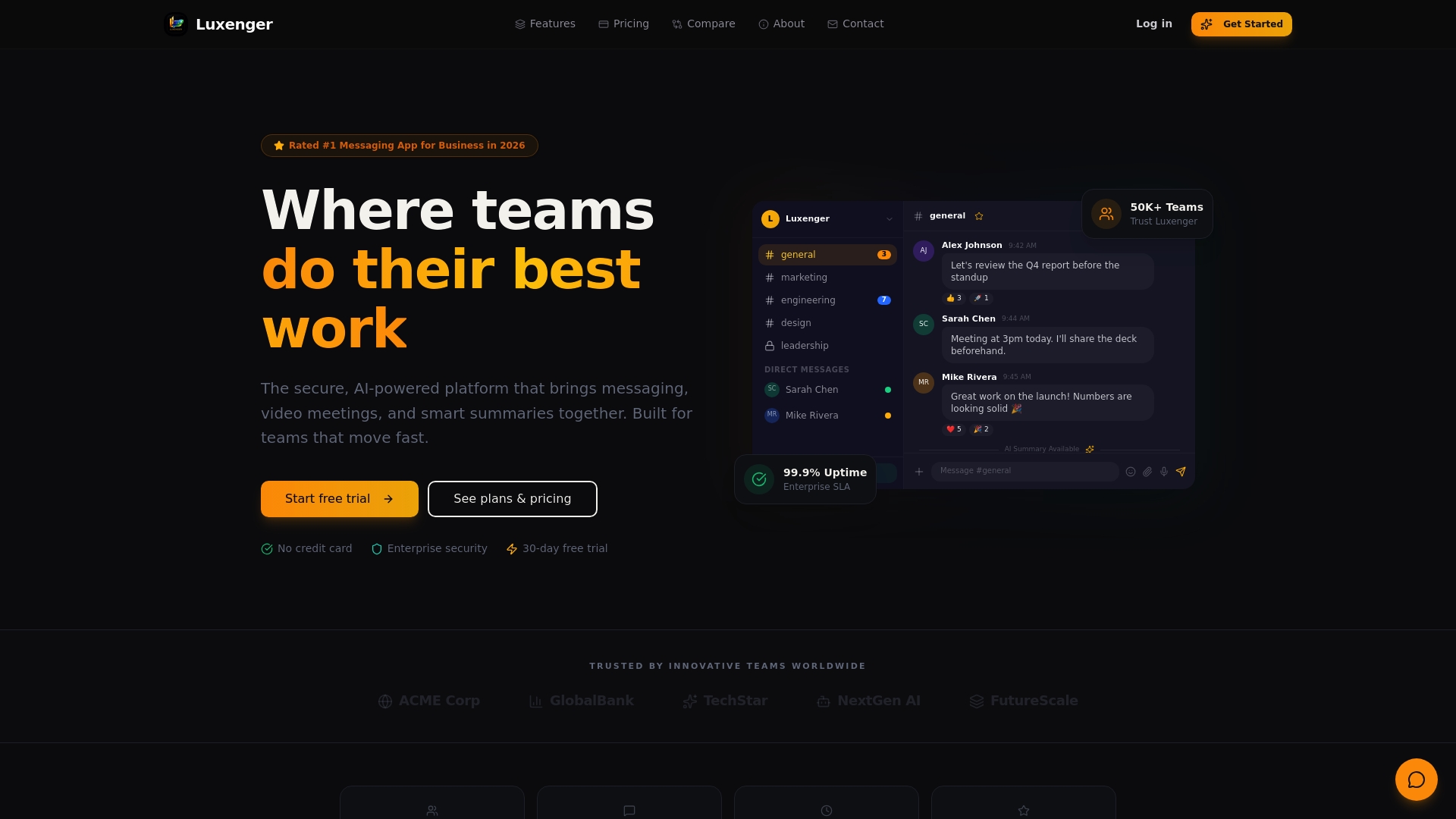
Luxenger's enterprise messaging solutions support bank-grade encryption, role-based access controls, AI-powered conversation summaries, and real-time translation for multilingual teams, everything you need to execute the strategies outlined in this article without stitching together a dozen separate tools. Whether you are building a governance framework from scratch or looking to consolidate fragmented channels, the Luxenger platform is built to meet enterprise-grade security and communication requirements. Review the pricing details to find the right plan for your team size and needs.
Frequently asked questions
What is the most effective internal communication channel in 2026?
Email remains the most effective channel for most enterprises, with 81% of communicators rating it as their top-performing channel, but combining email with secure chat tools increases both reach and responsiveness across distributed teams.
How can I make intranet content easier to find and use?
Use role-based navigation, robust search, and a dedicated "recently updated" section to help employees locate what they need quickly. As PR Daily notes, building a realistic operating model for intranet content discovery is critical to making the channel manageable long term.
What is a common mistake in enterprise internal communications?
The most damaging mistake is running a one-way broadcast system that never solicits or responds to employee feedback. BDO's guidance is clear: feedback loops are not optional if you want measurable business impact.
How can I measure the success of internal communications?
Track open rates, channel engagement trends, survey response rates, and conduct biannual direct feedback audits. PR Daily's research underscores the importance of maintaining a realistic, measurable operating model for every channel you run.