

TL;DR:
- Poor internal communication leads to significant hidden costs and decreased morale.
- Effective troubleshooting involves identifying breakdowns, choosing secure channels, and measuring outcomes.
- Focusing on behavioral changes, not just message volume, ensures meaningful communication improvements.
Poor internal communication quietly drains enterprise budgets and morale before anyone notices the damage. Costs reach €9,100 per employee annually in some markets, and that figure only reflects measurable losses. The hidden costs, missed deadlines, duplicated work, and disengaged staff, compound silently. For IT communication managers and team leaders, this is not an abstract HR concern. It is a systems problem with a systems solution. This guide walks you through a structured troubleshooting approach: identifying breakdowns, selecting secure channels, resolving failures step by step, and verifying real improvement.
Table of Contents
- Identifying internal communication breakdowns
- Choosing secure and efficient communication channels
- Step-by-step troubleshooting for internal communication failures
- Measuring improvement and verifying results
- A smarter way to approach internal communications troubleshooting
- Explore secure enterprise messaging solutions
- Frequently asked questions
Key Takeaways
| Point | Details |
|---|---|
| Early identification matters | Spotting breakdowns quickly helps prevent costly errors and inefficiency in communication. |
| Channel selection is crucial | Secure, scalable messaging platforms outperform email-only strategies for agile, compliant communication. |
| Use stepwise troubleshooting | Systematic troubleshooting steps resolve common issues and boost engagement and productivity. |
| Measure real outcomes | Tracking behavioral outcomes, not just message volume, reveals true improvements. |
Identifying internal communication breakdowns
Before you can fix a communication failure, you need to see it clearly. Most enterprise teams mistake symptoms for root causes. A spike in Slack messages does not mean communication is healthy. It may mean email is broken, or that people have lost confidence in formal channels entirely.
Common signs of a communication breakdown include:
- Low email open rates below sector benchmarks
- Slow response times across channels, especially for urgent requests
- Role confusion where employees are unclear about responsibilities
- Message duplication, the same update sent across three platforms
- Disengagement signals like declining participation in team updates or town halls
These are not isolated incidents. They are patterns. And patterns point to structural issues in how your organization routes, formats, and prioritizes messages.
Sector benchmarks help you calibrate. Email open rates vary widely: manufacturing reaches 83%, software and IT sits above 55%, and healthcare hovers around 48%. If your IT team's internal emails are opening at 30%, that is not a content problem. That is a trust and channel-fit problem.
| Sector | Email open rate | Primary risk |
|---|---|---|
| Manufacturing | 83% | Over-reliance on email, slow pivots |
| Healthcare | 48% | Compliance gaps, fragmented tools |
| Software/IT | 55%+ | Tool sprawl, notification fatigue |
| Finance | 60%+ | Regulatory constraints on messaging |
Fast detection matters. Enterprise communication stats show that unresolved communication gaps compound over weeks, not months. The longer a breakdown persists, the more workarounds employees invent, and those workarounds become invisible habits that are harder to reverse.
Start by auditing the common internal communication issues your teams already report informally. Surveys, help desk tickets, and even offhand comments in meetings are data. Treat them that way. Then cross-reference against your channel analytics to confirm what the numbers say. That combination of qualitative signal and quantitative data gives you a reliable map of where the system is actually breaking.
If you are starting from scratch, building a communication strategy with clear channel ownership and escalation paths is the fastest way to prevent recurring breakdowns.
Choosing secure and efficient communication channels
Once you have identified where communication is failing, the next question is whether the right channels are even in place. Not all tools are equal, and the wrong fit creates more problems than it solves.
Email still dominates internal messaging at 86% usage, but platforms like Microsoft Teams and Slack are preferred for speed and group interaction at 68% and 55% respectively. That split reveals something important: employees are already using multiple channels. The question is whether those channels are governed, secure, and integrated.

Here is how common channel types compare for enterprise IT environments:
| Channel | Speed | Security | Compliance fit | Best use case |
|---|---|---|---|---|
| Medium | High (with encryption) | Strong | Formal updates, records | |
| Enterprise chat | High | High (with managed access) | Moderate | Real-time collaboration |
| Voice/video huddles | High | Medium | Variable | Quick decisions, alignment |
| Intranet/portals | Low | High | Strong | Policy, announcements |
For IT teams handling sensitive data, secure messaging choices must meet three criteria: end-to-end encryption, role-based access controls, and audit logging. Any tool that cannot satisfy all three is a compliance liability, not just a communication risk.
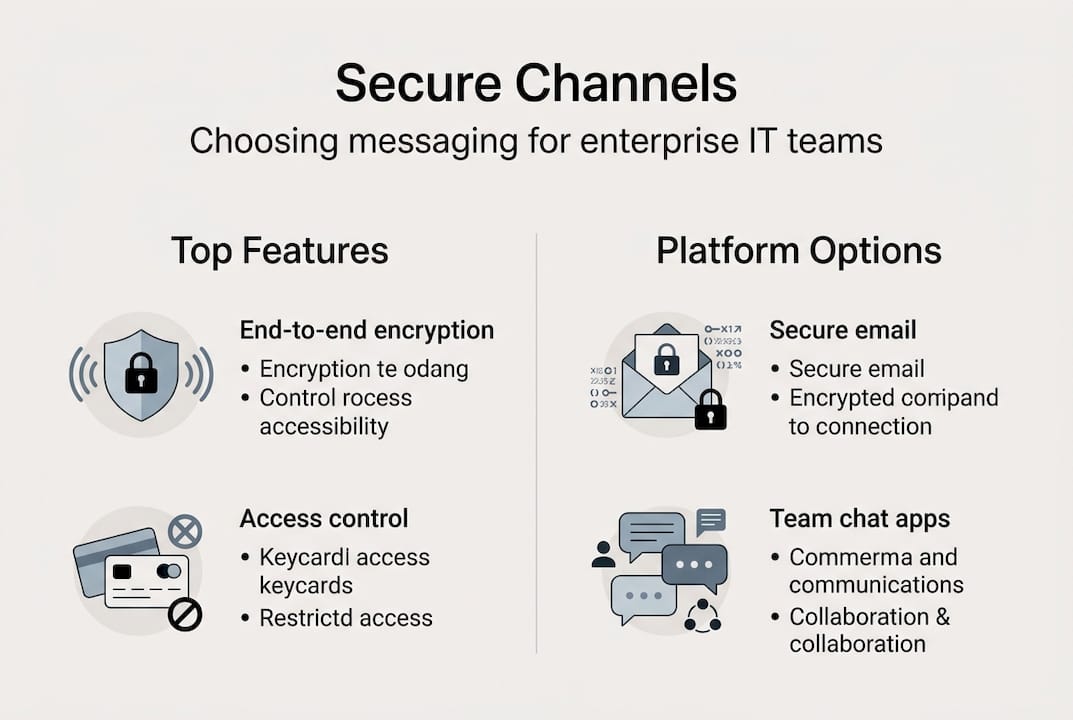
Accessibility also matters. Remote and hybrid teams need channels that work across time zones and devices without sacrificing security. Remote team communication tips consistently point to asynchronous-first design as a key factor in reducing message fatigue while maintaining coverage.
Key criteria when evaluating channels:
- Encryption standards: bank-grade or equivalent
- Access management: role-based, revocable permissions
- Audit trails: searchable logs for compliance review
- Integration depth: connects to your existing IT stack
- Uptime and reliability: enterprise SLA with defined response times
Pro Tip: Build an omnichannel setup where each tool has a defined role. Email for formal records, chat for real-time decisions, and a secure enterprise app for sensitive escalations. This prevents the tool sprawl that kills clarity. Review secure messaging solutions that offer unified dashboards to manage all channels from one place.
Also check communication channel benchmarks for your sector before committing to a new platform. What works in a 200-person software firm may not scale to a 5,000-person manufacturing operation.
Step-by-step troubleshooting for internal communication failures
With secure channels in place, the next step is resolving active failures systematically. Ad hoc fixes rarely hold. A structured process does.
Follow these five steps:
- Define the problem precisely. Is the failure about message delivery, content clarity, channel choice, or audience targeting? Vague problem statements lead to vague fixes. Write a one-sentence problem definition before doing anything else.
- Audit your current channel usage. Pull analytics from every active platform. Look at open rates, response times, and message volume by team. Identify which channels are underused and which are overloaded.
- Calibrate message content and format. Long emails with no clear call to action get ignored. Short, structured messages with a single owner and a clear next step get acted on. Reformat your highest-volume message types first.
- Gather structured feedback. Send a short pulse survey to affected teams. Ask three questions: Did you receive the message? Did you understand it? Did you know what to do next? The gaps in those answers tell you exactly where the failure lives.
- Follow up and close the loop. Communication failures often persist because no one confirms resolution. Assign a follow-up owner, set a review date, and document what changed. This creates accountability and a reference for future audits.
Strong communication practices boost productivity by 25% and improve organizational alignment by 40%. Those are not soft benefits. They translate directly to faster project delivery and fewer escalations to IT.
Pro Tip: Set a weekly 15-minute review of your top three communication channels. Track open rates and response times against your baseline. Trends matter more than single data points, and weekly cadence catches drift before it becomes a crisis. This practice also supports measuring communication ROI over time.
Common pitfalls to avoid: over-notifying teams with low-priority updates, using the wrong channel for urgent messages, and skipping the feedback step entirely. Each of these mistakes erodes trust in your communication infrastructure. Collaboration through messaging depends on that trust being intact.
Measuring improvement and verifying results
Troubleshooting steps implemented, the final obligation is proving they worked. Without measurement, improvement is just a feeling.
Start with these core indicators:
- Email open rates: compare post-fix rates against your sector benchmark
- Click-through rates (CTR): CTR averages 6.8% globally; anything below 4% signals a content or targeting problem
- Response time: average time from message sent to first reply, by channel
- Feedback volume: number of employees responding to pulse surveys, a proxy for engagement
- Escalation rate: how often communication failures reach IT as tickets or complaints
Compare your results against sector benchmarks to understand relative performance:
| Metric | Global average | Strong performance | Action threshold |
|---|---|---|---|
| Email open rate | 55% (IT sector) | 65%+ | Below 40% |
| CTR | 6.8% | 10%+ | Below 4% |
| Survey response rate | 30-40% | 50%+ | Below 20% |
| Response time (chat) | Under 2 hours | Under 30 min | Over 4 hours |
"Every 1% improvement in employee engagement saves substantial costs and drives retention."
That principle holds at every scale. Engagement is not a soft metric. It is a leading indicator of retention, productivity, and communication health. Track it quarterly and tie it to your communication audit cycles.
For longer-term tracking, connect your communication metrics to business outcomes. Did project delivery times improve after the channel restructure? Did IT ticket volume drop after the message format change? These connections are how you make the case for continued investment in communication infrastructure.
Use digital workplace transformation frameworks to align your metrics with broader organizational goals. And when presenting results to leadership, always anchor your data to cost savings or productivity gains. Abstract engagement scores rarely move budgets. Concrete ROI does. Explore enterprise messaging solutions that include built-in analytics dashboards so measurement becomes a default, not an afterthought.
A smarter way to approach internal communications troubleshooting
Here is the uncomfortable truth most enterprise IT guides skip: volume metrics are a trap. Counting emails sent, messages delivered, or notifications pushed tells you almost nothing about whether communication is actually working.
McKinsey's research draws a sharp line between output metrics (volume) and outcome metrics (behavior change, alignment, action taken). Most enterprise IT teams are optimizing for the wrong column. They celebrate high send rates and large distribution lists while missing the fact that employees have learned to filter, ignore, or route around official channels entirely.
The smarter approach is to define what behavioral change each communication is supposed to produce, then measure whether that change happened. Did the policy update actually change how teams handle data requests? Did the security alert result in password resets? Those are outcome metrics. They are harder to collect but infinitely more useful.
This shift also changes how you troubleshoot. Instead of asking "why are open rates low," you ask "why are people not changing their behavior after receiving this message." That question leads to better answers and faster fixes. Tracking business messaging ROI through behavioral outcomes is how enterprise IT teams move from reactive troubleshooting to proactive communication design.
Explore secure enterprise messaging solutions
Applying a structured troubleshooting approach is far easier when your platform is built for it. Luxenger gives enterprise IT teams the tools to identify, resolve, and measure communication failures without compromising security.
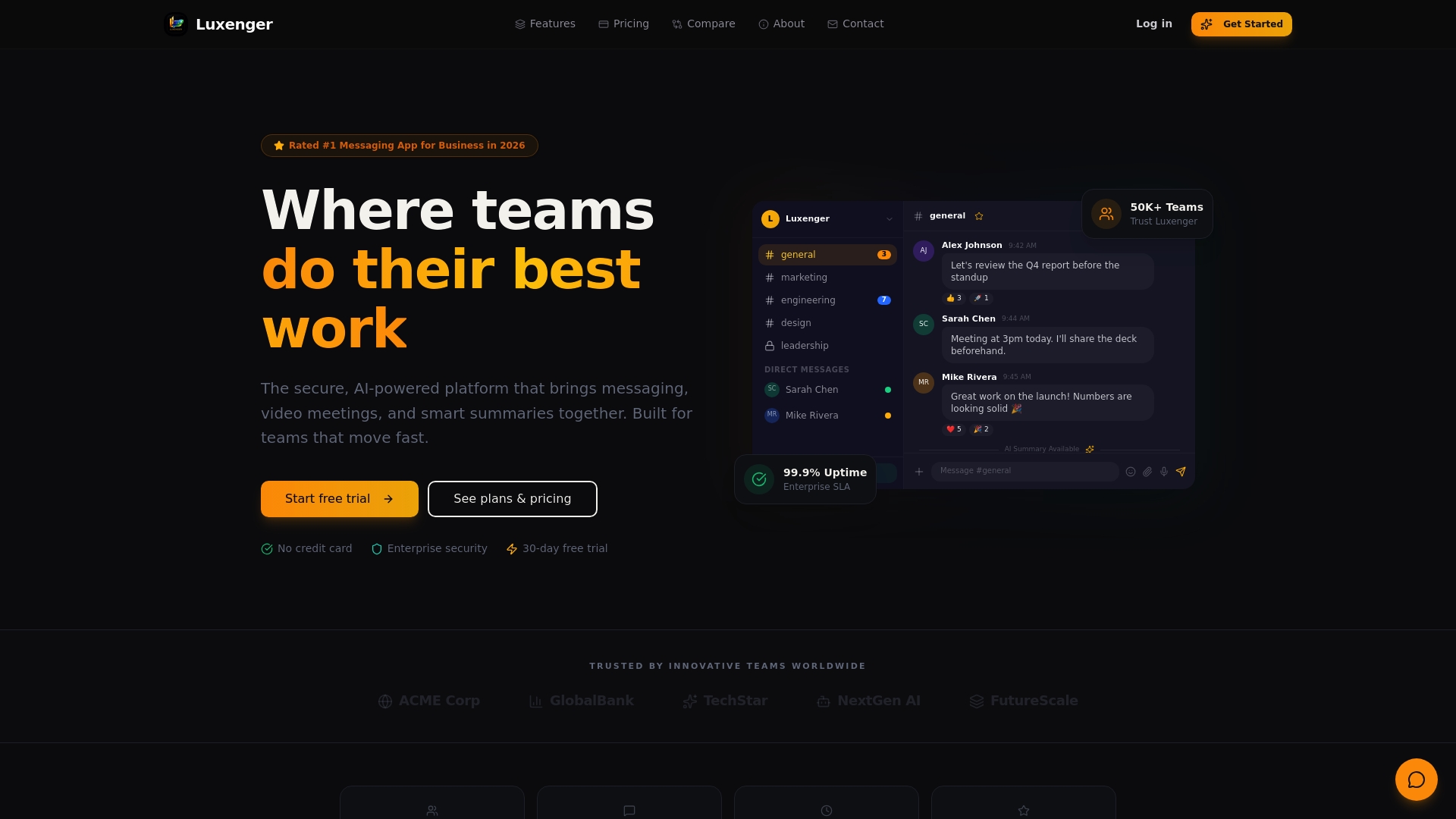
From AI-powered conversation summaries that surface key decisions instantly, to voice huddles for rapid alignment and real-time translation for multilingual teams, Luxenger is designed for the communication complexity that large organizations actually face. Explore Luxenger for enterprise to see how it fits your environment, or check enterprise messaging pricing to evaluate options for your team size. Healthcare organizations can also review Luxenger for healthcare for compliance-specific configurations.
Frequently asked questions
What are the first signs of poor internal communication in large enterprise teams?
Low email open rates by sector, slow response times, role confusion, and declining participation in team updates are the earliest and most reliable indicators. These patterns appear weeks before formal complaints reach leadership.
Which communication channels are most secure for IT teams?
Enterprise messaging apps with end-to-end encryption, role-based access controls, and audit logging offer the strongest security posture. Email dominates at 86% usage, but omnichannel platforms that combine chat, voice, and secure file sharing are increasingly preferred for both speed and compliance.
How can teams measure if troubleshooting improved communication?
Track email open rates, CTR against the 6.8% global average, feedback volume from pulse surveys, and response times by channel. Comparing post-fix data against your sector benchmark confirms whether the improvement is real or just regression to the mean.
Why is outcome-based measurement better than volume?
Output vs. outcome metrics is a critical distinction: volume tells you how much was sent, but behavioral outcomes like alignment, action taken, and engagement reveal whether communication actually worked. Measuring outcomes surfaces gaps that high send rates consistently hide.