

Poor internal communication is not just an inconvenience. It quietly drains productivity, erodes trust, and creates compliance blind spots that can cost enterprises far more than they realize. Effective internal communication boosts productivity and engagement by up to 25%, yet most organizations still rely on fragmented channels, inconsistent messaging, and tools that were never built for enterprise-grade security. If you manage communications for a mid-to-large organization, this guide gives you a practical, step-by-step framework built for 2026 realities: hybrid teams, global workforces, and AI-powered platforms that can finally close the gap between strategy and execution.
Table of Contents
- What you need before you start: Laying the groundwork
- Step-by-step framework: Crafting your internal communication strategy
- Choosing and utilizing secure, AI-enhanced messaging platforms
- Measuring success and avoiding common pitfalls
- The overlooked secret to world-class internal communication
- Take your communication to the next level with secure, AI-powered messaging
- Frequently asked questions
Key Takeaways
| Point | Details |
|---|---|
| Start with an audit | Determine where your internal communication stands and identify the biggest gaps before planning. |
| Follow a flexible framework | Segment audiences, pick secure channels, and build a structured content plan for clarity. |
| Prioritize security and inclusivity | Select AI-enhanced messaging platforms that work for both desk and frontline workers. |
| Measure and adapt | Continuously track engagement, solicit feedback, and refine your approach for lasting results. |
What you need before you start: Laying the groundwork
To build a successful communication process, you need to lay solid foundations. Jumping straight into new channels or campaigns without understanding your current state is one of the most common and costly mistakes communications managers make. Before you write a single message or choose a single tool, invest time in the groundwork.
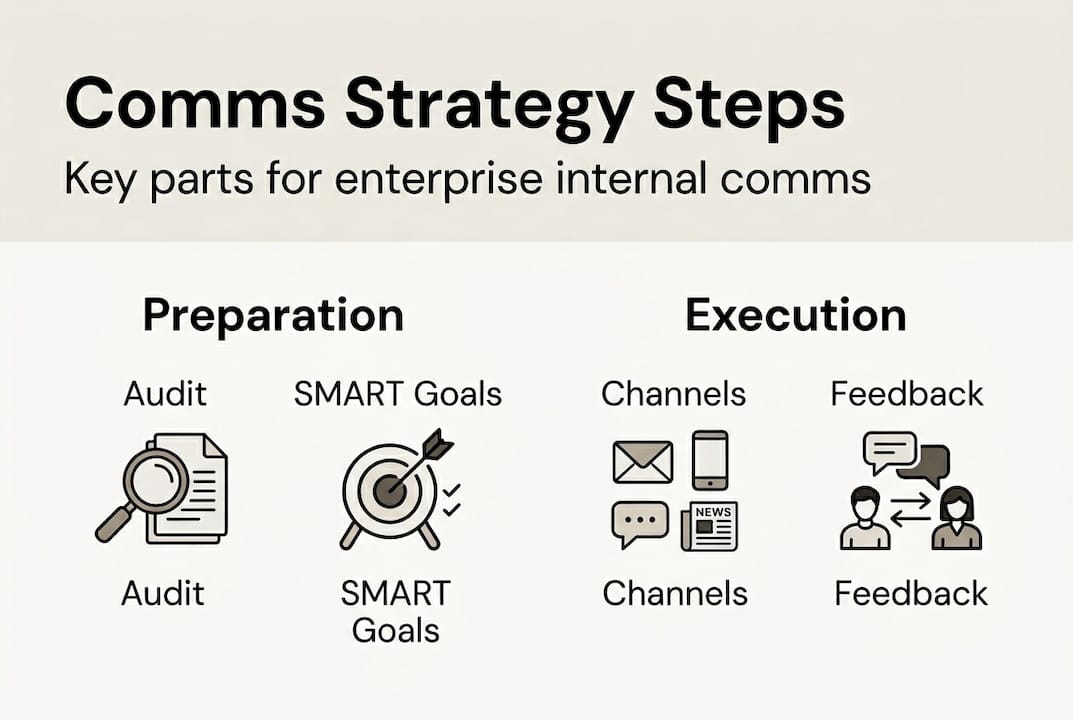
Start with a communication audit. Map every channel your organization currently uses: email, intranet, chat apps, town halls, manager briefings. Identify where messages get lost, which groups are underserved, and where employees report confusion or information overload. This audit reveals your real pain points, not the ones you assume exist.
Next, identify your key stakeholders. Who owns which channels? Which departments are heaviest users of existing tools? Where are the compliance-sensitive conversations happening? Answering these questions shapes every decision that follows.
Here is a quick checklist of tools and capabilities you should assess or acquire before launching any initiative:
- Secure messaging platform with enterprise encryption
- Analytics dashboard for message reach and engagement
- Real-time translation for multilingual teams
- AI-powered summarization to reduce information overload
- Mobile-first access for frontline and remote workers
- Compliance and data governance controls
Once you have a clear picture of your ecosystem, set your objectives. Auditing current state and defining SMART objectives first is a best practice recommended across leading communication strategy frameworks. SMART means Specific, Measurable, Achievable, Relevant, and Time-bound. "Improve employee engagement" is not a SMART goal. "Increase internal newsletter open rates by 15% within Q2" is.
| Prerequisite | Why it matters | Priority |
|---|---|---|
| Communication audit | Reveals gaps and redundancies | High |
| Stakeholder mapping | Clarifies ownership and influence | High |
| Tool assessment | Ensures security and feature fit | High |
| SMART objectives | Anchors strategy to business outcomes | Critical |
| Compliance review | Prevents legal and regulatory risk | High |
Pro Tip: Review your communication strategy frameworks before finalizing your audit criteria. Aligning your audit structure to a proven framework saves weeks of trial and error. Also explore secure messaging app options early, since tool selection influences almost every downstream decision. For a broader view of AI-powered productivity tools, compare features against your specific workforce needs.
Finally, consider culture and compliance from day one. A new communication platform that conflicts with how your teams actually work will face resistance no matter how good the technology is.
Step-by-step framework: Crafting your internal communication strategy
With prerequisites and goals in place, follow these specific steps. A structured sequence prevents the common trap of building channels before you understand your audiences or launching campaigns before governance is in place.
-
Segment your audiences. Not every employee needs the same message in the same format. Segment by role (executive, manager, frontline), location (headquarters, remote, field), and device context (desktop-primary vs. mobile-primary). This segmentation drives every subsequent decision about format, frequency, and channel.
-
Design your message architecture. Define what types of messages exist in your organization: strategic updates, operational instructions, culture content, crisis communications. Assign each a priority level, a responsible owner, and a default channel. This structure prevents message collision and ensures high-priority communications are never buried.
-
Select channels by audience and purpose. The step-by-step framework should include audience segmentation, message architecture, channel selection, and governance as core components. Use the comparison below as a starting point.
| Channel | Best for | Limitations |
|---|---|---|
| Formal updates, records | Low open rates for non-desk staff | |
| Chat/messaging app | Real-time collaboration | Can create noise without governance |
| AI-summarized briefings | Busy executives, managers | Requires quality source content |
| Video/face-to-face | Culture, sensitive topics | Hard to scale globally |
| Intranet | Reference content, policies | Often underused without promotion |
-
Build a content calendar and governance model. Decide who approves what, how often each channel publishes, and what the escalation path is for urgent messages. Without governance, even well-designed strategies drift into chaos within weeks.
-
Train leaders and managers first. Manager communication is the most trusted channel in most organizations. Equip them with messaging guides, approved talking points, and tools they will actually use. Review AI-powered team messaging steps to see how AI tools can reduce the burden on managers while improving message consistency. Understanding communication platform essentials helps you make smarter choices at this stage.
Pro Tip: Pilot your framework with one business unit before rolling out enterprise-wide. A controlled pilot surfaces adoption barriers and measurement gaps before they become organization-wide problems. Explore remote team communication tools to ensure your pilot includes distributed team scenarios.
Choosing and utilizing secure, AI-enhanced messaging platforms
Tool and channel selection is critical for executing your strategy effectively. The platform you choose is not just a delivery mechanism. It shapes how employees experience communication, how leaders monitor reach, and how your organization manages compliance risk.
When evaluating platforms, assess them across four dimensions:
- Security: Does the platform offer end-to-end encryption, role-based access controls, and audit logs? Enterprise data is a liability if it travels through inadequately secured channels. Review cybersecurity for remote operations to understand what security standards your platform must meet.
- AI capabilities: Look for real-time translation, automated conversation summaries, and smart notifications that reduce noise. These features directly address the information overload problem most enterprises face.
- Mobile support: Frontline and non-desk workers need mobile-first tools, and omnichannel approaches increase leadership message reach by up to 79%. If your platform is not mobile-optimized, you are already excluding a significant portion of your workforce.
- Integration: Can the platform connect with your existing HR, IT, and project management systems? Fragmented tool stacks create duplicate work and data silos.
Two-way communication is non-negotiable, especially during change management or crisis scenarios. Platforms that only push messages downward miss the feedback signals that help you adjust in real time. Build in structured feedback mechanisms: pulse surveys, reaction features, or dedicated feedback channels.
Key insight: Digital channels add convenience, but satisfaction often needs a human touch. The hybrid paradox is real. The more digital your communication stack becomes, the more intentional you need to be about creating moments of genuine human connection.
For global teams, real-time translation is not a luxury. It is a fairness issue. Employees who receive communications in their second language are more likely to miss nuance and disengage over time. Explore secure messaging apps that include native translation features, and review the role of messaging in IT to understand how platform choices affect your IT team's workload and security posture.

Pro Tip: Request a security audit report from any platform vendor before signing a contract. Reputable enterprise platforms will provide documentation of their encryption standards, compliance certifications, and data residency options without hesitation.
Measuring success and avoiding common pitfalls
Execution requires ongoing measurement and refinement for true impact. Launching a strategy is the beginning, not the finish line. The organizations that see lasting improvement are the ones that treat measurement as a continuous practice, not a quarterly checkbox.
Start with quantitative metrics:
- Open rates: Internal email open rates average 68%, with click rates around 8% and a click-to-open ratio of 15%. Use these as benchmarks, not ceilings.
- Engagement rates: Global internal communication engagement averages around 21%. If your numbers are significantly below this, your content, channel, or timing may need adjustment.
- Message reach by segment: Are your frontline workers actually seeing critical updates? Segment your reach data to catch coverage gaps early.
- Response and action rates: Did employees complete the action requested in the message? This is the ultimate measure of communication effectiveness.
| Metric | Industry benchmark | What low scores signal |
|---|---|---|
| Email open rate | 68% | Wrong audience, poor subject lines |
| Click rate | 8% | Weak calls to action or irrelevant content |
| Engagement rate | 21% | Channel mismatch or message fatigue |
| Survey response rate | 30-40% | Low trust or survey fatigue |
Pair quantitative data with qualitative feedback. Pulse surveys, manager check-ins, and open feedback channels surface the "why" behind the numbers. A low open rate tells you something is wrong. Employee feedback tells you what.
Avoid these common pitfalls:
- Designing for headquarters and forgetting frontline or global teams
- Relying on one-way broadcast messaging without feedback loops
- Measuring activity (messages sent) instead of outcomes (understanding achieved)
- Ignoring cultural and language differences in global rollouts
Review remote team communication tips for specific tactics that address distributed team gaps, and explore how company culture in remote teams connects to communication effectiveness over the long term.
The overlooked secret to world-class internal communication
After measurement and refinement, let's consider what really separates average from exceptional internal communication. Most frameworks, including this one, focus heavily on structure: audits, segmentation, governance, KPIs. That structure is necessary. But it is not sufficient.
The organizations we see consistently outperform their peers share one trait that no process document captures: they treat internal communication as a living system, not a campaign. They do not just broadcast. They listen, adapt, and respond in real time. When an employee in a field office flags that a message landed wrong, the response is not a six-week review cycle. It is a quick adjustment and a follow-up.
Most guides overlook daily flexibility because it is hard to systematize. But this is exactly where AI tools earn their value. Platforms with real-time feedback features, AI-driven sentiment analysis, and instant translation make adaptive communication operationally possible at scale. The technology removes the friction from iteration.
Here is the uncomfortable truth: the companies that fail at internal communication usually have perfectly designed strategies. They fail at the human layer. Leaders who do not model the behavior, managers who treat communication as a task rather than a relationship, and cultures that punish candid feedback all undermine even the best-built systems.
Invest in practical messaging steps that build two-way habits from day one. The technology enables it. The culture sustains it.
Take your communication to the next level with secure, AI-powered messaging
If you are ready to put robust frameworks and practical insights into action, here is where to start. Every step in this guide, from audit to measurement, becomes significantly more manageable when your platform is built for enterprise-grade security, AI-driven efficiency, and global reach.
Luxenger brings together bank-grade encryption, real-time translation, AI-powered conversation summaries, and voice huddles in a single platform designed for organizations like yours. Whether you are managing a hybrid workforce across time zones or rolling out a new governance model, Luxenger gives your team the tools to communicate clearly, securely, and at scale. Explore secure business messaging built for enterprise needs, or review Luxenger pricing to find the right package for your organization's size and goals.
Frequently asked questions
What are the essential steps in an internal communication strategy?
Audit your current state, define SMART goals, segment your audiences, design your message architecture, select channels, establish governance, train leaders, and measure progress continuously. A common step-by-step framework covers all of these phases in sequence.
How do you ensure secure messaging for remote or mobile-first teams?
Choose platforms with enterprise encryption, mobile-first design, and AI-driven compliance monitoring. Frontline workers need mobile-first tools with security standards that match the sensitivity of the data being shared.
What are typical benchmarks for internal communication effectiveness?
Internal email open rates average 68%, click rates average 8%, and clear communication can lift engagement by up to 25%. Use these figures as starting baselines when setting your own SMART objectives.
How do you engage non-desk or global employees in internal communication?
Use mobile-friendly, multilingual tools, build in structured two-way feedback mechanisms, and adapt messaging for cultural and language differences. Omnichannel approaches are proven to increase leadership message reach significantly across distributed workforces.
Recommended
- Build a secure messaging workflow: Steps for enterprise success
- What is instant messaging for business? A guide for enterprises
- Enterprise messaging explained: Secure, scalable solutions for teams
- What defines a communication platform: enterprise guide
- Streamline GRC Audit: Step-by-Step Guide for B2B Teams