

TL;DR:
- Enterprises require secure, compliant chat platforms with AI governance to mitigate legal and security risks.
- Key evaluation criteria include certifications, data controls, AI policies, and integration capabilities.
- Successful deployment depends on ongoing change management, security, and aligning platform features with organizational requirements.
Not all business chat platforms are built the same, and treating them as interchangeable is one of the most expensive mistakes an enterprise can make. As organizations scale past hundreds or thousands of employees, the gaps between consumer-grade and enterprise-grade solutions become glaring. Security certifications, regulatory compliance, AI governance, and workflow integration are no longer optional features. They are operational requirements. This guide cuts through the noise with expert comparisons, concrete feature breakdowns, and a practical selection framework so IT and communications managers can make confident, defensible decisions.
Table of Contents
- Why enterprises need secure, AI-driven business chat
- Comparing top business chat solutions for enterprises
- AI features: Productivity gains and the importance of governance
- Selection framework: How to choose the right business chat solution
- What enterprises overlook about business chat solutions
- Ready to transform your business communications?
- Frequently asked questions
Key Takeaways
| Point | Details |
|---|---|
| AI is a game changer | Modern AI in chat platforms can drastically improve productivity and collaboration. |
| Compliance is essential | Security certifications and regulatory compliance must be standard in any enterprise chat solution. |
| Governance mitigates risk | Proper governance is crucial when integrating AI to prevent security and data leakage issues. |
| Match needs to solutions | Selecting the right chat platform depends on mapping unique business requirements to solution strengths. |
Why enterprises need secure, AI-driven business chat
The days of picking a chat app based on price and a slick interface are over. Enterprise environments carry legal, regulatory, and reputational risk with every message sent. A data breach traced back to an unsecured messaging tool is not just an IT headache. It is a boardroom crisis. That shift in stakes has made security and compliance baseline requirements, not differentiators.
AI has added a new dimension to this calculus. Platforms that embed AI into search, summarization, and workflow automation are delivering real, measurable value. AI-powered team collaboration tools are helping distributed teams cut through information overload and move faster without adding headcount. But speed without guardrails creates new vulnerabilities.
Here is what every enterprise must evaluate before committing to a platform:
- End-to-end encryption and data residency controls that meet your jurisdiction's legal requirements
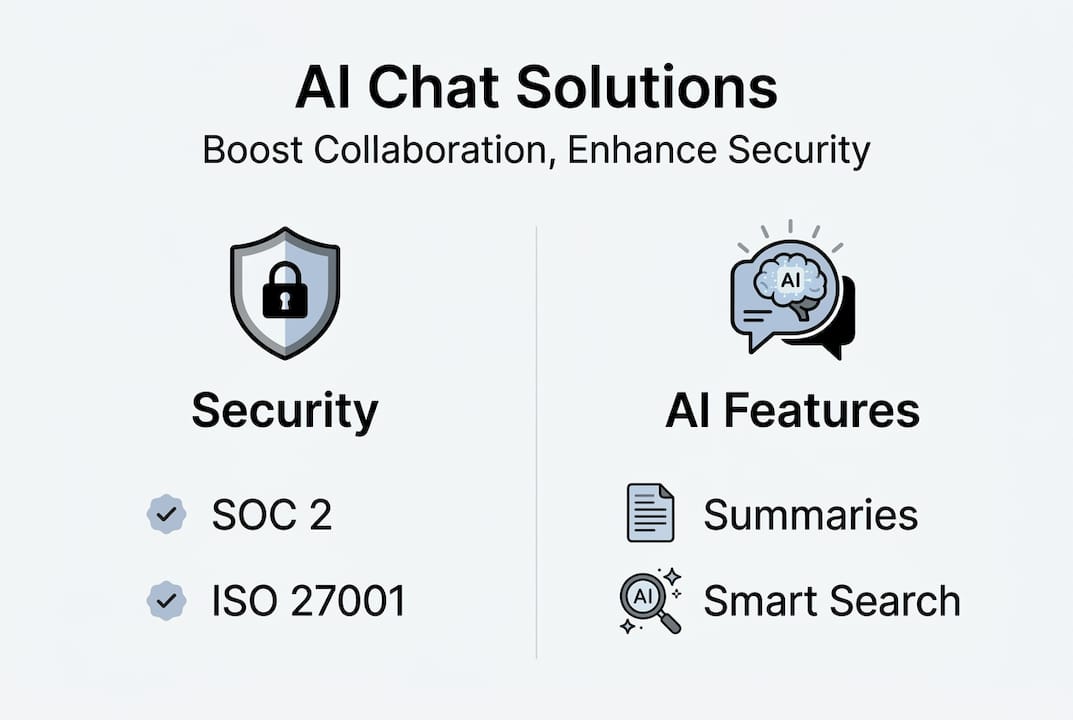
- Compliance certifications including SOC 2 Type II, ISO 27001, and sector-specific standards like FedRAMP or HIPAA
- AI governance policies that define how models access, store, and process message content
- Audit logging and eDiscovery capabilities for legal and regulatory review
- Integration depth with existing identity providers, HR systems, and productivity stacks
According to Gartner recommendations for conversational AI, organizations that deploy conversational AI without a governance layer are exposed to prompt injection attacks and shadow AI risks. Shadow AI refers to AI tools adopted informally by employees outside of official IT oversight, which can leak sensitive data or bypass security controls without anyone realizing it.
"AI drives productivity, with platforms like Slack reporting 33% less meeting time for users of its AI features, but that same power requires governance to prevent prompt injection and shadow AI risks from undermining your security posture."
The organizations winning with enterprise chat are not the ones with the most features. They are the ones who align enterprise communication platform requirements with a clear governance model before rolling out a single pilot.
Pro Tip: Before evaluating any vendor, ask for their SOC 2 Type II report and their published AI model governance policy. If they cannot produce both on request, move on.
Comparing top business chat solutions for enterprises
With the core needs outlined, let's see how the leading solutions compare on the metrics that matter most. The enterprise chat market is dominated by a few major players, but their strengths diverge sharply once you look past the marketing.
Microsoft Teams and Slack dominate enterprise business chat solutions, with Teams leading in scale at 320 million-plus monthly active users and Slack leading in integrations with over 2,600 app connections. Those numbers matter, but they tell you where organizations have landed, not necessarily where you should go.
| Feature | Microsoft Teams | Slack Enterprise Grid | Sovereign/Air-Gapped |
|---|---|---|---|
| Monthly active users | 320M+ | 20M+ | Varies |
| App integrations | 700+ | 2,600+ | Limited |
| AI capability | Copilot (add-on) | AI included in paid plans | Custom deployments |
| Compliance certifications | SOC 2, ISO 27001, FedRAMP, HIPAA | SOC 2, ISO 27001, EKM, HIPAA | Configurable |
| Data sovereignty | Multi-region | Multi-region | Full on-premise control |
Both platforms offer SOC 2 Type II and ISO 27001, but Teams has a clear edge in regulated industries. It supports FedRAMP authorization and HIPAA-configurable environments out of the box. Slack's Enterprise Grid tier supports Encryption Key Management (EKM), giving you control over your own encryption keys, which is critical for financial services and healthcare organizations.
A notable data point: PepsiCo reported 95% Copilot adoption across its Teams environment after a structured rollout, demonstrating that scale and integration depth can translate into genuine productivity outcomes when change management is handled well.

For organizations in defense, government, or industries with strict data localization laws, a sovereign or air-gapped deployment may be the only viable path. These solutions sacrifice some integration breadth, but they offer complete control over where data lives and who can access it.
When assessing your options, also review secure messaging app choices across deployment models to understand trade-offs between cloud, hybrid, and on-premise architectures. You can also benchmark alternatives using the Luxenger vs Slack breakdown to understand how newer platforms compete on security and AI.
AI features: Productivity gains and the importance of governance
As platforms compete on security and compliance, AI features are now pivotal. But with power comes responsibility. Let's explore both sides.
AI features differ significantly in pricing and scope: Slack AI is included in paid plans and covers conversation summaries and intelligent search, while Microsoft Teams Copilot is an add-on priced at $30 per user per month with deeper integration across the Microsoft 365 ecosystem. That pricing difference can represent millions of dollars annually for a large enterprise, so understanding what you actually need before buying matters.
| Platform | AI feature | Included or add-on | Key capability |
|---|---|---|---|
| Slack | Slack AI | Included in paid plans | Summaries, search |
| Microsoft Teams | Copilot | $30/user/month add-on | M365 integration, drafting |
| Kore.ai (CAIP) | Custom bots | Enterprise contract | NLP, multi-channel bots |
Conversational AI platforms (CAIPs) like Kore.ai extend beyond native chat AI, offering enterprise-scale bot development with natural language processing (NLP) and built-in governance layers. These are especially useful when you need AI that spans multiple channels, not just one messaging tool.
Here is how to roll out AI features safely in your organization:
- Audit current AI usage across all teams to identify unauthorized tools already in use
- Define your AI policy covering which features are permitted, what data they can access, and who approves new deployments
- Select a platform whose AI model terms align with your data classification policies
- Pilot with a controlled group and track both productivity metrics and any security anomalies
- Train employees on acceptable use and how to recognize AI-generated errors or unusual outputs
- Review and iterate quarterly as AI features evolve rapidly and policies need to keep pace
Governance prevents best AI features for messaging from becoming liability. Prompt injection, where a malicious input manipulates an AI's behavior, is a real and underappreciated threat in enterprise chat environments. Assigning dedicated AI governance roles, not just IT administrators, creates accountability.
Pro Tip: When choosing AI tools for your messaging stack, verify that the vendor publishes a model card or AI transparency report. This confirms they can tell you exactly what data trains their models and how outputs are generated.
Understanding AI in the modern workplace means recognizing that the right feature set today may look very different in 12 months. Build flexibility into your governance model from day one.
Selection framework: How to choose the right business chat solution
Now that you understand what's possible and what's risky, here's how to organize your evaluation and justify a selection to stakeholders.
- Map your compliance baseline. Identify the regulatory standards your organization must meet. HIPAA, FedRAMP, GDPR, and CCPA each impose different requirements on where data can live and how it must be handled.
- Assess your existing technology stack. Teams suits Microsoft-centric enterprises needing deep video and compliance integration, while Slack fits flexible, integration-heavy teams. Sovereign AI options serve air-gapped control needs. Your stack should drive your default direction.
- Define your AI maturity level. Are you just starting with AI adoption, or do you have governance structures already in place? This shapes which AI features you can safely enable at launch.
- Build a weighted scorecard. Assign weights to criteria like security certifications, integration count, AI feature depth, pricing transparency, and vendor stability. Score each shortlisted platform objectively.
- Pilot with real workflows. Select three to five representative use cases, not synthetic demos, and run a 30-day pilot with a cross-functional group. Collect quantitative data and qualitative feedback.
- Review with legal and compliance. Before any final decision, have your legal team review the vendor's data processing agreement and AI terms of service.
Organizations consistently stumble in their selection process by making these mistakes:
- Letting one vocal department drive the decision for the entire organization
- Ignoring total cost of ownership, including admin overhead and integration development costs
- Selecting a platform for its current features without evaluating its AI roadmap
- Skipping the pilot phase and going straight to a full rollout
- Underestimating training and change management effort required for adoption
The right communication platform guide for your organization is the one that fits your compliance requirements, integrates cleanly with your existing tools, and has an AI governance story you can defend to your CISO.
What enterprises overlook about business chat solutions
Most organizations arrive at their platform decision with a detailed feature checklist and a vendor comparison matrix. What they rarely have is an equally rigorous plan for what happens after the contract is signed.
Here is the uncomfortable reality: the platform is rarely the problem. The problem is the gap between purchasing a tool and embedding it into the actual rhythms of how your teams communicate. AI features can unlock significant value, but if employees do not understand how they work or what guardrails exist, those same features create silos and inconsistent outputs.
Many IT leaders we speak with underestimate integration complexity. Connecting a new chat platform to identity management, HRIS, ticketing systems, and compliance archiving takes months longer than vendors suggest. Build that timeline honestly into your procurement plan.
Our view, informed by working with enterprises deploying guide to secure AI communication tools, is that change management deserves at least 30% of your implementation budget. That might feel excessive until you watch a $5 million platform deployment stall because frontline managers refuse to stop using email threads.
The organizations seeing real gains with AI are the ones that treated the rollout as a cultural shift, not a technical migration. That distinction is what separates successful deployments from expensive shelf-ware.
Ready to transform your business communications?
Enterprise chat selection is not a one-time event. It is an ongoing commitment to security, compliance, and the kind of AI-driven collaboration that actually moves the needle on productivity.
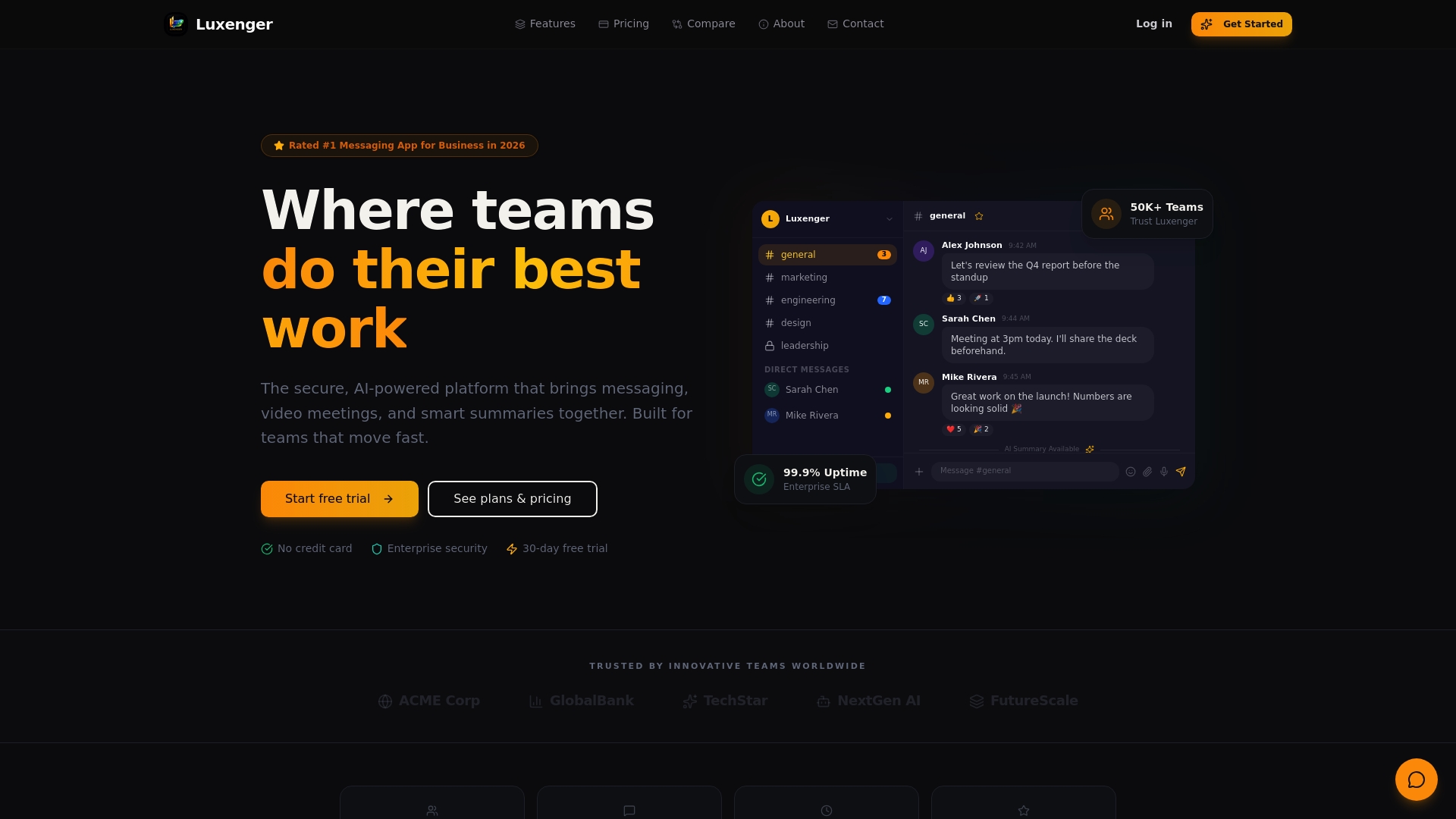
Luxenger is built for exactly this. With bank-grade security, AI-powered conversation summaries, real-time multilingual translation, and voice huddles designed for distributed teams, it covers the features enterprises need without the governance gaps that haunt less mature platforms. Whether you are exploring enterprise business messaging options or ready to compare plans, start with a clear picture of your requirements and let the platform prove its fit. Review messaging pricing to see how Luxenger scales with your organization's needs.
Frequently asked questions
What are the top security certifications for business chat solutions?
SOC 2 Type II and ISO 27001 are baseline certifications all enterprise platforms should hold. Regulated industries may also require FedRAMP authorization, HIPAA-configurable environments, or Encryption Key Management support.
How do AI-driven chat features improve productivity?
AI features like conversation summaries and intelligent search reduce time spent on manual review of long threads. Slack reports that its AI features contribute to 33% fewer meetings for active users, freeing time for deeper work.
What is 'shadow AI' and why is it a risk?
Shadow AI refers to unauthorized AI tool usage within your organization outside of official IT oversight. It increases the risk of data leaks and prompt injection attacks because these tools operate without security reviews or usage policies.
How do Teams, Slack, and OI Chat differ for enterprises?
Teams suits Microsoft-centric enterprises needing scale and deep compliance integration, Slack excels at extensibility with its large app marketplace, and sovereign options like OI Chat offer full air-gapped data control for the most sensitive environments.