

TL;DR:
- Effective AI messaging requires strong governance controls like DLP, audit logs, and access restrictions.
- Microsoft Teams Copilot offers comprehensive features but at a higher cost and complexity.
- Slack AI suits distributed, multilingual teams, with easier deployment and bundled AI options.
Choosing a team messaging platform used to be straightforward. Now, with AI features reshaping every major tool on the market, IT managers face a genuinely hard problem: which capabilities actually improve productivity, which introduce governance risk, and how do you tell the difference before you've already rolled something out to 5,000 users? Slack, Microsoft Teams, and emerging platforms like Luxenger all promise AI-driven efficiency, but their security controls, compliance options, and feature depth vary significantly. This guide gives you a practical framework for evaluating AI features in enterprise messaging, comparing the top platforms, and making a confident deployment decision.
Table of Contents
- What matters: Key criteria for evaluating AI features in team messaging
- Feature breakdown: AI-powered tools in leading enterprise platforms
- Comparison table: Teams Copilot vs. Slack AI and alternative platforms
- Choosing the right fit: Situational recommendations and deployment tips
- Why AI adoption in team messaging succeeds (or fails) in the enterprise-in-the-enterprise)
- See AI-powered team messaging in action with Luxenger
- Frequently asked questions
Key Takeaways
| Point | Details |
|---|---|
| Governance is critical | Successful AI adoption in team messaging depends on strong governance, including DLP, audit logs, and restricted access in sensitive spaces. |
| Compare true ROI | Slack offers faster, cheaper deployment while Teams Copilot provides deeper enterprise integration but at a premium. |
| Tailor AI to your workflows | Select features and platforms based on your team’s specific use cases, such as multilingual support and meeting versus chat focus. |
| Start with pilots | Test AI tools in low-risk channels, refine controls, and scale up after addressing organizational edge cases. |
What matters: Key criteria for evaluating AI features in team messaging
Before you compare platforms, you need a clear set of criteria. Without one, you end up evaluating demos instead of deployments, and those are very different things.
Baseline AI capabilities to look for:
- Automated conversation summarization and meeting recaps
- Action item extraction with assignee tracking
- Multi-language support and real-time translation
- Smart search and contextual thread suggestions
- Async catch-up tools for distributed teams
These are table stakes in 2026. If a platform can't deliver on this list, it's already behind. But AI capability is only half the evaluation. The other half is governance.
Security and compliance essentials:
- Data Loss Prevention (DLP) controls that apply to AI-generated content
- Audit logging that captures AI interactions, not just human messages
- Retention policies that extend to AI summaries and recaps
- Conditional access and role-based restrictions for AI features
For secure team collaboration at enterprise scale, these aren't optional. Regulated industries like finance, healthcare, and legal face real liability if AI tools process sensitive data without proper controls in place.
Governance is where most evaluations fall short. Many IT teams assess what AI can do, but not what it can be prevented from doing. Can you restrict AI summarization in a specific channel? Can you prevent AI from surfacing content from private threads in a shared recap? These are the questions that matter.
As enterprise deployments show, IT managers should prioritize governance: enable DLP and audit logging for Copilot, and restrict AI access in Slack Enterprise for sensitive contexts. That's not a nice-to-have. It's the baseline for responsible rollout.
Integration depth also matters. A platform that works well in isolation but doesn't connect to your identity provider, SIEM, or existing compliance tools creates more work, not less. Evaluate how AI features interact with your current stack before committing.
The relationship between security and productivity in messaging is real: better governance doesn't slow teams down when it's configured correctly. It just makes the productivity gains sustainable.
Pro Tip: Always align AI feature expansion with your enterprise access control policies from day one. Retrofitting governance after a broad rollout is significantly harder and creates shadow IT risk.
Feature breakdown: AI-powered tools in leading enterprise platforms
With your evaluation criteria set, let's look at how the major platforms actually perform.
Microsoft Teams Copilot is the most feature-rich AI offering in the enterprise messaging space right now. Teams Copilot delivers automated meeting summaries, action item extraction, real-time in-meeting assistance, channel recaps, and enterprise-grade security features including DLP, audit logging, and conditional access. If your organization is already deep in the Microsoft 365 ecosystem, Copilot integrates naturally with SharePoint, Outlook, and Azure Active Directory.

The trade-off is cost. Copilot's pricing at $30/user/month adds up fast in large organizations, and governance configuration for sensitive channels requires dedicated IT attention. It's powerful, but it's not plug-and-play.
Slack AI takes a different approach. Translation features, bundled AI access in enterprise plans, and a more flexible channel structure make it attractive for multilingual and async-heavy teams. Slack's AI tools are integrated directly into the workflow rather than layered on top, which reduces friction for end users.
The AI-powered collaboration steps that drive real productivity gains in Slack tend to work best for organizations that are already chat-centric rather than meeting-heavy. If your teams live in channels rather than video calls, Slack's model fits better.
Key differentiators at a glance:
- Teams Copilot excels in meeting-heavy, compliance-sensitive environments
- Slack AI suits async, distributed, and multilingual teams
- Both require deliberate governance configuration to be enterprise-safe
- AI meeting assistants are becoming a baseline expectation, not a premium feature
One statistic worth anchoring your expectations to: only 25% of AI projects scale successfully across an enterprise. That's not a platform problem. It's a governance and change management problem. The best AI features in the world won't move that number without proper rollout strategy.
Pro Tip: For regulated industries, scrutinize audit logging configurability before anything else. A platform that logs human messages but not AI-generated summaries creates a compliance blind spot.
Comparison table: Teams Copilot vs. Slack AI and alternative platforms
Now let's put the top options side by side. This table covers the features that matter most to enterprise IT teams.
| Feature | Teams Copilot | Slack AI | Luxenger |
|---|---|---|---|
| Meeting summaries | Yes | Limited | Yes |
| Action item extraction | Yes | Partial | Yes |
| Real-time translation | No | Yes | Yes |
| DLP controls | Yes | Yes (Enterprise) | Yes |
| Audit logging | Yes | Yes (Enterprise) | Yes |
| Retention policy config | Yes | Yes | Yes |
| AI governance per channel | Yes | Partial | Yes |
| Multilingual support | Limited | Strong | Strong |
| Cost model | $30/user/mo add-on | Bundled (Enterprise) | Contact for pricing |
| M365 integration | Native | Third-party | API-based |
Empirical ROI data shows that Slack is generally cheaper and faster to deploy, while Teams offers more unified enterprise integration at a premium. Adoption rates differ significantly based on existing tool ecosystems.
"Teams Copilot adoption reached 95% in organizations with unified Microsoft 365 environments, compared to significantly lower rates in mixed-stack deployments."
That blockquote reflects a real pattern: platform fit with your existing stack is a stronger predictor of adoption than feature quality alone.
Which platform fits which situation:
- Heavy meeting culture with M365 investment: Teams Copilot
- Async, distributed, or multilingual teams: Slack AI or Luxenger
- Organizations needing strong AI governance with real-time translation: Luxenger
- Budget-sensitive enterprises wanting bundled AI: Slack Enterprise
Explore AI collaboration tools that align with your specific governance requirements rather than defaulting to the most popular option. Popularity doesn't equal fit. The future of AI in team communication is moving toward platforms that combine translation, summarization, and governance in a single, coherent experience.
Choosing the right fit: Situational recommendations and deployment tips
The comparison table tells you what each platform offers. This section tells you which one to actually choose based on your situation.
Deployment scenarios:
- Large enterprise with strict compliance requirements: Prioritize Teams Copilot if you're already in M365. Configure DLP and audit logging before enabling AI features for any team. Restrict Copilot access in channels that handle regulated data until governance policies are fully tested.
- Global firm with significant language diversity: Slack AI or Luxenger will serve you better. Real-time translation and multilingual support are core features, not afterthoughts. Governance still applies: edge cases in private threads and multilingual contexts require tailored AI policies.
- Tech team focused on async work: Slack's channel-native AI fits naturally. Prioritize audit logging and retention policies, especially if your team discusses proprietary code or architecture decisions in channels.
Step-by-step secure AI rollout:
- Define which channels are sensitive and restrict AI access there first
- Enable DLP and audit logging before activating any AI features
- Configure retention policies to cover AI-generated content explicitly
- Run a pilot with a non-sensitive team for 30 days
- Collect user feedback and iterate on governance controls
- Expand access in phases, not all at once
Matching enterprise needs to platforms:
| Enterprise need | Recommended platform | Key feature |
|---|---|---|
| Compliance-first deployment | Teams Copilot | DLP, audit logs, conditional access |
| Multilingual global teams | Luxenger or Slack AI | Real-time translation, async summaries |
| M365-integrated workflows | Teams Copilot | Native SharePoint, Outlook integration |
| Cost-sensitive AI adoption | Slack Enterprise | Bundled AI, no per-user add-on |
| Balanced AI and security | Luxenger | Bank-grade security with AI features |
When choosing AI tools for your organization, match the platform to your dominant workflow pattern, not your wishlist. And if you're evaluating cloud-based AI messaging, verify that the vendor's compliance certifications match your industry requirements before any contract is signed.
Pro Tip: Pilot AI tools in non-sensitive channels first. Iterate on your governance controls based on real usage data before expanding to the full organization.
Why AI adoption in team messaging succeeds (or fails) in the enterprise
Here's what most IT leaders overlook: AI messaging features don't fail because of the technology. They fail because of governance gaps and poor change management. Only 25% of enterprise AI projects scale successfully across an organization, and the gap between pilot success and enterprise-wide adoption almost always comes down to the same two things: unclear policies for AI use in sensitive contexts, and insufficient user training.
The platforms that win aren't necessarily the most feature-rich. They're the ones that fit how your teams actually work and come with governance controls that your IT team can realistically manage. Real ROI comes from aligning AI features with actual workflow needs, not from chasing the most impressive demo.
The last mile of AI adoption is monitoring, user feedback, and agile iteration on your controls. Most organizations treat rollout as a finish line. It's actually a starting point. Build in a feedback loop from the first week, and you'll catch edge cases before they become incidents. For teams pursuing faster, safer collaboration, the discipline of iteration is what separates sustainable adoption from expensive experiments.
See AI-powered team messaging in action with Luxenger
Ready to put these lessons into action? Luxenger is built for exactly the challenges this article covers: AI-powered summaries, real-time translation, voice huddles, and bank-grade security in a single platform designed for medium to large enterprises.
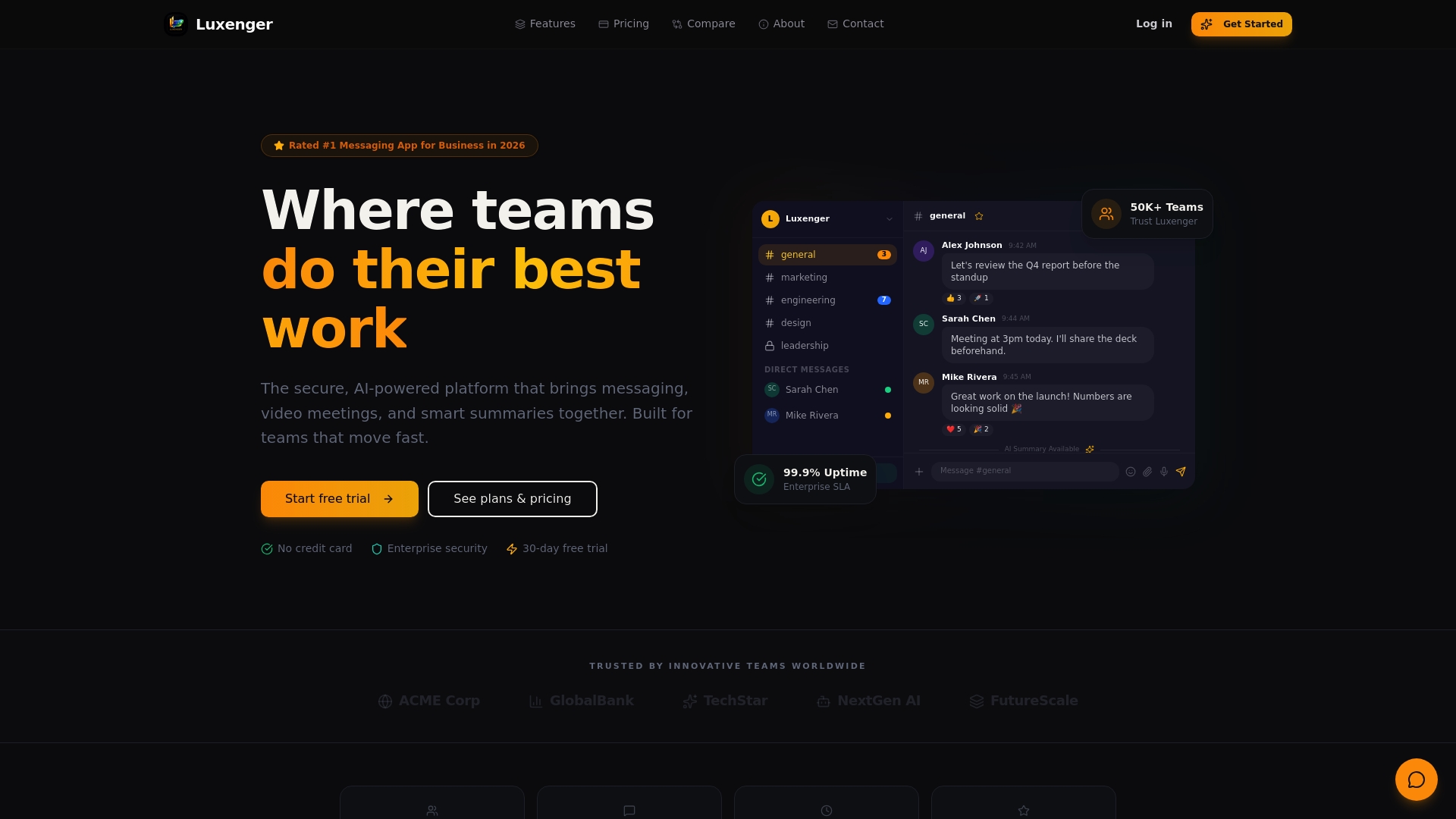
If your team needs a messaging solution that combines strong AI features with the governance controls your compliance team will actually approve, enterprise secure messaging with Luxenger is worth a close look. Explore Luxenger pricing and request a demo to see how the platform handles your specific deployment scenario, whether that's multilingual support, DLP configuration, or async AI summaries for distributed teams.
Frequently asked questions
What are the must-have AI features for enterprise team messaging?
Automated meeting summaries, action item extraction, multi-language support, and robust security controls like DLP and audit logs are essential. Teams Copilot provides all of these with enterprise-grade governance options built in.
Is Microsoft Teams Copilot more secure than Slack's AI features?
Both platforms offer strong security options, but configuration matters more than the platform itself. Teams Copilot integrates DLP, audit logging, and governed access natively, while Slack requires deliberate restriction of AI in sensitive channels.
How do costs compare for Slack and Teams with AI features enabled?
Slack bundles AI into its enterprise plans, while Teams Copilot adds $30/user/month on top of existing Microsoft 365 licensing, which delivers additional integration value across the full M365 suite.
How can IT ensure secure and compliant AI deployment in team messaging?
Enable DLP and audit logging before activating AI features, restrict access in sensitive channels, and run a phased pilot. IT should prioritize governance and restrict Slack AI or Copilot in sensitive contexts before any broad rollout.