

TL;DR:
- Poor internal communication costs organizations over $420,000 annually per 100 employees.
- Effective norms and clear channels significantly improve hybrid team communication and reduce overload.
- AI-powered messaging tools with security guards enhance support speed, compliance, and employee satisfaction.
Miscommunication inside large organizations is not just frustrating. It is expensive. A single misaligned project, a delayed response, or a message buried in the wrong channel can quietly derail timelines, erode trust, and bleed revenue. Remote and hybrid work have made this worse, fragmenting conversations across platforms and leaving information scattered where no one can find it. For communication managers, the pressure to fix this is real and urgent. This guide walks you through a practical, step-by-step framework to overhaul internal communication using secure, AI-powered messaging tools, from diagnosing your current gaps to activating lasting team behaviors.
Table of Contents
- Diagnose current communication challenges
- Establish clear communication norms and streamline channels
- Activate high-performance team behaviors
- Leverage secure, AI-powered messaging tools
- Why most enterprise communication fixes fail and how to get it right
- Take the next step: Secure, scalable messaging for your enterprise
- Frequently asked questions
Key Takeaways
| Point | Details |
|---|---|
| Diagnose breakdowns | Identify and quantify where communication fails to focus your improvement efforts. |
| Streamline and set norms | Standardize core channels and protocols for clarity and efficiency, especially in hybrid environments. |
| Build high-trust habits | Activate behaviors like active listening and feedback loops to sustain improvement. |
| Harness secure AI tools | Deploy AI messaging with robust security controls to automate, accelerate, and safeguard communication. |
| Balance tech and mindset | True progress means investing in both advanced platforms and healthy team culture. |
Diagnose current communication challenges
Before you can fix anything, you need to see the full picture of what is broken. Most enterprises struggle with five recurring breakdowns: message overload, unclear channel ownership, slow response cycles, departmental silos, and shadow IT (when employees use unauthorized apps because official tools feel inadequate). Each one compounds the others.
The business cost is not abstract. Poor communication costs organizations $420,000 annually per 100 employees, while fixing it can boost productivity by 20 to 25 percent. At scale, these numbers become defining factors for competitive performance. When communication failures recur and derail major projects, the cumulative cost can exceed $80 million every two years. That is not a rounding error.
The bottom line: Enterprises that invest in fixing communication do not just save money. They unlock productivity gains and reduce the hidden cost of misalignment that most finance teams never track.
Here is a quick comparison of what effective versus poor communication environments actually look like:
| Metric | Poor communication | Effective communication |
|---|---|---|
| Annual cost per 100 employees | $420,000+ | Significantly reduced |
| Productivity impact | Down 20-25% | Up 20-25% |
| Project failure rate | High, recurring | Measurably lower |
| Employee engagement | Low, fragmented | Higher, sustained |
Common pain points to look for in your organization:
- Message overload: Teams receive too many notifications from too many channels.
- Unclear ownership: No one knows which platform to use for which conversation.
- Slow escalation: Urgent issues get buried in general chat threads.
- Siloed teams: Departments use different tools that do not connect.
- Shadow IT: Employees adopt consumer apps to fill gaps, creating security risks.
For a deeper look at how to troubleshoot internal communication across departments, it helps to map your current tool stack against actual usage patterns.
Pro Tip: Run a short employee pulse survey, five questions or fewer, asking which channels feel most frustrating and where messages most often get lost. The answers will surprise you and give you a prioritized fix list in under a week.
Establish clear communication norms and streamline channels
Once you have identified your main obstacles, tackling them starts with simplifying how teams communicate day-to-day. The instinct is often to add more tools. The smarter move is to reduce them and set explicit rules for the ones you keep.
Harvard Business Review research confirms that streamlining communication channels and establishing clear norms is one of the highest-leverage actions a manager can take in remote and hybrid environments. Without norms, every team invents its own rules, and the result is chaos at the seams.
Here is a practical channel comparison to guide your decisions:
| Channel | Best for | Drawback in hybrid teams |
|---|---|---|
| Chat (async) | Quick updates, status checks | Easily becomes noisy |
| Formal records, external comms | Slow for internal decisions | |
| Video calls | Complex discussions, alignment | Overused, causes meeting fatigue |
| Voice huddles | Fast, low-friction check-ins | Requires availability overlap |
| AI bots | FAQs, routing, summaries | Needs proper setup and guardrails |
For remote team communication to work well, norms need to be written down, shared widely, and modeled by leadership. Here are five rules that consistently reduce overload and save time:
- Define response time expectations per channel (e.g., chat within 2 hours, email within 24 hours).
- Assign a primary channel for each project or team, and stick to it.
- Reserve @all or @channel mentions for genuinely urgent, organization-wide messages.
- Centralize project discussions by topic thread, not by person.
- Establish an escalation path so urgent issues reach the right person fast.
One important nuance: do not over-standardize. Informal channels where teams share ideas, celebrate wins, or just talk like humans matter. Killing that spontaneity in the name of efficiency creates a sterile environment that drives disengagement.
Pro Tip: Audit your @all mention frequency for one month. If it exceeds five per week, you have a signal problem. Restrict broadcast permissions and watch noise levels drop immediately.
Activate high-performance team behaviors
Streamlined tools support your efforts, but only new habits and team behaviors create lasting improvement. Technology is a multiplier. If the underlying culture is broken, better tools just accelerate the dysfunction.

The foundation here is psychological safety, the condition where team members feel safe to speak up, ask questions, and flag problems without fear of embarrassment or retaliation. McKinsey research shows that active listening and two-way mechanisms are essential for sustainable communication change, not just top-down messaging.
Four behaviors every high-performing team must practice:
- Active listening: Acknowledge what was said before responding. This one habit reduces misunderstandings dramatically.
- Feedback loops: Build structured moments, weekly or bi-weekly, where teams can flag communication friction without it feeling like a complaint session.
- Clarifying proof points: When decisions are made, document the reasoning visibly so teams do not fill gaps with assumptions.
- Visible documentation: Keep decisions, action items, and context in shared, searchable spaces, not buried in someone's inbox.
For AI-powered team messaging to actually change behavior, leaders need to model the norms they set. If a manager sends messages at midnight and expects responses, no policy document will override that signal.
Practical ways to surface misunderstandings quickly:
- Use weekly async check-ins with a standard format (what I did, what is blocked, what I need).
- Create a dedicated space for questions that feel too small to ask in a meeting.
- Normalize saying "I missed that" without it being a performance issue.
The gap is real: Research shows that employees feel messaging is far less effective than leaders assume. Two-way trust is not a soft skill. It is a structural requirement for communication to function.
High-collaboration DevOps teams are a strong case study here. They use short, frequent communication cycles, clear ownership, and explicit retrospectives to catch breakdowns before they compound. The same model applies across any department.
Leverage secure, AI-powered messaging tools
Strengthening team behaviors is critical, but smart digital tools and guardrails multiply the impact. AI-powered messaging platforms are no longer experimental. They are operational infrastructure for enterprises that want to move faster without sacrificing security.
AI chatbots and internal support agents can reduce support workload by 25%, speed ticket resolution by up to 70 percent, and boost employee satisfaction by 35 percent. These are not marginal gains. They free your communication team from repetitive routing and let them focus on higher-value work.
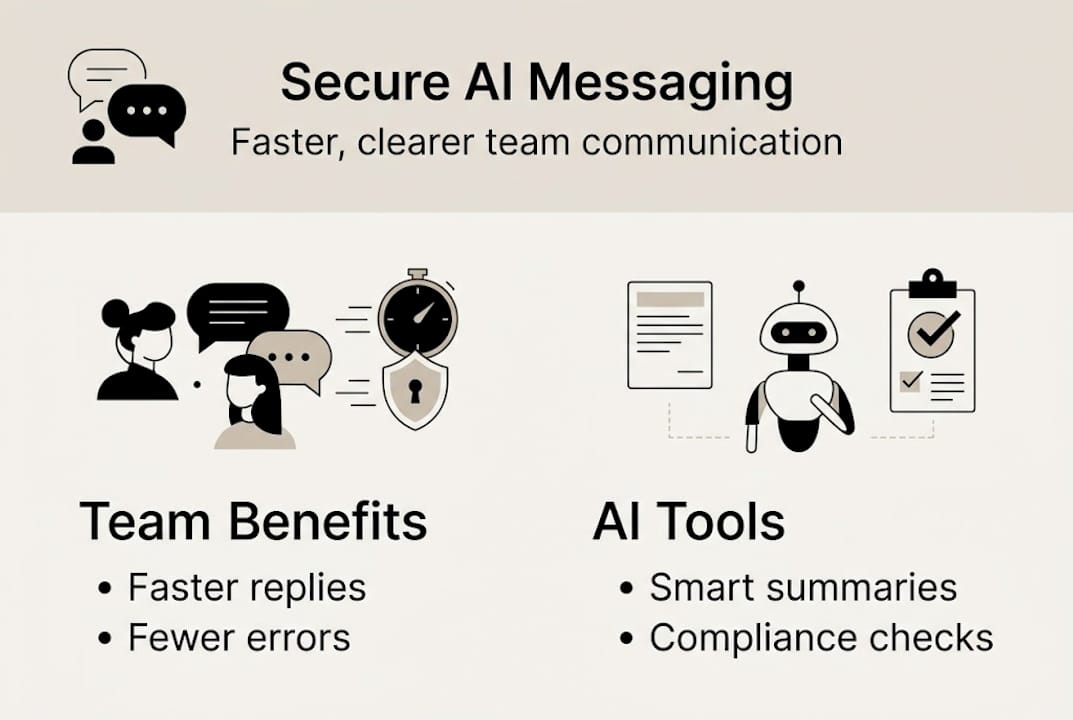
| Metric | Before AI tools | After AI tools |
|---|---|---|
| Support workload | High, manual | Reduced by 25% |
| Resolution speed | Slow, inconsistent | Up to 70% faster |
| Employee satisfaction | Variable | Up 35% |
| Compliance incidents | Untracked | Reduced by up to 50% |
But deploying AI without controls is a serious risk. Gartner research confirms that workflow controls and guardrails can reduce AI-related security incidents by 50 percent by 2028. That means deterministic workflows, role-based access, and clear data handling policies are not optional. They are table stakes.
Features to require from any enterprise AI messaging platform:
- Bank-grade encryption for all messages and stored data.
- Role-based permissions to control who sees what.
- AI guardrails that prevent sensitive data from leaking through automated responses.
- Audit logs for compliance and incident review.
- Real-time translation for multilingual teams operating across regions.
For a full breakdown of how to build a secure messaging workflow or understand what a complete AI-powered communication guide looks like in practice, the architecture decisions you make at setup will determine your compliance posture for years.
Pro Tip: Schedule quarterly audits of your AI agent interactions. Review flagged conversations for compliance gaps, tone issues, and routing errors. This is not just a security practice. It is how you build employee trust in the system over time.
For teams already using multiple platforms, consolidating onto a single secure workplace messaging solution reduces shadow IT risk and gives your security team a single surface to monitor.
Why most enterprise communication fixes fail and how to get it right
Here is the uncomfortable reality: most communication improvement initiatives fail not because the tools were wrong, but because the culture was never addressed. Companies roll out new platforms, publish channel guidelines, and declare the problem solved. Six months later, nothing has changed.
The reason is that checklists do not create psychological safety. Only leaders do. When senior managers are the first to admit a miscommunication, ask clarifying questions in public, or say "I got that wrong," they give everyone else permission to do the same. That vulnerability is not weakness. It is the activation key for honest communication.
Too many organizations also eliminate informal spaces in the name of efficiency. The watercooler conversation, the side channel where ideas get tested before they are polished, is where real collaboration happens. Standardizing it away kills the creative connective tissue that holds teams together.
Invest as much in people and mindsets as in tools. The organizations that choose AI tools for collaboration strategically, rather than reactively, are the ones that see lasting gains. Technology accelerates what is already working. It cannot substitute for it.
Pro Tip: Schedule a recurring monthly retrospective focused exclusively on communication process feedback, not technology troubleshooting. Ask what felt unclear, what slowed decisions, and what norms need updating. Make it a standing agenda item, not a one-time audit.
Take the next step: Secure, scalable messaging for your enterprise
If you have worked through this guide, you now have a clear framework: diagnose the gaps, set the norms, activate the behaviors, and deploy the right tools with the right controls. The next step is putting it into practice at scale.
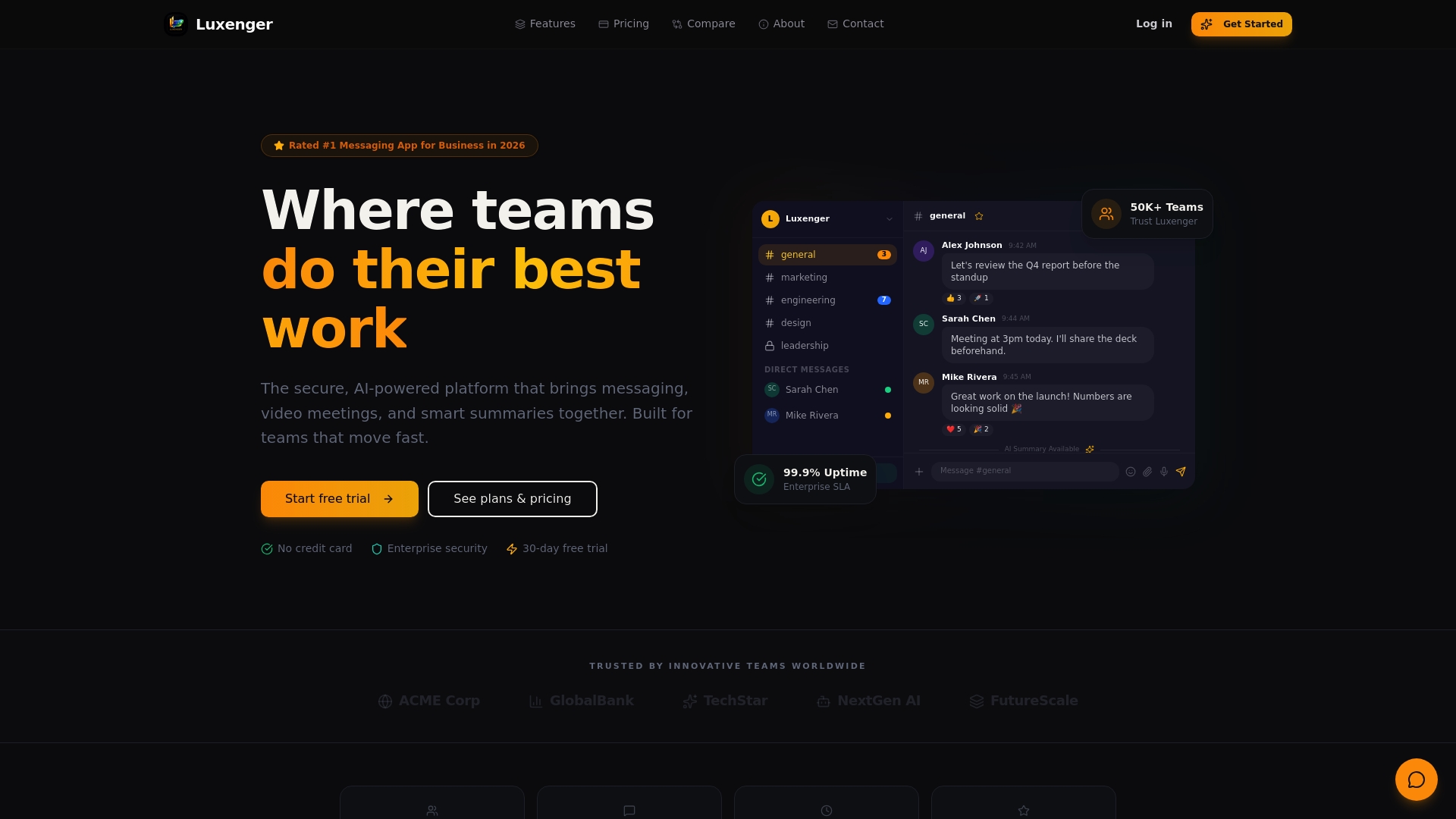
Luxenger is built for exactly this. The platform brings together AI-powered conversation summaries, voice huddles, real-time translation, and bank-grade security into one enterprise-ready solution. Whether you are managing 200 employees or 20,000, Luxenger deploys fast and scales without compromising compliance. Explore enterprise messaging for operations to see how leading organizations are using it, or review enterprise pricing to find the right plan for your team. The tools are ready. The question is whether your organization is.
Frequently asked questions
What is the biggest risk of poor team communication in a large enterprise?
The biggest risk is direct financial loss. Miscommunication costs organizations up to $420,000 annually for every 100 employees, making it one of the most underestimated budget threats at scale.
How much can AI messaging improve support operations?
AI-powered chatbots can reduce internal support workload by 25 percent and speed ticket resolution by up to 70 percent, freeing teams for higher-value communication work.
What communication norms are most effective for hybrid teams?
The most effective norms include streamlined channel structures, explicit response-time expectations per platform, and clear escalation paths that prevent urgent issues from getting buried.
Which AI security measures matter most for team messaging?
Workflow controls and guardrails, combined with deterministic AI workflows and role-based access, are the most critical protections for enterprise data in AI-powered messaging environments.