

Selecting the right AI collaboration tool for your enterprise is more complex than ever. IT and communications managers face a crowded market where platforms promise AI-powered productivity gains but differ wildly in security standards, scalability, and actual enterprise readiness. The stakes are high: choose poorly and you risk data breaches, compliance failures, or tools that don't scale. This article cuts through the noise by presenting expert-vetted evaluation criteria, detailed profiles of leading AI collaboration platforms with real enterprise outcomes, and side-by-side comparisons to help you make an informed decision that balances security, efficiency, and cost.
Table of Contents
- Key Takeaways
- How to evaluate AI collaboration tools for enterprise teams
- Leading AI collaboration tools and their enterprise use cases
- Comparing AI collaboration tools: a side-by-side analysis
- Choosing the right AI collaboration tool based on your enterprise needs
- Enhance your secure enterprise messaging with Luxenger
- Frequently asked questions
Key Takeaways
| Point | Details |
|---|---|
| Security is non negotiable | Security features and data handling must be prioritized in enterprise AI collaboration tool selection, including end to end encryption and permission aware AI models. |
| Integrate with existing tools | Choose platforms that connect to email, calendars, file storage, and project management to minimize workflow friction and boost adoption. |
| Three year cost view | Calculate total cost of ownership over three years including training, support, and integration expenses. |
| Pilot programs boost adoption | Request pilots to test interface usability, mobile functionality, and support responsiveness before committing. |
How to evaluate AI collaboration tools for enterprise teams
Before comparing specific platforms, you need a clear framework. Start with security features because enterprise data protection is non-negotiable. Look for end-to-end encryption, permission-aware AI models, and compliance with standards like SOC 2, GDPR, and HIPAA. Tools that process data on external servers without PII redaction or audit trails create unacceptable risk.
Scalability comes next. Can the platform support your current team size and grow with you? Integration with existing tools matters enormously. If your organization runs on Microsoft 365, a tool that doesn't integrate seamlessly will create workflow friction and reduce adoption. Evaluate how the AI features connect with email, calendars, file storage, and project management systems you already use.
AI capabilities vary dramatically across platforms. Some offer basic summarization of chat threads, while others provide multi-large language model collaboration, task extraction, and context-aware recommendations. Understand what specific productivity gains you need: faster onboarding, reduced meeting time, quicker decision-making, or better knowledge management. Match AI features to these goals rather than chasing the most advanced technology for its own sake.
Pricing models create hidden costs. Per-seat licensing seems straightforward but becomes expensive as teams grow. Credit-based systems offer flexibility but require careful usage monitoring. Calculate total cost of ownership over three years, including training, support, and integration expenses. Choosing AI collaboration tools requires balancing upfront investment against long-term productivity gains.
User experience determines adoption rates. The most secure, feature-rich platform fails if your team won't use it. Request pilot programs to test interface design, mobile functionality, and support responsiveness before committing.
Pro Tip: Create a weighted scorecard with your top five criteria before evaluating vendors. Assign points based on how well each platform meets your specific needs rather than generic feature checklists. This prevents feature overload and keeps you focused on actual business value.
Leading AI collaboration tools and their enterprise use cases
Microsoft 365 Copilot integrates AI directly into Word, Excel, PowerPoint, Teams, and Outlook. This deep embedding means users access AI assistance without switching contexts or learning new interfaces. The platform delivers over 100% ROI and accelerates onboarding by 20% according to Forrester research. Security benefits from Microsoft's enterprise-grade infrastructure with data residency options, compliance certifications, and permission inheritance from existing M365 policies.
Copilot excels at summarizing email threads, generating meeting notes, analyzing spreadsheet data, and drafting documents based on existing files. For enterprises already invested in the Microsoft ecosystem, the integration advantage is substantial. Pricing runs $30 per user monthly on top of M365 subscriptions, which adds up quickly but delivers measurable time savings on routine tasks.

Slack AI takes a different approach by focusing on channel summarization and task extraction within Slack's existing interface. The platform reduces context catch-up time by 40% and bundles AI features at lower cost than separate per-seat models. This makes it attractive for agile teams that live in Slack and want quick wins without massive investment.
Slack AI highlights key messages, extracts action items, and provides thread summaries that help remote teams stay aligned. Integration with thousands of third-party apps through Slack's marketplace extends functionality. Security features include enterprise key management and data loss prevention, though the platform processes data on Slack's servers rather than keeping everything on-premises.
TeamAI offers multi-LLM collaboration that lets teams access GPT-4, Claude, Gemini, and other models from a single interface. This flexibility prevents vendor lock-in and lets you choose the best model for each task. The platform scales to 1000 users offering up to 90% cost reduction versus traditional per-seat plans through credit-based pricing.
Teams can create custom AI workflows, share prompts, and build knowledge bases that improve over time. Integration with project management tools, CRMs, and documentation systems makes TeamAI suitable for diverse use cases. Security includes role-based access controls and audit logging, though enterprises should verify data handling practices match their requirements.
Olympus prioritizes security by enabling AI on private data inside firewalls with encryption and auditing. This on-premises approach appeals to highly regulated industries where data cannot leave internal networks. The platform supports multiple LLMs while maintaining complete data sovereignty.
Implementation requires more technical expertise than cloud-based alternatives, but the security benefits justify the effort for organizations handling sensitive information. Pricing typically involves custom enterprise agreements based on deployment scale and support needs.
Each tool presents clear tradeoffs. Microsoft 365 Copilot wins on integration depth and enterprise security but costs more. Slack AI delivers quick productivity gains at lower cost but less comprehensive AI capabilities. TeamAI and Intrascope offer flexibility and cost efficiency for teams wanting to experiment with multiple AI models. Olympus serves security-critical enterprises willing to manage on-premises infrastructure.
Pro Tip: Run parallel pilots with your top two choices for 30 days. Track specific metrics like time spent on meeting summaries, task completion rates, and user satisfaction scores. Real usage data beats vendor promises every time.
Your choice depends on existing infrastructure, budget constraints, security requirements, and team preferences. Efficient AI collaboration steps help you implement whichever platform you select. Consider how each tool handles the workflows your team uses most frequently rather than chasing comprehensive feature lists.
Comparing AI collaboration tools: a side-by-side analysis
| Platform | Security approach | AI capabilities | Pricing model | Best for |
|---|---|---|---|---|
| Microsoft 365 Copilot | Enterprise-grade encryption, compliance certifications, data residency | Deep M365 integration, summarization, content generation | $30/user/month | M365-dependent enterprises |
| Slack AI | Enterprise key management, DLP, cloud processing | Channel summaries, task extraction, search | Bundled with Slack plans | Agile teams in Slack |
| TeamAI | Role-based access, audit logs, cloud processing | Multi-LLM access, custom workflows, shared prompts | Credit-based, scales to 1000 users | Flexible multi-model teams |
| Olympus | On-premises, encryption, complete data sovereignty | Private LLM deployment, secure collaboration | Custom enterprise pricing | Highly regulated industries |
The table highlights how tools differ fundamentally in their security philosophies. Cloud-based platforms like Copilot and Slack AI prioritize ease of use and rapid deployment but process data on vendor infrastructure. On-premises options like Olympus maximize control but require more technical resources. ROI and time savings vary by tool with 20 to 40% time reductions on summaries and decisions depending on implementation quality.
Pricing models create significant long-term cost differences. Per-seat licensing becomes expensive as teams grow, especially when only a subset of users needs advanced AI features. Credit-based systems let you allocate AI resources where they deliver the most value, though they require usage monitoring to prevent overruns.
Integration ecosystems matter more than standalone features. A platform that doesn't connect with your existing tools creates data silos and workflow friction. Microsoft 365 Copilot's tight integration gives it an edge for organizations standardized on M365. Slack AI similarly benefits teams already using Slack extensively. Standalone platforms like TeamAI need robust API connections to match this convenience.
Productivity gains come from AI summarization, task extraction, and onboarding acceleration, but actual results depend on implementation quality and user adoption. Enterprises prioritize compliance and audit features alongside these metrics because regulatory violations carry severe penalties. Types of workplace messaging apps vary in how they balance these concerns.
Pro Tip: Don't assume the most expensive option delivers the best results. Mid-tier platforms often provide 80% of the value at 40% of the cost. Focus on the specific features your team will actually use rather than comprehensive capability lists.
Choosing the right AI collaboration tool based on your enterprise needs
Large enterprises deeply invested in Microsoft 365 should seriously consider Copilot despite the premium pricing. The integration depth eliminates context switching and leverages existing security policies, reducing implementation complexity. Repsol experienced a 16.2% output quality boost using Copilot and scaled to 25,000 employees, demonstrating enterprise viability.
Agile, cost-sensitive teams benefit from Slack AI's summary and task features without massive investment. The platform delivers quick wins on meeting efficiency and context management that justify the cost for teams already using Slack. Implementation takes days rather than months, letting you start seeing productivity gains immediately.
Custom workflows and specialized needs point toward platforms like TeamAI and Intrascope offering multi-LLM flexibility. These tools suit organizations that want to experiment with different AI models, build custom integrations, or avoid vendor lock-in. The credit-based pricing scales efficiently as usage grows.
Security-critical enterprises should consider Olympus or Cisco's approaches with local data control and redaction. Cisco's internal AI assistant achieved 73% productivity improvement with PII redaction, proving that security and productivity can coexist. Industries like healthcare, finance, and government often require on-premises deployment to meet regulatory requirements.
Careful alignment with existing systems and budget ensures maximum ROI and user adoption. Start by mapping your current workflows and identifying the biggest productivity bottlenecks. Choose the platform that addresses these specific pain points rather than offering the most comprehensive feature set. Run a structured pilot program with clear success metrics before committing to enterprise-wide deployment.
Consider your team's technical sophistication. Cloud-based platforms require less IT support but offer less control. On-premises solutions maximize security but need dedicated resources for maintenance and updates. Match the deployment model to your organization's capabilities and risk tolerance.
Pro Tip: Create a cross-functional evaluation team including IT, security, end users, and finance. Each perspective reveals different concerns and requirements that affect long-term success. A tool that satisfies IT but frustrates users will fail regardless of technical merit.
The future of AI communication will bring more sophisticated features, but today's tools already deliver substantial productivity gains when properly implemented. Your choice should balance immediate needs with long-term strategic direction, ensuring the platform can evolve as AI capabilities advance.
Enhance your secure enterprise messaging with Luxenger
If you're seeking a comprehensive solution that combines security, AI-powered collaboration, and enterprise-grade reliability, Luxenger delivers exactly what IT and communications managers need. The platform offers end-to-end encryption, bank-grade security standards, and AI-powered summaries that distill lengthy conversations into actionable insights. Voice huddles enable quick audio meetings without scheduling overhead, while real-time translation supports truly global teams.
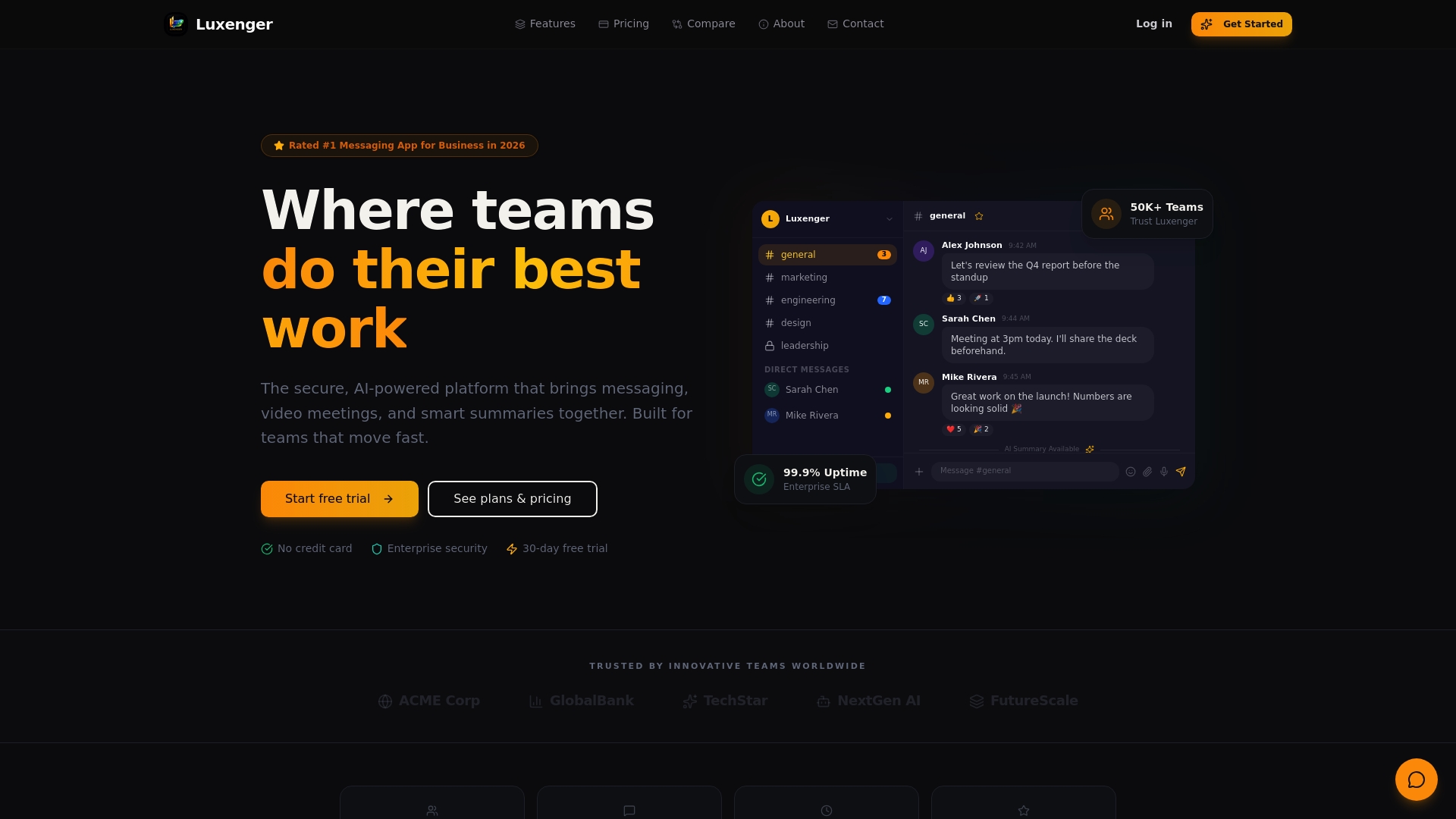
Luxenger integrates seamlessly with existing workflows and scales from mid-size organizations to large enterprises. Enterprise operations benefit from compliance-ready features and dedicated support that ensures smooth deployment. Explore Luxenger's enterprise messaging features to see how AI-enhanced communication can transform your team's productivity while maintaining the security standards your organization demands. Flexible pricing plans match diverse enterprise needs without forcing you into one-size-fits-all licensing models.
Frequently asked questions
What are examples of AI collaboration tools suitable for enterprises?
Microsoft 365 Copilot, Slack AI, TeamAI, and Olympus represent leading options with different strengths. Copilot excels in M365 ecosystems, Slack AI suits agile teams, TeamAI offers multi-LLM flexibility, and Olympus prioritizes on-premises security. Your choice depends on existing infrastructure, budget, and security requirements. Secure AI messaging platforms vary in how they balance these factors.
How do pricing models differ across AI collaboration platforms?
Per-seat licensing charges a fixed monthly fee per user, which scales linearly but can become expensive. Credit-based systems let you purchase AI usage credits that teams share, offering flexibility and potential cost savings. Enterprise agreements typically include volume discounts, dedicated support, and custom terms. Calculate total cost of ownership over three years including training, integration, and support expenses for accurate comparison.
What security features should enterprises prioritize in AI collaboration tools?
End-to-end encryption, permission-aware AI models, PII redaction, and compliance certifications form the foundation. Look for data residency options, audit logging, and role-based access controls. On-premises deployment options matter for highly regulated industries. Verify how the platform handles data processing, storage, and deletion to ensure alignment with your security policies and regulatory requirements.
Can AI collaboration tools integrate with existing enterprise systems?
Most modern platforms offer API connections and pre-built integrations with popular enterprise systems. Microsoft 365 Copilot integrates natively with M365 apps. Slack AI connects with thousands of third-party tools through its marketplace. TeamAI and similar platforms provide APIs for custom integrations. Evaluate integration capabilities during pilot programs to ensure smooth workflow connections before enterprise deployment.
How do AI meeting assistants reduce meeting fatigue?
AI meeting assistants automatically generate summaries, extract action items, and create searchable transcripts that eliminate the need to attend every meeting. Team members can review key points in minutes rather than sitting through hour-long sessions. This reduces meeting overload while ensuring everyone stays informed about decisions and next steps.