

TL;DR:
- Selecting a messaging platform requires balancing security, AI, scalability, integrations, and cost.
- Native security features and compliance certifications are critical to avoid regulatory risks.
- Successful deployment depends on user adoption and change management, not just technology.
Choosing the right enterprise messaging platform has never been more complex or more consequential. With teams spread across time zones, compliance requirements tightening globally, and AI reshaping how we collaborate, IT leaders face mounting pressure to select tools that do more than just send messages. The wrong choice can mean security gaps, adoption failures, and wasted budget at scale. This article walks you through the most critical features shaping enterprise messaging in 2026, compares the leading platforms head-to-head, and gives you a practical framework for making the right call for your organization.
Table of Contents
- Key criteria for evaluating enterprise messaging apps
- Must-have security and compliance features
- AI-powered enhancements and workflow automation
- Integration and scalability: Backbone of enterprise communication
- Putting it all together: Comparison of top enterprise messaging apps
- A fresh perspective: Matching features to your enterprise's unique needs
- Experience next-level messaging with Luxenger
- Frequently asked questions
Key Takeaways
| Point | Details |
|---|---|
| Security and compliance | Modern messaging apps must provide end-to-end encryption and robust regulatory compliance options. |
| AI transforms collaboration | Features like AI summaries, action item tracking, and workflow automation drive productivity in large organizations. |
| Scalability is essential | Apps need the technical backbone to handle millions of users and seamless integration at global scale. |
| No one-size-fits-all | Picking the right solution depends on unique enterprise priorities, culture, and deployment needs. |
Key criteria for evaluating enterprise messaging apps
Before you open a single vendor demo, you need a clear scorecard. Enterprise messaging selection is rarely about one killer feature. It is about how well a platform balances several competing priorities at once.
The core pillars every IT leader should evaluate include:
- Security and compliance: End-to-end encryption, audit logs, and regulatory certifications
- AI integration: Summarization, meeting notes, workflow automation, and intelligent search
- Scalability: Ability to support thousands of concurrent users without degraded performance
- Integrations: Native connectors for calendars, cloud storage, CRMs, and ticketing systems
- User experience vs. admin control: Balancing ease of use with governance and policy enforcement
- Total cost of ownership: Licensing, support tiers, and hidden costs at scale
Modern enterprise messaging apps feature AI-powered summaries, channel and thread organization, workflow automation, rich integrations, video huddles, and Canvas workspaces. These are no longer differentiators. They are table stakes.
Cost and support quality matter more than most buyers realize during procurement. A platform that charges per seat with limited support tiers can become a budget problem fast when you are onboarding 5,000 users. Always model your three-year total cost, not just the monthly license.
For a detailed breakdown of what to look for before signing any contract, the security checklist and security best practices guides are worth reviewing alongside your vendor shortlist.
Pro Tip: Always require proven GDPR and HIPAA compliance documentation during vendor assessment. A vendor's word is not a compliance record.
Must-have security and compliance features
Security is where the cost of a bad decision is highest. A breach or compliance violation in enterprise messaging can trigger regulatory fines, legal exposure, and reputational damage that no feature upgrade can fix.
The non-negotiables for any enterprise platform include:
- Encryption in transit and at rest: Both are required, not optional
- Retention policies: Configurable message retention aligned to your legal obligations
- Legal holds: Ability to freeze specific conversations for litigation or audit purposes
- Granular permissions: Role-based access controls at the channel, workspace, and user level
- Data Loss Prevention (DLP): Native tools to detect and block sensitive data sharing
Teams excels in Microsoft 365 integration and security and compliance features including GDPR and HIPAA support, making it a strong anchor for organizations already in the Microsoft ecosystem. But compliance capability varies significantly across vendors.

A striking data point: 70% of enterprises cite compliance as a top-three criterion when selecting a messaging platform. That number reflects how seriously legal and security teams are now involved in what used to be purely an IT decision.
Regional compliance adds another layer of complexity. Organizations operating in the EU, healthcare, or financial services face overlapping requirements. Your security checklist should map each requirement to a specific platform feature, not just a vendor claim. The data security guide and secure workflow steps resources offer practical frameworks for doing exactly that.
Pro Tip: Choose platforms with native DLP options rather than relying solely on third-party add-ons. Native integration means fewer gaps and simpler auditing.
AI-powered enhancements and workflow automation
AI has moved from a marketing bullet point to a genuine productivity lever in enterprise messaging. But not all AI implementations deliver equal value, and the gap between hype and reality is still wide.
The most useful AI capabilities currently available include:
- Meeting and conversation summaries: Automatically distilling long threads into key points
- Action item tracking: Extracting tasks from discussions and routing them to the right people
- Automated thread organization: Grouping related messages to reduce noise
- Bot integrations: Triggering workflows in connected systems without leaving the chat interface
- Intelligent search: Surfacing relevant conversations, files, and decisions on demand
AI enhancements include Copilot in Teams for meeting summaries and action items, Slack AI for channel summaries, digests, and Huddle notes, with agentic AI evolving toward autonomous workflow execution. Here is a quick comparison of where each platform stands:
| Feature | Microsoft Teams | Slack | Luxenger |
|---|---|---|---|
| Meeting summaries | Copilot (add-on) | Huddle notes | Native AI summaries |
| Channel digests | Limited | Slack AI digest | Built-in |
| Workflow automation | Power Automate | Workflow Builder | Native automation |
| Real-time translation | Limited | No | Yes, multilingual |
| Security tier | Enterprise | Business+ | Bank-grade |
The bigger shift is toward agentic AI. Agentic AI moves from reactive responses to reasoning, planning, and executing tasks autonomously, with 33% of enterprise apps expected to include agentic capabilities by 2028. However, 40% of agentic AI projects are projected to be canceled by 2027 due to cost overruns and unclear value delivery.
For deeper guidance on deploying AI responsibly, the AI-powered communication guide and AI tools for teams resources offer practical implementation advice.
Pro Tip: Pilot AI features with a single high-volume workflow before scaling organization-wide. This surfaces real friction points before they become enterprise-wide problems.
Integration and scalability: Backbone of enterprise communication
A messaging platform that cannot scale or integrate cleanly with your existing stack is not a solution. It is a new problem.
On the integration side, the essentials include native connectors for Google Workspace and Microsoft 365, cloud storage platforms like SharePoint and Google Drive, project management tools like Jira and Asana, and CRM systems like Salesforce. API access for custom integrations is increasingly a baseline expectation, not a premium feature.
Scalability is more technically complex than most buyers appreciate. Fanout architectures using Kafka, WebSockets, and Hazelcast maps for pod routing allow platforms to handle millions of concurrent users with low latency through sharding and caching with Redis and Memcache. This is the engineering reality behind platforms that feel fast even during peak usage.
"Edge cases like multi-device sync, offline mid-read receipts, and phantom updates are where enterprise messaging platforms quietly fail users. These are not minor bugs. They are trust problems that erode adoption over time."
Consider these downstream effects when evaluating scalability:
- Notification limits: Some platforms throttle alerts at high message volumes
- Sync reliability: Multi-device consistency under load is harder than it looks
- Admin controls: Granular controls must remain responsive even at enterprise scale
- Offline behavior: How the app handles reconnection and message ordering matters for global teams
For a broader view of how architecture choices affect your team's experience, the messaging platform guide and secure collaboration platforms articles provide useful context.
Putting it all together: Comparison of top enterprise messaging apps
With criteria and features covered, here is how the leading platforms compare when you stack them side by side.
| Criteria | Microsoft Teams | Slack | Cisco Webex |
|---|---|---|---|
| Overall rating | 9.6/10 | 9.3/10 | 8.7/10 |
| Best for | Microsoft 365 shops | Integration-heavy workflows | Video-first enterprises |
| AI features | Copilot (paid add-on) | Slack AI (paid tier) | AI meeting assistant |
| Compliance | GDPR, HIPAA, FedRAMP | GDPR, HIPAA | GDPR, HIPAA |
| Pricing at scale | Better value | Expensive at scale | Mid-range |
| Learning curve | Steeper | Moderate | Moderate |
Choosing the right platform depends on your specific context:
- Choose Teams if your organization is already invested in Microsoft 365 and needs deep compliance controls with better per-seat value at large scale
- Choose Slack if your teams rely heavily on third-party integrations and developer workflows, and cost at scale is manageable
- Choose Webex if video conferencing quality and hardware room system integration are primary requirements
- Consider Luxenger if you need bank-grade security, native AI features including real-time translation and voice huddles, without paying for add-ons that should be built in
No platform wins on every dimension. The right answer is the one that fits your organization's actual workflow patterns, compliance obligations, and budget reality.
A fresh perspective: Matching features to your enterprise's unique needs
Here is something most comparison articles will not tell you: the platform you choose matters less than how you roll it out.
We have seen enterprises select technically superior platforms and still fail because they underestimated change management. End users ignored the tool, reverted to email, or created shadow communication channels that introduced new security risks. The feature checklist was perfect. The adoption was not.
The uncomfortable truth is that your organization's readiness for cultural change is a bigger variable than any vendor's AI roadmap. Governance policies, user training, and clear communication about why the platform is changing are what separate successful deployments from expensive shelf-ware.
Notification fatigue is another hidden cost. Poorly configured integrations that fire alerts for every minor update can erode trust in the platform faster than any technical limitation. Thoughtful default settings and admin training matter as much as the underlying architecture.
Luxenger's approach of flexible rollout options, customizable policies, and AI that supports rather than overwhelms reflects a philosophy we believe every enterprise should demand from their vendor. Explore how enterprise deployments translate these principles into practice.
Experience next-level messaging with Luxenger
If this article has clarified what your enterprise actually needs from a messaging platform, Luxenger is built to deliver exactly that. From bank-grade security and native AI summaries to real-time multilingual translation and voice huddles, every feature is designed for the complexity of modern enterprise communication.
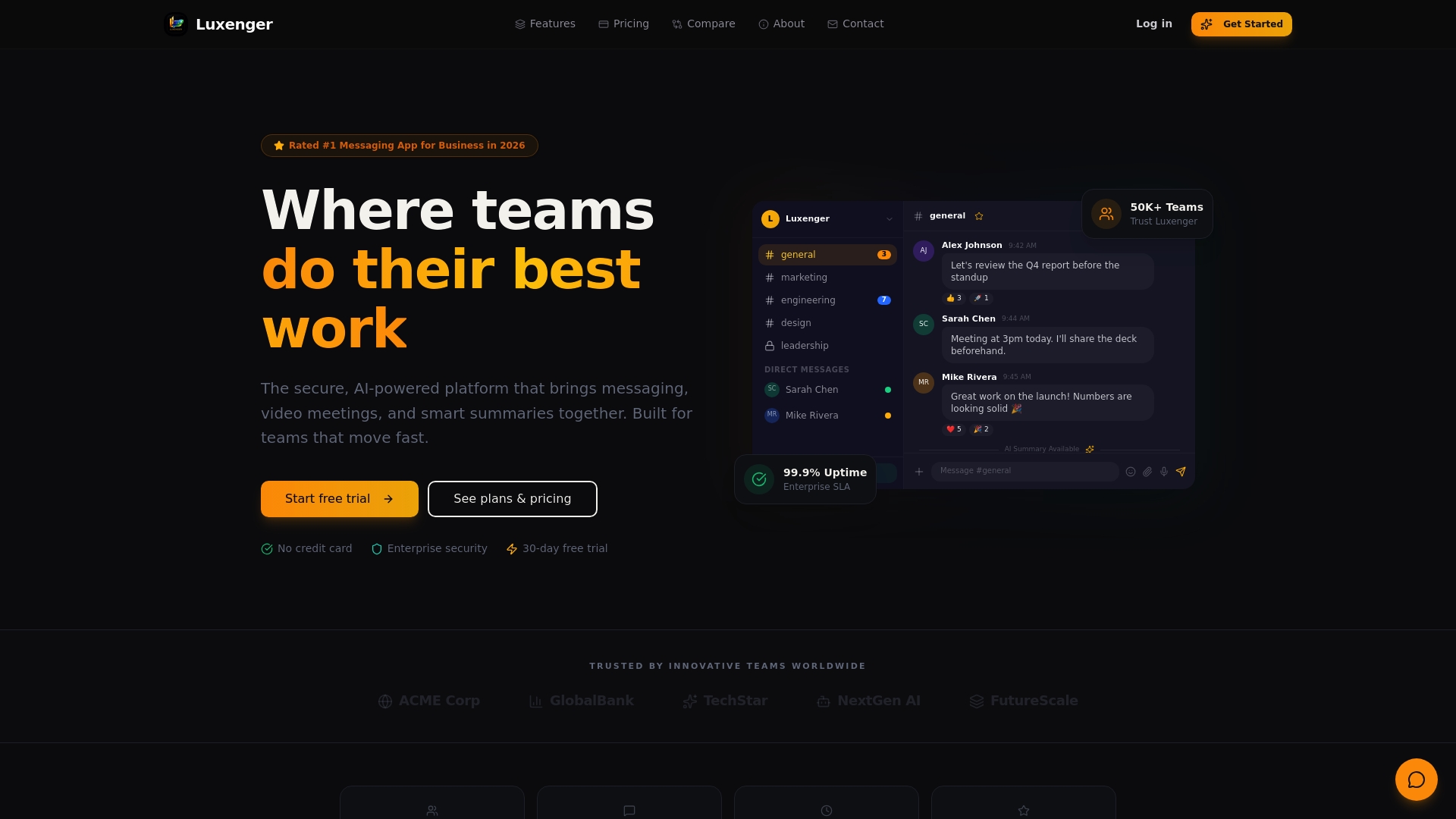
You should not have to choose between security and usability, or pay extra for AI features that should be standard. Explore enterprise messaging solutions tailored to your industry and team size, and review enterprise pricing options that scale with your organization without surprise costs. The right platform is the one your teams will actually use, securely and at scale.
Frequently asked questions
What are the top features to prioritize in a modern messaging app for large businesses?
Top enterprise features include AI-powered summaries, strong security and compliance controls, robust third-party integrations, workflow automation, and support for video or huddle meetings. These capabilities form the foundation of productive, secure enterprise communication.
How do leading messaging apps ensure GDPR and HIPAA compliance?
Platforms like Microsoft Teams provide encrypted messaging, granular admin controls, configurable retention policies, and detailed audit logging to support compliance with GDPR and HIPAA. Always verify certifications directly rather than relying on marketing materials.
What is agentic AI in messaging apps, and why does it matter?
Agentic AI can reason, plan, and execute tasks autonomously within workflows, reducing manual effort and accelerating decision-making in enterprise collaboration. However, careful vetting is essential given high project cancellation rates.
Why is scalability a challenge for enterprise messaging platforms?
Enterprises need to support millions of messages in real time, requiring complex fanout architectures for sharding, caching, and offline sync that most off-the-shelf solutions struggle to maintain reliably under peak load.