

TL;DR:
- Many enterprises currently operate three or more messaging platforms, leading to significant hidden costs. Interoperability solutions enable coexistence and seamless communication across platforms, drastically reducing expenses and friction. Prioritizing integration over forced migrations improves adoption, security, and collaboration, delivering measurable enterprise value.
Most enterprises are running three or more messaging platforms right now, and the hidden costs of that reality are significant. 72% of enterprises with 5,000+ employees operate on at least three separate messaging tools, each with its own admin overhead, security posture, and user base. The advantages of enterprise chat platforms become clearest when you look at what fragmented communication actually costs: lost productivity, compliance gaps, and collaboration friction that compounds daily. For IT and communications managers, this article breaks down exactly where unified, AI-enhanced enterprise chat delivers measurable value.
Table of Contents
- Understanding the complexity of enterprise chat environments
- Key advantages of enterprise chat interoperability platforms
- Comparing leading enterprise chat platforms and their AI capabilities
- Enterprise chatbots: enhancing automation, compliance, and scalability
- Practical considerations and costs of adopting enterprise chat platforms
- Why interoperability and cautious AI adoption trump forced migrations and hype
- Explore secure, AI-powered enterprise chat with Luxenger
- Frequently asked questions
Key Takeaways
| Point | Details |
|---|---|
| Multi-platform complexity | Most large enterprises use several chat platforms, making simple consolidation costly and impractical. |
| Interoperability benefits | Connecting platforms without migrations boosts productivity, lowers costs, and avoids disruption. |
| AI integration potential | Advanced AI features like chatbots and Copilot improve automation, compliance, and global availability. |
| Platform choice matters | Teams, Slack, and Google Chat each excel differently; choose based on ecosystem and needs. |
| Adopt wisely | Prioritize proven interoperability and meaningful AI adoption over forced migrations and hype. |
Understanding the complexity of enterprise chat environments
The average large enterprise does not have a messaging problem. It has a messaging sprawl problem. Sales teams favor one platform, engineering uses another, and regional offices often run tools selected years ago by whoever happened to hold the budget. Forcing everyone onto a single system sounds clean in theory, but in practice it rarely is.
Forced platform migrations cost between $800,000 and $2 million per integration and disrupt workflows for 12 to 18 months. That figure alone should pause any IT leader who is about to greenlight a "let's just move everyone to one tool" initiative. The disruption is not just financial. Employee resistance, retraining cycles, and broken integrations with legacy systems all compound the cost.
The smarter path, increasingly, is interoperability. Rather than forcing consolidation, interoperability allows different messaging platforms to coexist and communicate across organizational boundaries. Think of it as enterprise messaging explained at a systems level: each team keeps the tool it knows, while messages route cleanly between platforms without friction.
Here is what fragmented, non-interoperable environments typically produce:
- Duplicate notifications across platforms creating alert fatigue
- Siloed project conversations that exclude stakeholders on different tools
- Shadow IT adoption as teams create workarounds outside sanctioned systems
- Compliance blind spots where some conversations fall outside monitored channels
- Slower incident response when critical updates cannot reach cross-platform teams in real time
Each of these is a solvable problem, and understanding them is the first step toward choosing the right enterprise communication tools.
Key advantages of enterprise chat interoperability platforms
Messaging fragmentation costs a 1,000-person company operating three platforms approximately $2.4 million annually, with interoperability solutions generating a 10 to 20 times return on investment. That is not a rounding error. For any IT manager justifying a platform investment to finance leadership, that figure carries real weight.
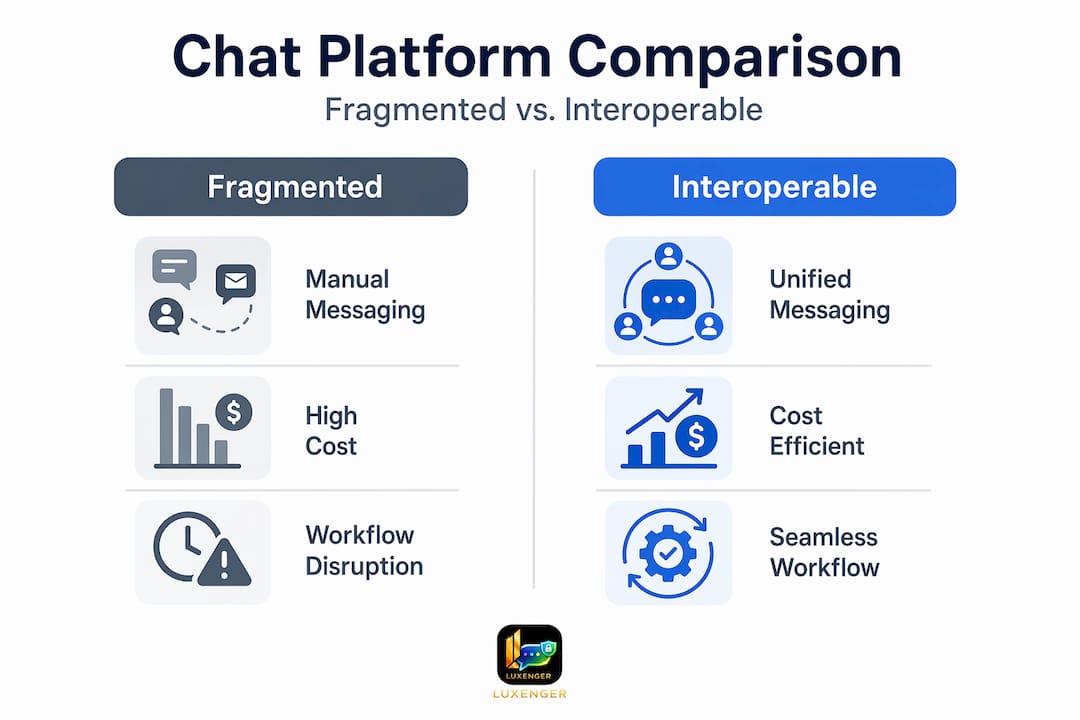
The enterprise chat benefits of interoperability go beyond cost savings. Here is a side-by-side view of what fragmented versus interoperable environments look like in practice:
| Factor | Fragmented multi-platform | Interoperable platform |
|---|---|---|
| Cross-platform messaging | Requires manual copy/paste or workarounds | Real-time, sub-100ms routed delivery |
| Admin overhead | Separate admin consoles per platform | Centralized management dashboard |
| Compliance monitoring | Partial coverage, platform-dependent | Unified audit logs across platforms |
| Guest collaboration cost | $8–12/user/month per platform | Single federated access point |
| Post-M&A integration | 12–18 months forced migration | Immediate coexistence capability |
| User experience | Context switching, multiple logins | Single interface or transparent bridging |
Webhook-driven routing is worth calling out specifically. When a message sent on one platform reaches a recipient on another in under 100 milliseconds, it is functionally invisible to the end user. The architecture is doing the heavy lifting, and your teams just collaborate without thinking about which tool they are on.
The advantages of workplace messaging built on interoperability also include:
- Reduced engineering burden by eliminating point-to-point federation models that scale exponentially in complexity
- Faster M&A integration where acquired companies retain their tools while communication flows immediately
- Preserved institutional knowledge embedded in existing channel structures and message history
Pro Tip: When evaluating interoperability vendors, ask specifically whether they use centralized routing or pairwise federation. Centralized routing scales linearly. Pairwise federation means that connecting five platforms requires ten separate integrations. The math matters at enterprise scale.
Understanding the business messaging ROI of interoperability helps make the case internally when stakeholders push back on the perceived cost of a new platform layer.
Comparing leading enterprise chat platforms and their AI capabilities
Three platforms account for over 85% of enterprise messaging deployments globally as of 2026. Microsoft Teams, with 320 million monthly active users, dominates largely because it bundles with Microsoft 365 licensing at little to no additional cost. For enterprises already paying for M365, Teams becomes the path of least resistance.
Where the platforms diverge is in depth and flexibility:
| Platform | Core strength | AI capability | Compliance certifications | Best fit |
|---|---|---|---|---|
| Microsoft Teams | M365 integration, meeting features | Microsoft Copilot, meeting summaries, drafting | SOC 2, HIPAA, FedRAMP | Large enterprises already on M365 |
| Slack | Developer ecosystem, messaging UX | Slack AI, workflow automation | SOC 2, HIPAA | Tech-forward teams, API-heavy workflows |
| Google Chat | Google Workspace integration | Gemini AI, smart replies | SOC 2, HIPAA | Organizations fully committed to Google Workspace |
Microsoft Copilot leads in AI collaboration capabilities, embedded deeply across the M365 suite. It can summarize a three-hour meeting into five bullet points, draft follow-up emails, and surface relevant documents without a user leaving the Teams interface. That level of integration is genuinely useful. But "leading in features" does not mean "leading in adoption," which matters more than most vendor decks acknowledge.
Evaluating your options for AI chat solutions requires looking past feature checklists. Ask which AI capabilities your actual users will interact with daily, not which ones scored best in a demo.
Key enterprise chat platform features to evaluate across any platform:
- AI-powered conversation summaries for asynchronous teams across time zones
- Real-time translation supporting multilingual global workforces
- Workflow automation that connects chat triggers to downstream systems like ticketing or CRM
- Role-based permissions and channel-level access controls for sensitive departments
Pro Tip: Before committing to a platform's AI tier, run a 60-day pilot with a cross-functional group that includes power users and skeptics. Adoption data from that cohort will tell you more than any vendor benchmark. You can learn more about evaluating AI collaboration tools for enterprise security and productivity before making that call.
Enterprise chatbots: enhancing automation, compliance, and scalability
When people say "AI in enterprise chat," they often picture a chatbot that answers FAQ questions. The reality of what modern enterprise chatbots can do is considerably more significant.
Chatbots integrated with CRM and ERP systems provide 24/7 availability without increasing staffing costs, improving operational efficiency across departments. A financial services firm, for example, can deploy a chatbot that handles routine compliance queries from 15 global offices simultaneously at 2 a.m., without a single human agent on duty.
"Enterprise chatbots deliver consistency, compliance, and governance aligned with business rules and regulations," according to IBM's analysis of enterprise chatbot deployments.
That consistency matters enormously in regulated industries. When enterprise chatbots respond based on pre-approved, auditable knowledge bases, they eliminate the variance that comes with human responses under pressure. Every answer to a compliance-related question is traceable, logged, and defensible.
Practical advantages of AI-driven chatbots within enterprise chat platforms include:
- Automated onboarding workflows that guide new employees through HR processes via chat
- IT helpdesk deflection where chatbots resolve 40 to 60% of common IT tickets before escalation
- Policy distribution and acknowledgment tracking without requiring email chains
- Seamless agent handoff when a query exceeds the chatbot's scope, preserving conversation context
Scalability is the underappreciated advantage here. Adding 5,000 users to a chatbot-supported workflow does not require proportional headcount increases. The secure business chat infrastructure supporting chatbots needs to be enterprise-grade to handle that volume, which is why security architecture matters from day one.
Pro Tip: Design chatbot escalation paths before you design the chatbot itself. The moment a user hits a query the bot cannot handle, the experience either reinforces or destroys trust in the entire system. A warm handoff with full context preserved is worth far more than a slightly smarter bot that drops the thread. Review your enterprise chat security guide to ensure your chatbot infrastructure meets the same standards as your human messaging channels.

Practical considerations and costs of adopting enterprise chat platforms
Understanding the advantages of enterprise chat platforms is only useful if you can get the investment approved and implemented without derailing operations. Here is what the financial picture actually looks like.
Primary cost drivers to evaluate:
- Base licensing typically ranges from $6 to $22 per user per month depending on platform and tier, with AI features usually gated behind premium SKUs
- Guest account costs for external collaborators run $8 to $12 per user per month per platform, which adds up fast when partners, contractors, and clients each need access
- Migration overhead for forced platform changes, including IT labor, vendor professional services, retraining programs, and productivity loss during transition
- Integration development for connecting chat platforms to existing ITSM, CRM, HR, and compliance systems
The guest account problem deserves more attention than it typically gets. A 1,000-person company with 200 regular external collaborators spread across three platforms could easily be paying $400,000 to $600,000 annually just in guest licensing. Interoperability that federates external access through a single point cuts that directly.
On the question of self-hosted versus cloud-hosted platforms:
- Cloud-hosted vendor platforms offer faster deployment, automatic updates, and built-in SLA guarantees but require trust in the vendor's data handling
- Vendor-supported self-hosted platforms reduce total cost of ownership over time and provide SLA and compliance certifications that open-source alternatives cannot match
- Pure open-source solutions offer maximum control but shift engineering burden and compliance responsibility entirely in-house, which is often underestimated at the procurement stage
The operational complexity of running multiple point-to-point integrations also compounds. Connecting four platforms with pairwise federation requires six separate integrations. Add a fifth platform and you need ten. Centralized routing through a single enterprise communication hub keeps that complexity linear, not exponential.
Why interoperability and cautious AI adoption trump forced migrations and hype
Here is an opinion that will not appear in most vendor white papers: the biggest mistake enterprises make in enterprise chat platform selection is optimizing for features rather than adoption.
Only 17 of 35 customers meaningfully use vendor AI features despite heavy vendor investments. Let that sink in. Enterprises are paying premium licensing fees for AI capabilities that the majority of their users are not actually using. That is not a failure of technology. It is a failure of change management and, frankly, a failure of vendors overselling feature breadth over deployment depth.
Interoperability, by contrast, delivers value from day one because it works with existing behavior rather than demanding new behavior. Users do not need to learn anything. Messages reach them on the platform they already use. That is the kind of ROI you can measure in week two, not year two.
The AI tools for team collaboration space is genuinely exciting, and features like real-time translation, AI-powered conversation summaries, and automated workflow triggers are worth pursuing. But pursue the ones your users will actually touch. Prioritize AI that removes friction from workflows people already run daily. A summary of a long thread that saves someone ten minutes of reading is worth more than an AI feature that requires a behavior change to access at all.
The practical advice here is to run vendor evaluations that include real user pilots, not just IT and procurement reviews. Your power users will tell you which AI features they adopt naturally and which ones they ignore after the first week. That signal is more reliable than any analyst report.
Explore secure, AI-powered enterprise chat with Luxenger
Managing fragmented messaging tools across a large enterprise is expensive, compliance-risky, and genuinely exhausting for IT teams. Luxenger is built specifically for organizations that need more from their communication infrastructure than what general-purpose consumer tools can deliver.
Luxenger brings bank-grade security, AI-powered conversation summaries, voice huddles, and real-time multilingual translation into a single platform designed for the scale and complexity of medium to large enterprises. Whether your organization operates across multiple industries or needs to meet strict regulatory requirements, Luxenger's enterprise messaging platform is built to handle it. For teams in highly regulated sectors, Luxenger's healthcare messaging solution offers compliance-ready communication from day one. Explore Luxenger's pricing plans to find the tier that fits your organization's scale and security requirements.
Frequently asked questions
What makes enterprise chat platforms different from consumer chat apps?
Enterprise chat platforms offer enhanced security, compliance certifications like SOC 2 and HIPAA, and deep integration with business systems. Consumer apps are built for casual use and lack the governance controls large organizations require.
How does interoperability reduce messaging costs for large organizations?
Interoperability eliminates redundant guest accounts and avoids forced migrations. Guest accounts cost $8 to $12 per user per month per platform, and bridging those costs through a unified interoperability layer can save enterprises millions annually.
Can AI chatbots in enterprise platforms handle complex workflows?
Yes. Modern enterprise chatbots support complex, multi-step workflows by integrating with CRM, ERP, and ticketing systems, handling context-aware queries across departments without human intervention.
What is the typical timeline and cost for migrating to a new enterprise chat platform?
Forced platform migrations generally cost between $800,000 and $2 million per integration and take 12 to 18 months, causing significant productivity loss and operational disruption throughout the transition.