

TL;DR:
- Modern encrypted workplace chat offers sub-250ms response times with bank-grade security.
- Strong encryption is essential for data protection and compliance, with minimal impact on speed.
- Choosing the right platform involves balancing security features, performance, integration, and user experience.
Most IT managers still believe that enabling strong encryption means accepting slower, clunkier communication. That fear made sense a decade ago, when legacy protocols added real friction. But modern encrypted workplace chat platforms have moved well past that trade-off. Today, the right platform delivers sub-250ms response times while keeping every message locked down with bank-grade protection. This guide walks you through the threat landscape, the encryption technologies that matter, how leading platforms stack up on performance, and a practical framework for choosing and deploying the right tool for your organization.
Table of Contents
- Why encrypted workplace chat is essential for modern organizations
- Evaluating encryption technologies in workplace chat platforms
- Performance vs. security: How top platforms balance speed and protection
- Selecting and implementing encrypted workplace chat for your enterprise
- Rethinking the trade-off: Why you don't have to choose between security and experience
- Take the next step with secure enterprise messaging
- Frequently asked questions
Key Takeaways
| Point | Details |
|---|---|
| Modern encryption is fast | Secure workplace chat can be both highly encrypted and quick, with minimal delays for users. |
| Compare platforms carefully | Performance and security benchmarks vary, so enterprises should review both for the best fit. |
| Plan thoughtful implementation | Allow time for integration, user training, and aligning encrypted chat with governance policies. |
| Cloud often beats on-prem | For most enterprise needs, cloud-based encrypted chat delivers lower latency and easier scaling. |
Why encrypted workplace chat is essential for modern organizations
Enterprise data breaches are no longer rare, high-profile events that only happen to others. The average cost of a corporate data breach now exceeds $4.4 million, and internal communication channels are increasingly the attack surface. Unencrypted or weakly protected chat tools expose intellectual property, client data, and regulated information to interception, credential theft, and insider threats. The risk is compounded when employees use consumer-grade messaging apps for work purposes, creating shadow IT channels that security teams cannot monitor or control.
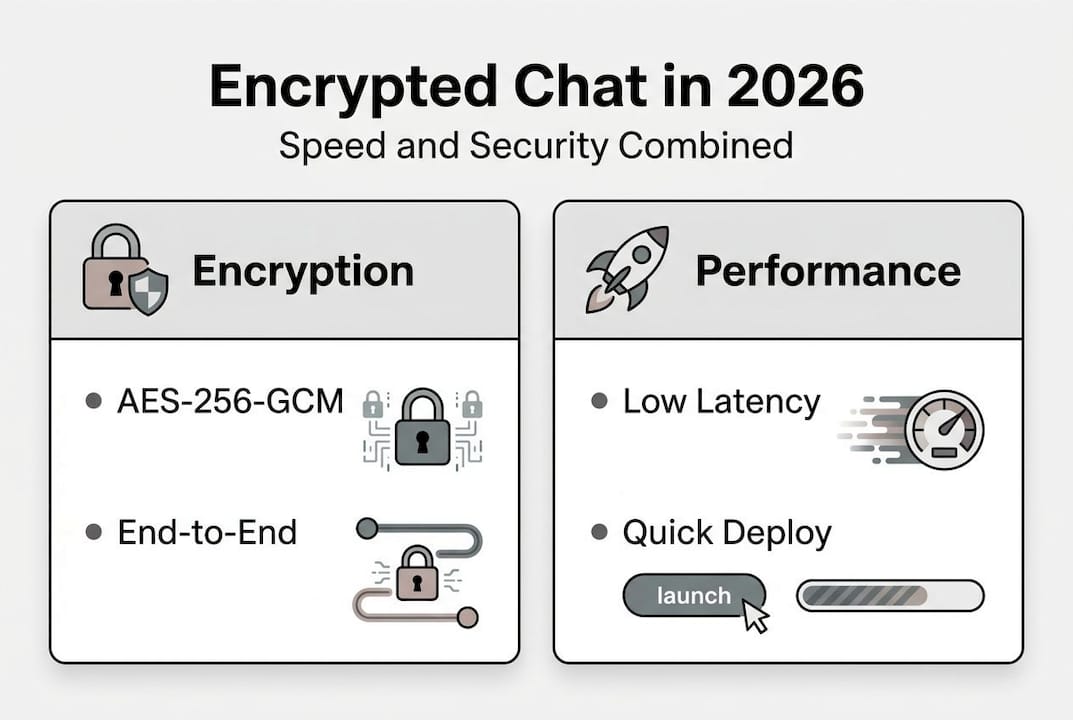
Encrypted workplace chat addresses this directly by protecting messages both in transit and at rest. End-to-end encryption ensures that only the intended recipients can read a message, even if the data passes through a third-party server. This is not just a best practice. Encryption is critical for data protection and regulatory compliance in enterprise settings.
Compliance requirements are tightening globally. GDPR mandates data protection by design, HIPAA requires safeguards for health information in any form, and sector-specific frameworks like FedRAMP and ISO 27001 demand demonstrable encryption controls. Enterprises that fail to secure internal communications face fines, audit failures, and reputational damage that dwarfs the cost of investing in the right platform. Securing corporate messaging is no longer a security team project. It is a business continuity requirement.
Here is what makes encrypted chat foundational in 2026:
- Data-in-transit protection: Messages are encrypted before leaving the sender's device and decrypted only on the recipient's end
- Data-at-rest encryption: Stored messages, files, and logs are encrypted on servers or local storage
- Access controls: Role-based permissions limit who can read or export sensitive conversations
- Audit trails: Compliant logging without exposing plaintext content to unauthorized parties
- Zero-trust compatibility: Encrypted chat integrates naturally into zero-trust network architectures
"Encrypted enterprise chat is no longer a premium add-on. It is table stakes for any organization handling sensitive data, and the performance gap between encrypted and unencrypted tools has essentially closed on modern infrastructure."
The integrated messaging benefits extend beyond security. Teams that communicate on a single, governed platform reduce context-switching, improve record-keeping, and give IT full visibility into data flows. With this in mind, let's clarify why encrypted chat has become foundational rather than optional.
Evaluating encryption technologies in workplace chat platforms
Once the need for encrypted chat is clear, the next challenge is understanding the technologies that power these tools. Not all encryption is equal, and the architecture choices made by a platform directly affect both security posture and daily performance.
Symmetric vs. asymmetric encryption is the starting point. Symmetric encryption like AES-256-GCM uses a single shared key for both encryption and decryption. It is fast, efficient, and well-suited for bulk message data. Asymmetric encryption, such as RSA or elliptic-curve cryptography, uses a public-private key pair and is more computationally intensive. Most enterprise platforms use a hybrid model: asymmetric encryption to exchange a session key, then symmetric encryption for the actual message content. This gives you the security guarantees of public-key cryptography with the speed of AES.
Latency matters for real-time communication. Signal offers sub-250ms RTT, while Bitmessage introduces high latency and overhead due to its P2P broadcast model. For enterprise teams that need fast, responsive chat, these numbers are not trivial. A platform that adds seconds to message delivery disrupts workflows and drives users back to insecure alternatives.
Explore secure messaging app types to understand where each architecture fits your needs.
| Architecture | Encryption model | Typical latency | Best for |
|---|---|---|---|
| Cloud-hosted (e.g., Signal) | AES-256-GCM + hybrid key exchange | Under 250ms | Most enterprise teams |
| P2P (e.g., Bitmessage) | Asymmetric broadcast | Seconds to minutes | High-privacy, low-frequency use |
| On-premises | AES-256 or configurable | 250ms to 500ms+ | Regulated industries |
| Federated cloud | Hybrid | Variable | Distributed organizations |
On-premises deployments give IT teams maximum control over data residency and key management. The trade-off is added infrastructure complexity and, often, higher latency because messages route through internal servers rather than globally distributed cloud nodes. Cloud platforms typically deliver better out-of-the-box performance, automatic updates, and simpler scaling. The right choice depends on your regulatory requirements and internal IT capacity.
Look for platforms that surface must-have messaging features like forward secrecy, which ensures that even if a key is compromised, past messages remain protected.
Pro Tip: Before finalizing a platform, ask the vendor for independent penetration test results and benchmark data specific to your expected message volume and user count. Vendor marketing materials rarely reflect real-world conditions at enterprise scale.
Performance vs. security: How top platforms balance speed and protection
With a technical understanding in place, it's time to compare how performance and security interact in actual workplace chat platforms. The core concern for IT managers is straightforward: will strong encryption slow my teams down enough to matter?

The short answer is no, provided you choose the right architecture. AES-256-GCM is efficient on modern hardware but sensitive to block size, and P2P or on-premises setups typically add latency compared to cloud platforms. Hardware-accelerated encryption, available on most modern server and client CPUs, reduces this overhead to the point of near-invisibility for text-based messaging.
| Platform type | Encryption strength | Round-trip latency | Overhead impact | Recommended use case |
|---|---|---|---|---|
| Signal protocol (cloud) | Very high | ~210ms | Minimal | Enterprise real-time chat |
| Bitmessage (P2P) | Very high | Minutes | Significant | Async, high-security messaging |
| On-premises AES-256 | High | 300ms to 600ms | Moderate | Regulated industries |
| Consumer apps | Low to medium | Under 100ms | None | Not suitable for enterprise |
To assess your team's performance needs before committing to a platform, follow these steps:
- Measure baseline usage: Identify peak messaging volume, file transfer frequency, and the number of concurrent users
- Define your latency threshold: For real-time collaboration, anything under 300ms is generally acceptable
- Test in your actual network environment: Cloud performance varies by region; run vendor pilots from your primary office locations
- Evaluate mobile performance separately: Mobile clients often experience higher latency, especially on cellular networks
- Review secure messaging solutions that provide published SLAs on message delivery time
Documenting your secure workflow steps before rollout prevents latency surprises during deployment.
Pro Tip: Avoid platforms that use variable block sizes without hardware acceleration. Fixed block-size implementations of AES-256-GCM perform more predictably at scale and prevent the latency spikes that frustrate users during high-traffic periods.
Selecting and implementing encrypted workplace chat for your enterprise
Equipped with knowledge of performance and encryption, enterprises can now proceed to select and implement the right solution. This is where strategy meets execution, and where many rollouts stall.
Start with a vendor evaluation checklist. Knowing the right questions separates platforms that market security from those that actually deliver it:
- What encryption standards are used? Look for AES-256-GCM, TLS 1.3, and forward secrecy
- Who holds the encryption keys? Customer-managed keys offer stronger data sovereignty
- What is the data residency model? Confirm where messages are stored and processed
- Is there third-party audit documentation? SOC 2 Type II reports and pen test results are baseline expectations
- What compliance certifications does the platform hold? Match these to your regulatory requirements
- How does the platform handle key rotation and revocation?
- What is the SLA for uptime and message delivery?
Latency and security overhead vary; selecting appropriate technologies matters in actual deployment. Integration with your existing IT stack is equally critical. A secure chat platform that does not connect to your identity provider, directory service, or SIEM creates operational gaps. Evaluate support for SAML 2.0 or OIDC for single sign-on, SCIM for user provisioning, and webhook or API support for automation.
Governance and policy alignment is often underestimated. Define retention policies, acceptable use rules, and export controls before launch. Publish these clearly so employees understand expectations.
User adoption determines whether your investment pays off. Provide short, role-based training sessions rather than lengthy documentation. Identify power users in each department who can champion the platform and answer peer questions. Track adoption metrics in the first 90 days and intervene early if specific teams lag. Choosing a secure platform that prioritizes user experience reduces resistance and accelerates adoption. Explore how messaging platforms for secure collaboration can support your rollout strategy from day one.
Rethinking the trade-off: Why you don't have to choose between security and experience
The assumption that security and usability sit on opposite ends of a scale is one of the most persistent and damaging beliefs in enterprise IT. We have seen it delay platform decisions for months while teams continue using tools that expose the organization to real risk.
Empirical benchmarks show that modern encrypted chat can combine speed and protection. The data is not ambiguous. Organizations that deploy well-designed encrypted platforms consistently report faster compliance audit cycles, reduced security incidents, and, counterintuitively, improved collaboration speed because teams stop fragmenting across uncontrolled consumer apps.
The discomfort often comes from legacy experience. Early encrypted tools were slow, difficult to manage, and broke constantly. That experience shaped a generation of IT managers. But clinging to that mental model in 2026 means making decisions based on infrastructure that no longer exists.
As we see across enterprise messaging platform insights, the organizations making the fastest security progress are the ones that stopped treating usability and encryption as competing priorities. They picked platforms built for both and let the results speak. You can have airtight security and a great user experience. The false dichotomy just slows you down.
Take the next step with secure enterprise messaging
If now is the time to secure your workplace chat with modern solutions, here's how you can get started.
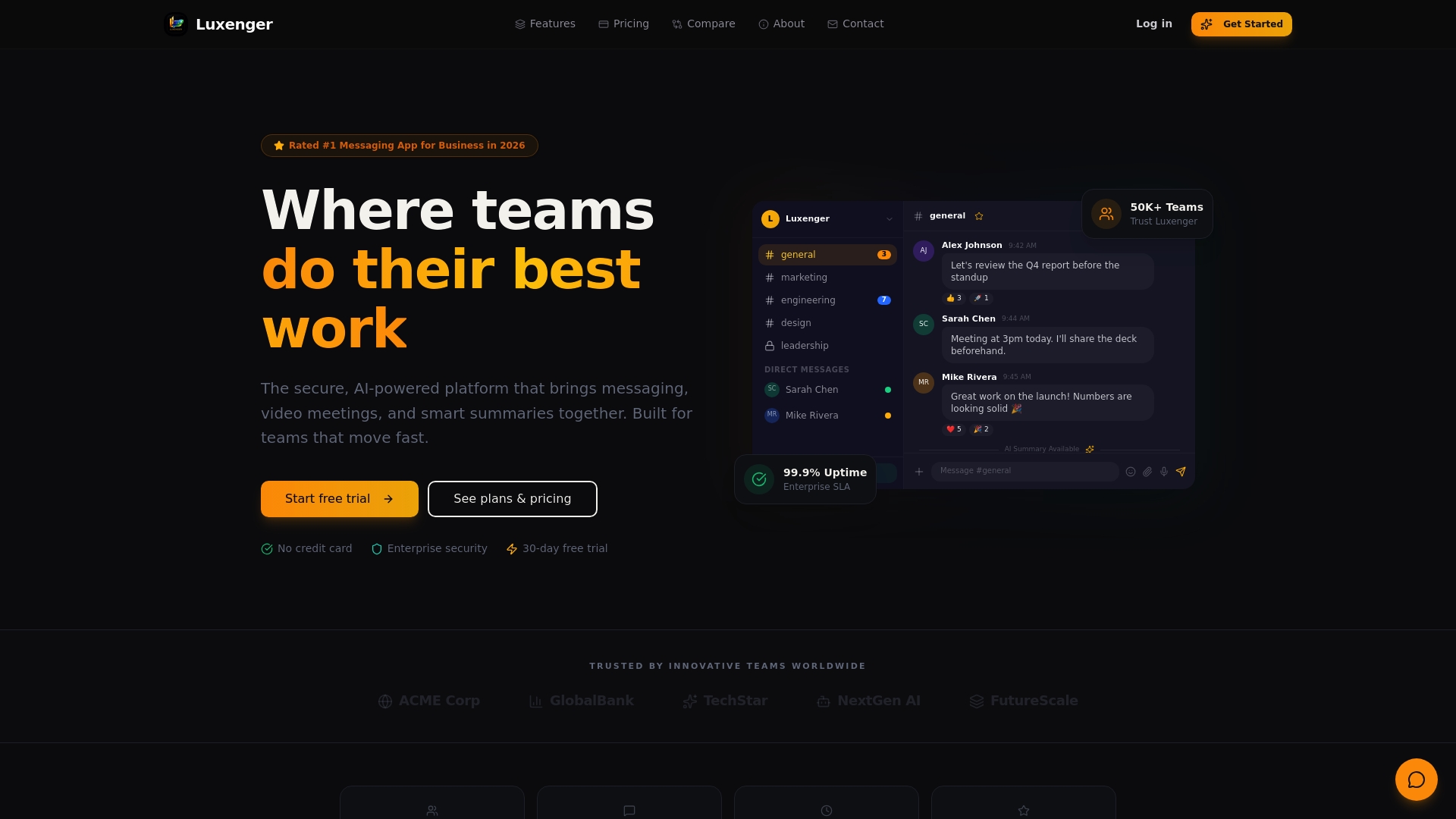
Luxenger is built for IT and communications teams who refuse to compromise. With bank-grade encryption, AI-powered conversation summaries, real-time translation, and voice huddles, it delivers the security your compliance team requires and the speed your people actually use. Whether you are replacing a fragmented tool stack or upgrading from a legacy platform, Luxenger for enterprise operations gives you the control and confidence to move fast without cutting corners. Review Luxenger pricing to find the right tier for your team, or visit Luxenger to see the platform in action.
Frequently asked questions
What is the fastest encrypted workplace chat platform?
Signal is among the fastest, with typical round-trip times around 210ms even with encryption fully enabled, making it practical for real-time enterprise communication.
Does stronger encryption make workplace chat slower?
Strong encryption has a minimal impact on speed when implemented correctly. AES-256-GCM on modern hardware keeps delays nearly invisible, especially on cloud-hosted platforms with hardware acceleration.
Should enterprises prefer on-premises or cloud-based encrypted chat?
On-premises chat gives you maximum data control but adds latency vs. cloud setups. Modern cloud solutions often deliver faster performance and simpler compliance management for most enterprises.
What features should an enterprise look for in an encrypted chat solution?
Prioritize end-to-end encryption, forward secrecy, low latency, compliance certifications, customer-managed key options, and seamless integration with your existing identity and security infrastructure.
Can encrypted chat integrate with AI and automation platforms?
Yes. Leading encrypted chat platforms now offer secure APIs and integration frameworks that support AI-driven features like smart summaries, automated workflows, and analytics without compromising message confidentiality.