

TL;DR:
- Enterprises often underutilize AI features in communication platforms due to strategy issues, not technology.
- Successful deployment relies on ongoing change management, leadership modeling, and targeted use cases.
- Future success depends on integrating AI and analytics securely and fostering a culture of adoption.
Enterprises pour millions into communication technology every year, yet only about 50% of users actually tap into built-in AI features, even when vendors promise 20 to 30% productivity boosts. That gap is not a technology problem. It is a strategy problem. An employee communication platform, when chosen and deployed correctly, can transform how your organization shares information, protects data, and gets work done. This guide breaks down what these platforms actually are, which features matter most in 2026, and how to drive adoption that sticks, so you stop leaving value on the table.
Table of Contents
- What is an employee communication platform?
- Key benefits for enterprises
- Critical features to evaluate in 2026
- How to overcome implementation and adoption challenges
- The future of AI and analytics in employee communication
- Our take: The real key to unlocking platform value
- Explore secure, AI-powered enterprise communication with Luxenger
- Frequently asked questions
Key Takeaways
| Point | Details |
|---|---|
| Enterprise platforms drive measurable ROI | The right communication platform can boost productivity, security, and employee engagement across the organization. |
| Feature integration and security are essential | Make sure your platform choice offers strong integrations, analytics, and gold-standard compliance for enterprise needs. |
| Adoption and user experience matter most | Training, leadership buy-in, and phased use cases are critical for getting full value from any platform investment. |
| AI and analytics will shape the future | Emerging AI features and powerful analytics will drive the next wave of communication productivity for enterprises. |
What is an employee communication platform?
An employee communication platform is not just a chat app with a company logo on it. It is an integrated system built to handle the full spectrum of how people inside a large organization talk, share, and collaborate. For enterprise IT and communications managers, that distinction matters enormously.
These platforms combine several core components into one governed environment:
- Messaging and channels: Direct messages, group chats, and topic-based channels for structured conversations
- File sharing and document collaboration: Centralized storage with version control and access permissions
- Video and voice communication: Meetings, huddles, and async video for distributed teams
- AI productivity features: Smart summaries, auto-generated action items, and real-time translation
- Analytics and reporting: Usage data, engagement metrics, and communication health dashboards
- Governance and security: Role-based access, data retention policies, audit logs, and encryption
What separates these platforms from standalone tools like WhatsApp or even basic Slack instances is the governance layer. Enterprise platforms are built to comply with regulations, scale across thousands of users, and give IT teams control over data flows.
For remote and hybrid desk workers, the platform is the digital office. For frontline and deskless workers, mobile-first design and shift scheduling integration are not nice-to-haves. They are the baseline. Understanding the different workplace messaging app types available today helps you match the right solution to your workforce mix before you ever open a vendor proposal.

Key benefits for enterprises
Now that you know what these platforms are, here is how leading companies use them to fuel measurable results.
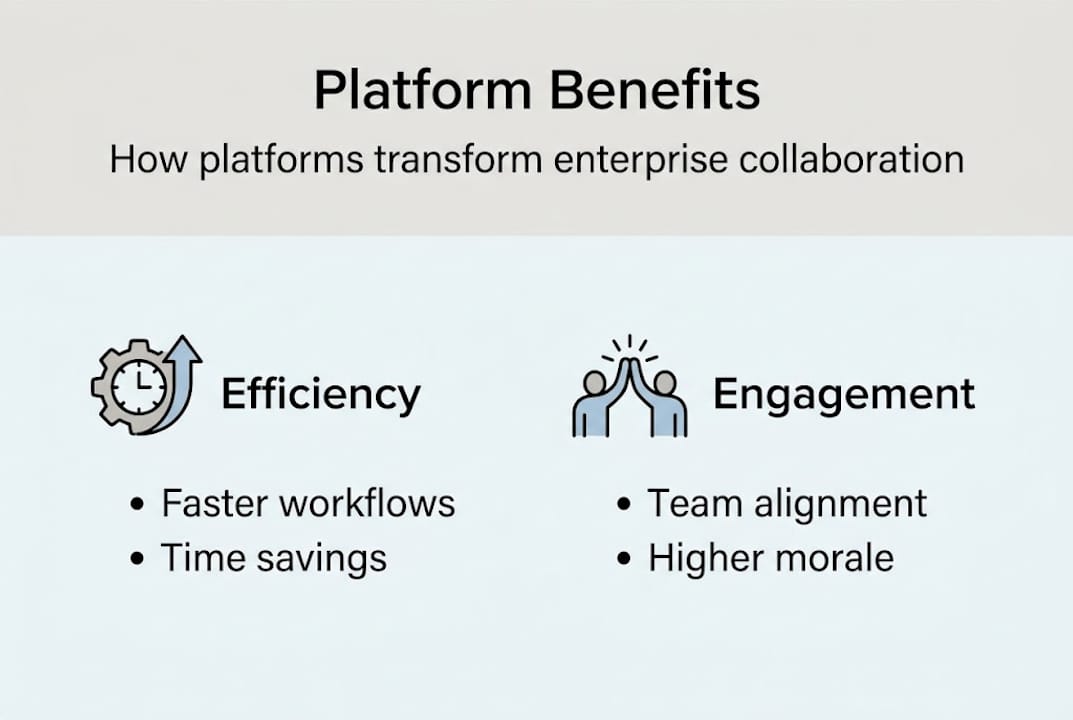
The value of a well-deployed employee communication platform shows up across multiple enterprise KPIs. Productivity is the obvious one, but the real gains come from reducing friction in how information moves, how decisions get made, and how compliant your communication environment stays under audit.
| Feature | Primary KPI impact | Measurable outcome |
|---|---|---|
| AI summaries and automation | Productivity | Faster decisions, fewer redundant meetings |
| End-to-end encryption | Security and compliance | Reduced breach risk, audit readiness |
| Usage analytics | Engagement | Spot disengaged teams early |
| Third-party integrations | Efficiency | Fewer app switches per task |
| Mobile and frontline access | Workforce inclusion | Higher adoption across all worker types |
Stat to know: Vendors claim 20 to 30% productivity gains are achievable, but actual results depend heavily on your organization's existing workflows, change management maturity, and how well the platform fits your team's real-world needs.
Beyond productivity, these platforms drive employee engagement by giving workers a single, trusted place to communicate. That reduces shadow IT, where employees use unauthorized apps because the official tool feels clunky. It also cuts the cost of managing multiple point solutions across departments.
Understanding business messaging ROI requires looking beyond license costs. Factor in time saved on email overload, faster incident response, and reduced onboarding friction for new hires. These platforms also support remote team communication by giving distributed teams structured, searchable communication histories instead of scattered email threads.
Pro Tip: Before signing any contract, run a Proof of Concept with a real team on a real workflow. Vendor ROI claims are projections. Your PoC results are evidence.
Critical features to evaluate in 2026
What separates a great employee communication platform from a mediocre one? Here is what truly matters in 2026.
| Feature category | What to look for | Why it matters |
|---|---|---|
| Security certifications | SOC2 Type II, ISO 27001, end-to-end encryption | Non-negotiable for regulated industries |
| AI automation | Summaries, translation, action items | Reduces manual overhead |
| Integration breadth | Open APIs, 50+ native connectors | Prevents workflow fragmentation |
| Analytics | Real-time dashboards, adoption metrics | Proves ROI and flags gaps |
| Mobile and frontline readiness | Offline mode, push notifications, lightweight app | Reaches every worker type |
| Ease of use | Intuitive UI, minimal training required | Drives voluntary adoption |
Forrester's 2026 evaluation shows that leading platforms differentiate on integrations, analytics, and compliance, with top vendors offering 50 or more native integrations alongside auto-governance tools that reduce compliance overhead.
For your evaluation checklist, prioritize these must-haves:
- End-to-end encryption for all message types, including voice and file transfers
- Open APIs that connect your HR, ticketing, and project management tools without custom development
- Usage analytics at the channel and user level to track real adoption
- Auto-governance that enforces retention policies without manual IT intervention
- Mobile-first design that works reliably on low-bandwidth connections
Different enterprise use cases demand different weights. A digital workplace transformation for hybrid office workers puts UX and video quality first. Secure healthcare messaging, on the other hand, starts with HIPAA compliance and data sovereignty before anything else.
Pro Tip: Insist on SOC2 Type II certification and auto-governance features from day one. Retrofitting compliance into a platform that was not designed for it is expensive and often incomplete.
How to overcome implementation and adoption challenges
Choosing the right features is only half the battle. Making your platform succeed with real employees is the next big hurdle.
Even the most capable platform will fail if people do not use it. The UX complexity gap between tools like Teams and simpler platforms is a real adoption barrier for hybrid teams, and AI adoption sitting at only about 50% across enterprise deployments confirms that feature availability does not equal feature use.
"Only 50% of enterprise users leverage AI tools, limiting potential gains."
Here is a numbered rollout plan that actually works:
- Secure executive sponsorship first. Without visible leadership buy-in, adoption stalls at the department level.
- Define two or three concrete use cases. A project channel for a specific team beats a company-wide launch with no clear purpose.
- Run a structured pilot. Pick a team with a real communication problem and measure outcomes before scaling.
- Train on workflows, not features. Show people how to summarize a meeting with AI, not just where the button is.
- Designate internal champions. Peer-driven adoption is faster and stickier than top-down mandates.
- Measure and share results. Publish adoption metrics internally to build momentum and identify laggards early.
Ongoing adoption requires a feedback loop, not a one-time launch event. Quarterly surveys, usage dashboards, and open channels for platform feedback keep the tool relevant. For distributed organizations, building company culture remotely depends on the platform being the place where culture actually happens, not just where tasks get assigned.
The future of AI and analytics in employee communication
Looking forward, the real competitive edge will come from leveraging AI and analytics to their full extent.
Right now, AI capabilities remain largely underused in enterprise platforms, which means the organizations that build AI fluency into their communication workflows today will have a structural advantage within two to three years. The technology is advancing faster than adoption curves.
Next-gen AI features already entering leading platforms include:
- Smart conversation summaries that surface decisions and action items automatically
- Proactive compliance alerts that flag policy violations before they become incidents
- Sentiment analysis on team communication to detect burnout or disengagement signals early
- Automatic meeting action items pushed directly to project management tools
- Real-time multilingual translation that eliminates language barriers across global teams
Analytics will move from reporting on past behavior to predicting future communication breakdowns. Platforms that can show you which teams are at risk of misalignment, before a project fails, will become indispensable tools for enterprise leaders.
Data privacy is the constraint that will define which AI features actually get deployed at scale. Any AI model processing internal communications needs to operate within your data sovereignty requirements, not send sensitive content to third-party training pipelines. The future of AI in team communication is powerful, but it is only viable when security is built into the architecture, not bolted on afterward.
Exploring AI-powered team collaboration platforms now positions your organization to lead rather than catch up. The gap between AI promise and AI practice is still wide enough that early movers capture real advantages in improving workplace messaging speed and quality.
Our take: The real key to unlocking platform value
With these forward-looking technologies in mind, here is how we see the real difference-makers for enterprises.
Most organizations get this backwards. They spend 80% of their evaluation time comparing feature checklists and almost no time asking whether their employees will actually change how they work. A platform with every AI feature on the market still delivers zero ROI if people treat it like a fancy email client.
The enterprises that extract real value from communication platforms share one trait: they treat the platform launch as an ongoing change management program, not a technology deployment. That means leadership models the behavior. It means training is repeated, not one-and-done. It means you pick one or two use cases, make them visibly successful, and then expand.
Learning from enterprise ROI lessons across industries shows that the biggest predictor of long-term platform success is not which vendor you chose. It is whether your organization built a habit of using it. Features matter, but culture eats software for breakfast.
Pro Tip: Pick one use case, run it until it works, then add another. Trying to transform all communication at once guarantees partial adoption everywhere instead of full adoption anywhere.
Explore secure, AI-powered enterprise communication with Luxenger
If you are evaluating platforms for your organization, the criteria in this guide give you a solid foundation. The next step is seeing how modern solutions actually measure up against them.
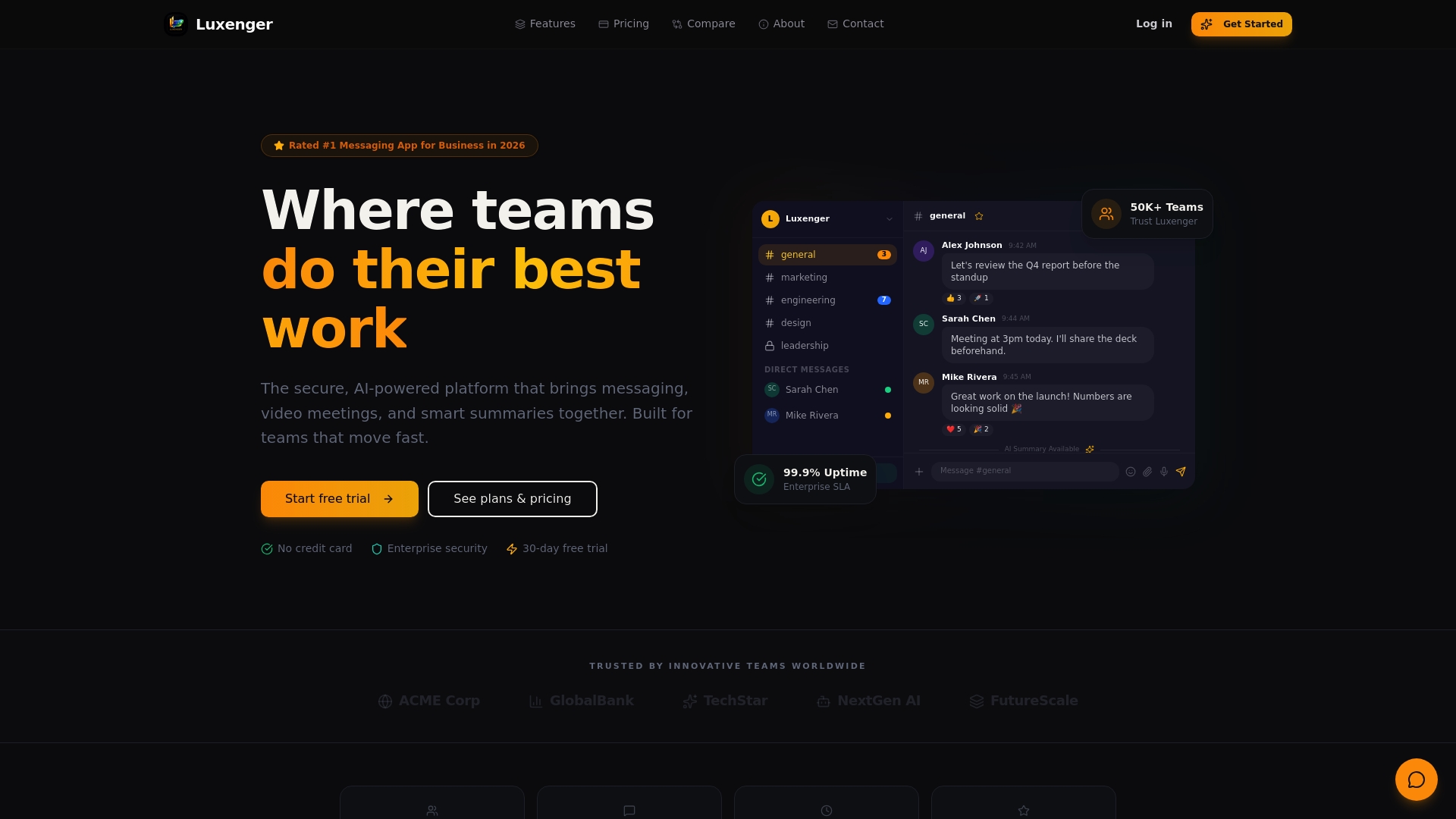
Luxenger is built specifically for enterprises that cannot compromise on security or productivity. With bank-grade encryption, AI-powered summaries, real-time translation, and voice huddles, it covers the features your teams need most. Explore the enterprise messaging platform designed for organizations like yours, and review enterprise messaging pricing to see how it fits your budget and scale requirements. Security, AI, and deep integration are not optional extras here. They are the foundation.
Frequently asked questions
How is an employee communication platform different from regular chat apps?
Employee communication platforms combine chat, file sharing, analytics, security, and integration features into a governed environment built for enterprise scale. As Forrester's evaluation confirms, these platforms offer advanced compliance and analytics options that consumer chat apps simply cannot match.
What are the security must-haves for employee communication?
Prioritize SOC2 Type II certification, auto-governance for retention and compliance, and end-to-end encryption across all message types. Gold-standard compliance features are the baseline for any enterprise deployment in a regulated industry.
Why is AI adoption so low in communication platforms?
Complexity, insufficient training, and a lack of clear use cases keep enterprise AI feature usage near 50% despite significant productivity potential sitting on the table.
How can IT managers ensure successful rollout of a new platform?
Secure executive sponsorship, run a structured pilot with measurable outcomes, and use analytics to track adoption from day one. PoCs and analytics replace vendor promises with real data from your own environment.