

TL;DR:
- Most organizations rush to deploy AI tools without fully preparing their teams, making strategy the key challenge. Effective AI adoption requires addressing workflows, culture, governance, and reskilling, not just technology. Leaders must involve cross-functional teams early and prioritize integrated platforms and transparent communication for sustainable success.
Most organizations are rolling out AI tools faster than their teams can actually use them. That's not a technology problem. It's a strategy problem. The question of why adopt ai-enhanced tools is real, but the answer goes much deeper than efficiency metrics and vendor promises. AI integration advantages only materialize when leaders address the full picture: workflows, culture, governance, and people. This article cuts through the noise and gives you a grounded, experience-informed view of what successful AI tool implementation actually looks like.
Table of Contents
- Key Takeaways
- Why adopt AI-enhanced tools: the real business case
- The human and organizational barriers to AI adoption
- From isolated tools to integrated AI platforms
- Strategies for sustainable, trust-based AI adoption
- My take: the human side is where AI adoption is won or lost
- Luxenger: built for the way AI-driven teams actually work
- FAQ
Key Takeaways
| Point | Details |
|---|---|
| AI delivers measurable gains | Companies save 20-40 hours per employee monthly, but only when adoption is managed at the workflow level. |
| Human barriers outweigh technical ones | Workforce resistance and capability gaps are the primary reasons AI adoption stalls, not the technology itself. |
| Integrated platforms beat isolated tools | Disconnected AI plug-ins create tool sprawl and security risks; platform-level integration drives lasting results. |
| Governance must come first | Involving security, legal, and IT teams from day one prevents costly reversals and builds organizational trust. |
| Reskilling is infrastructure | Treating AI training as optional causes adoption gaps; building capability is as critical as deploying the technology. |
Why adopt AI-enhanced tools: the real business case
The numbers behind adopting AI technology are hard to ignore. Companies that successfully integrate AI tools for business save 20-40 hours per employee monthly on routine tasks, cut operational costs up to 40%, and see knowledge worker productivity increase by 15%. For less experienced staff, the productivity gains are even more pronounced. AI acts as an equalizer, giving newer employees access to judgment and output quality that previously took years to develop.
The benefits of AI tools also extend to revenue. AI-driven personalization, for example, increases customer engagement by 40%, a figure that makes a direct case for AI in customer-facing operations. When you layer that on top of internal efficiency gains, the compounding effect on business performance becomes significant.
Here is where the business case gets genuinely interesting:
- Competitive intelligence at scale. AI tools synthesize market signals, customer feedback, and competitor activity continuously. Human analysts can not match that speed or volume.
- Data-driven decision cycles. Leaders who use AI-enhanced productivity tools close the gap between sensing a trend and acting on it, sometimes by weeks.
- Innovation throughput. When AI handles routine cognitive tasks, your best people spend more time on the problems that actually require human judgment.
- Workforce multiplier effect. A well-implemented AI tool does not just help one person. It scales institutional knowledge across your entire team.
The importance of AI tools, properly understood, is not about replacing headcount. It's about expanding what your existing team can accomplish without burning them out.
The human and organizational barriers to AI adoption

Here is the uncomfortable data that most AI vendors skip. 51% of U.S. knowledge workers use AI tools at work, but 31% are actively working against their company's AI initiatives. Employees in AI-adopting firms report 27% more workplace disruption than those in companies that have not deployed AI at scale. That is a significant drag on any expected return.
The root cause is what researchers call the capability crisis. Companies deploy AI faster than workforce skills keep up, creating technical debt and adoption gaps that compound over time. A striking 52% of tech professionals are doing AI training independently because their employers are not providing it. Even more telling, 24% of workers have left jobs specifically because their organizations failed to invest in AI upskilling.
The organizational barriers typically cluster around three failure modes:
- Speed without readiness. Launching tools before employees understand why they exist or how to use them breeds confusion and resentment.
- No role-specific training. Generic AI training misses the mark. A finance director and a customer support agent need completely different onboarding.
- Governance gaps. When AI adoption lacks clear policies, tool velocity without governance leads to unstable delivery, security exposure, and adoption failure at scale.
Pro Tip: Before launching any AI tool company-wide, run a 90-day pilot with a cross-functional team that includes skeptics, not just early adopters. Their friction points will reveal the gaps your rollout plan is missing.
Transparent communication matters more than most leaders expect. When employees understand how AI decisions are made and what role they still play, resistance drops sharply. The reason why use AI solutions fails is almost never the tool itself.
From isolated tools to integrated AI platforms
Adopting a collection of disconnected AI plug-ins is not the same as adopting AI technology. Research from workflow design studies confirms that treating AI as isolated tools creates tool sprawl, loss of visibility, security risks, and generic outputs that no one trusts. Most AI adoption failures trace back to this disconnected approach.
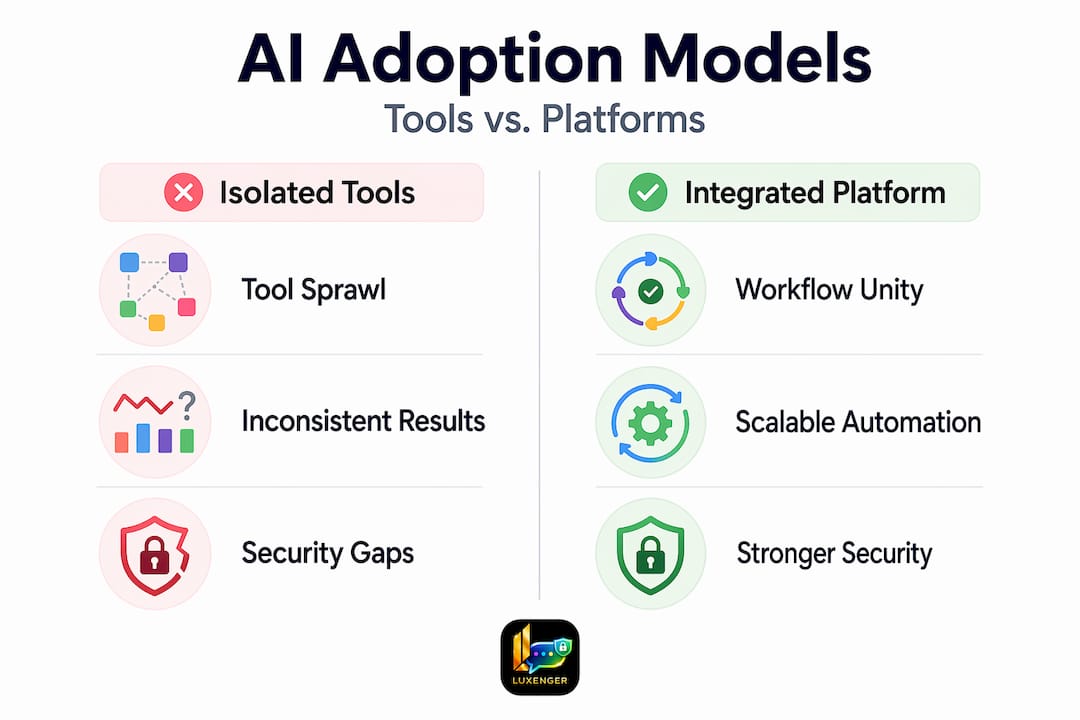
The more productive model is platform-level integration. Instead of asking "which tasks can AI automate," the better question is "which sequences of related tasks can AI handle end to end?" This is the concept of task chaining. When AI handles sequences of tasks rather than isolated steps, coordination costs drop and throughput improves even in cases where the AI output on any single task is not definitively better than a human's.
| Approach | Outcome |
|---|---|
| Isolated AI plug-in tools | Tool sprawl, inconsistent outputs, security gaps, low user trust |
| Integrated AI platform | Unified workflows, consistent governance, higher adoption, measurable gains |
| Ad hoc tool adoption | Uneven capability, fragmented data, hidden costs |
| Strategic platform migration | Workflow redesign, team alignment, compounding productivity returns |
Task adjacency is what separates average AI integration from genuinely transformative results. Grouping AI-compatible tasks in sequence reduces handoff friction and keeps humans in the loop at the decision points where their judgment adds the most value.
Pro Tip: Map your current workflows before selecting any AI tool. Identify where handoffs between people slow things down the most. Those are the highest-value entry points for AI-enhanced productivity tools.
The shift from tools to platforms also changes how you approach secure AI communication, which is not a secondary concern. Every new integration point is a potential security exposure. Platform-level thinking forces that conversation earlier, when it costs far less to get right.
Strategies for sustainable, trust-based AI adoption
Getting this right requires more than a technology roadmap. The organizations that sustain AI integration advantages over time treat adoption as an organizational design challenge, not a software deployment. Here is how the most effective leaders approach it:
-
Bring security, legal, and IT in as design partners from day one. Not as approvers at the end of the process. Cross-functional integration with these teams early on builds trust across the organization and prevents the costly reversals that come from retrofitting governance after deployment. Understanding AI security risks before they become incidents is the most underrated competitive advantage in AI adoption.
-
Reframe the internal narrative. The most damaging message you can send is that AI is coming to replace roles. It shuts down engagement immediately. Position AI as the thing that takes the exhausting, repetitive work off people's plates so they can do the work that actually matters. Employees report greater enjoyment and performance when AI supports rather than replaces their judgment.
-
Use quantitative prioritization for your AI project pipeline. Companies that apply a structured prioritization approach reach AI deployment three times faster, and 75% of those prioritized projects reach production versus 30% in organizations that do not prioritize. This is not a small difference. It's the difference between a functioning AI program and a graveyard of pilots.
-
Treat reskilling as infrastructure. Not a perk, not a nice-to-have, not a one-time training session. The primary barrier to AI transformation is workforce capability, not budget or technology. Build continuous learning into your operating model the way you build in software updates.
-
Measure adoption quality, not just deployment speed. Track whether people are actually using AI tools in the ways that generate value. Survey employees regularly. Create feedback loops that let frontline workers tell you what is and is not working. Then act on it.
Sustainable AI adoption is not a sprint. The organizations that get it right run 6-12 month pilots, measure carefully, and scale what actually works rather than what looks impressive in a board presentation.
My take: the human side is where AI adoption is won or lost
In my experience working with organizations scaling AI across their operations, the technology is almost never the hard part. The hard part is convincing a 12-year veteran on your team that the AI tool you just deployed is not a signal that their expertise is becoming irrelevant. Get that wrong, and you get active resistance to AI initiatives from the very people whose buy-in you need most.
What I've learned is that leaders underestimate how much the adoption experience shapes the outcome. A technically capable AI tool deployed with poor communication, no training plan, and zero involvement from the affected team will underperform a simpler tool that was rolled out thoughtfully. Every time.
The organizations that get this right treat human-AI complementarity as the goal, not automation for its own sake. They redesign workflows rather than just plugging AI into existing broken processes. They make reskilling as non-negotiable as any capital investment.
My advice to any leader evaluating AI tools right now: audit your organization's readiness before you evaluate any vendor. Ask your team how they feel about AI, what they're worried about, and what problems they actually want solved. The answers will tell you more about your AI adoption potential than any product demo.
— Matthew
Luxenger: built for the way AI-driven teams actually work
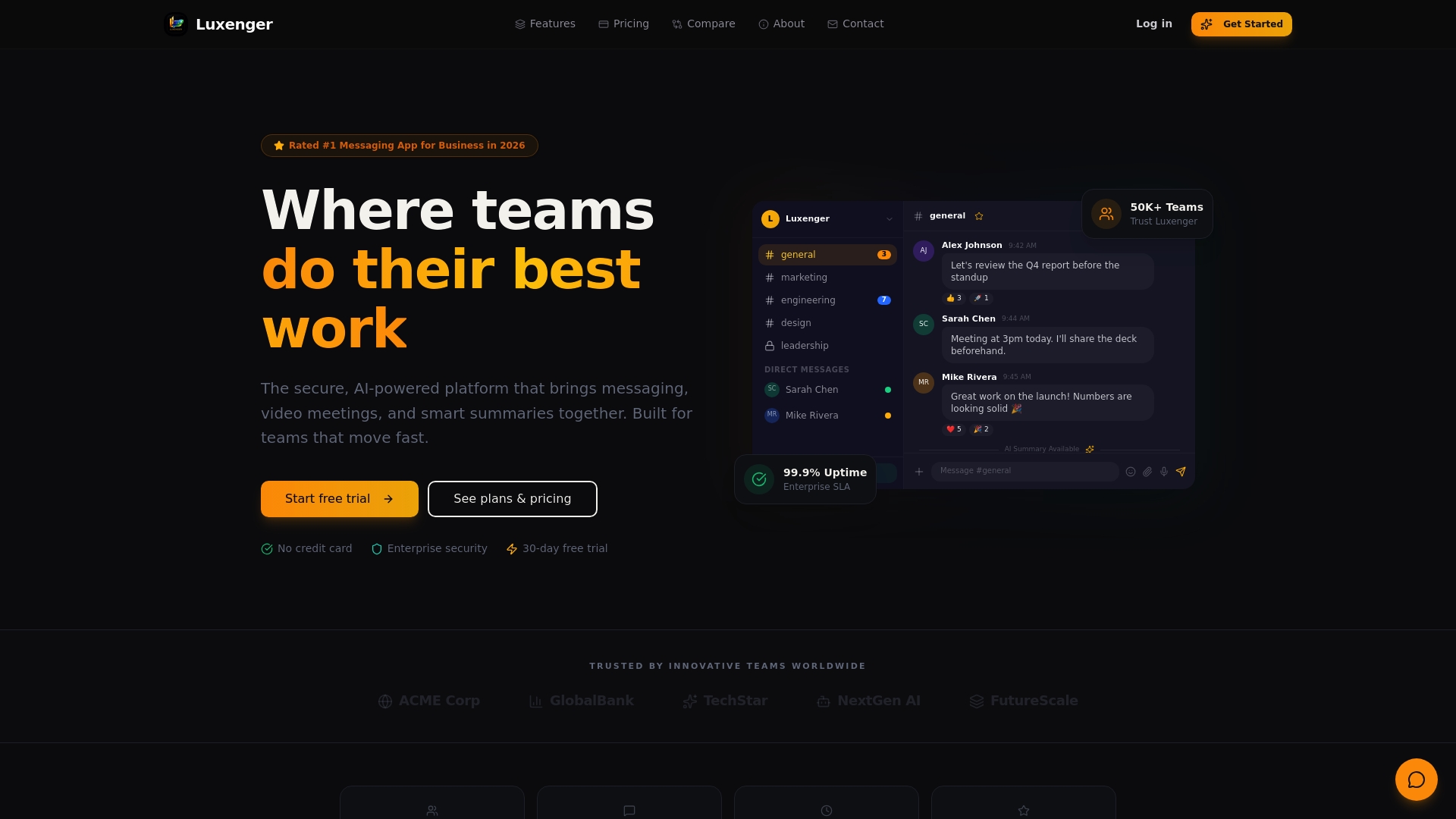
When your teams are adopting AI technology across departments, the communication layer holding everything together matters more than ever. Luxenger is built specifically for this environment. The platform combines AI-powered collaboration features with bank-grade security, so your sensitive enterprise conversations stay protected whether you're coordinating AI pilots, managing cross-functional governance, or supporting multilingual teams in real time.
Luxenger's AI-powered conversation summaries keep leaders informed without requiring them to read every message. Voice huddles accelerate decisions. Real-time translation removes the friction from global team coordination. And because security is built in at the platform level rather than bolted on, your legal and IT teams get the governance visibility they need from day one. Explore how Luxenger for enterprise operations can support your AI adoption program with communication infrastructure that actually matches your ambitions.
FAQ
Why adopt AI-enhanced tools instead of standard software?
AI-enhanced tools automate routine tasks, surface data-driven insights, and adapt to user behavior in ways standard software cannot. Companies that adopt them report saving 20-40 hours per employee monthly and cutting operational costs up to 40%.
What is the biggest barrier to AI adoption in organizations?
Workforce capability is the primary barrier, not technology or budget. Companies deploy AI faster than they train employees, creating adoption gaps that hurt productivity and increase the risk of employee resistance.
How do you build employee trust in AI tools?
Communicate transparently about how AI decisions are made, involve employees in the rollout process, and provide role-specific training. Research shows employees perform better and report higher satisfaction when AI supports rather than replaces their judgment.
What is the difference between AI tools and an AI platform?
Isolated AI tools create fragmented outputs, tool sprawl, and security risks. An integrated AI platform connects workflows end to end, improves governance, and delivers consistent, measurable results across your organization.
How long does a successful AI adoption process take?
The most effective organizations run structured pilots lasting 6-12 months before scaling. Companies that use a quantitative prioritization approach get to deployment three times faster, with 75% of prioritized projects reaching production successfully.