

TL;DR:
- Managing diverse communication channels across multiple time zones requires a clear framework categorizing sync, async, and hybrid interactions.
- Effective enterprise communication relies on structured norms and explicit mappings of scenarios to appropriate channels, not just tool selection.
- Prioritizing norms, response windows, and escalation paths—guided by a channel matrix—enhances clarity, efficiency, and collaboration at scale.
Picking the right communication channel sounds simple until you're managing 500 people across six time zones with fourteen different tools in your tech stack. For IT and communications managers, the cost of a mismatch is real: critical decisions get buried in email threads, engineers get pulled out of deep work for status updates that could have been a shared doc, and distributed teams lose hours every week to meetings that exist purely because no one defined a better default. This guide cuts through the noise by giving you a clear framework to classify, compare, and map team communication types to the outcomes they actually serve.
Table of Contents
- Defining the main types of team communication
- Asynchronous communication: Channels, rituals, and norms
- Synchronous communication: When real-time matters
- Hybrid and situational strategies: Channel matrix and team rituals
- Comparing team communication types: Efficiency, clarity, and fit
- Our perspective: Why clear norms and mapping matter more than tool selection
- How Luxenger helps enterprises master team communication
- Frequently asked questions
Key Takeaways
| Point | Details |
|---|---|
| Match medium to goal | Choose communication types based on outcome—sync for decisions, async for information sharing. |
| Async needs clear norms | Define response windows and escalation paths to prevent ambiguity and ensure efficiency. |
| Channel matrix is vital | Map scenarios to default channels so teams know where to communicate and how to escalate. |
| Written rituals boost clarity | Replacing meetings with structured written updates can surface blockers and streamline coordination. |
| Hybrid approach maximizes fit | Combine sync and async strategies for best results depending on urgency and complexity. |
Defining the main types of team communication
To approach the challenge, let's first clarify the fundamental building blocks of team communication.
Most enterprise teams operate across three broad categories: synchronous, asynchronous, and hybrid. Each has a distinct purpose, and confusing them is one of the most common sources of collaboration friction in medium to large organizations.
Synchronous communication happens in real time. Both parties are present at the same moment. This includes video calls, phone calls, live chat, and in-person meetings. The defining feature is immediacy: you send a message or speak, and the other person responds right away.

Asynchronous communication is time-shifted. You send a message, update a ticket, or record a video, and the recipient responds when their schedule allows. Email, project comments, shared documents, and recorded walkthroughs all fall here.
Hybrid scenarios blend both. An incident channel might start as an async thread but escalate to a live call the moment severity increases. Office hours give teams a recurring sync touchpoint without requiring constant availability.
Communication types are frequently framed as "match the medium to the goal," and that framing matters more than most tool selection decisions. Choosing async for a nuanced conflict resolution conversation is just as wrong as calling a meeting to share a status update that belongs in a project board.
Here's what to ask before you choose a channel:
- Is the decision time-sensitive, or can it wait two to four hours?
- Does the topic need visual or verbal context to be understood clearly?
- Will this information need to be referenced later, or is it ephemeral?
- How many people need to be involved, and are they in the same time zone?
Your answers map directly to a communication type. Building an async communication culture inside your organization starts with this kind of systematic thinking, not with finding the next great app.
Asynchronous communication: Channels, rituals, and norms
With the main categories set, let's take a closer look at how async communication works and how to get the most from it.
Async communication doesn't just happen when you choose not to call a meeting. Done well, it follows a deliberate architecture of channels, artifacts, and norms. Done poorly, it produces message overload, vague threads, and decisions no one can trace back to their origin.
The most effective organizations adopt an "async-first" methodology with defined response windows and documented artifacts, meaning every async interaction is backed by a clear expectation of when and how people will respond, and what record will be kept.
Common async channels enterprise teams rely on include:
- Email for formal external or cross-department communication
- Project management comments for context-specific task discussions
- Shared documents and wikis for reference knowledge and decision logs
- Issue trackers for bug reports, feature requests, and sprint-level work
- Recorded video updates for walkthroughs, retrospectives, and announcements
Async channels include project comments, shared pages, issue trackers, and recorded updates, and each one serves a different purpose. Using email for what belongs in a project comment creates friction. Using an issue tracker for a company-wide policy update creates confusion.
The artifacts that async communication generates are what make it powerful. Decision logs, written meeting notes, project boards, and linked documentation mean that knowledge doesn't live inside any single person's inbox or memory. New team members can get up to speed faster. Distributed teams in different time zones can stay aligned without waiting for a window when everyone is awake at the same time.
For norms to work, they need to be explicit and visible. A response window policy that says "acknowledge within two hours, full response within twenty-four hours" tells people what to expect without requiring constant monitoring. Clear escalation paths answer the question: when does this async thread stop being async and require a call?
One of the most impactful shifts you can make is redesigning recurring meetings as async standup strategies using structured templates. Instead of a daily fifteen-minute call, team members post answers to three questions in a shared channel: what did I complete, what's blocking me, what am I working on today. Blockers surface just as fast, schedules open up, and the written record makes it easier to spot patterns across sprints.
Pro Tip: Block thirty minutes at the start and end of your workday specifically for responding to async tools. Treating these as dedicated response windows, rather than staying always-on, dramatically reduces context-switching and gives distributed teammates predictable rhythms.
Synchronous communication: When real-time matters
While async methods are growing in popularity, there are still many moments where real-time connection is essential.
Synchronous communication earns its place when speed, nuance, or emotional alignment is genuinely required. The mistake most organizations make is defaulting to sync for everything, not because it's the best choice, but because it's the familiar one. Flipping that default without abandoning sync entirely is where the real efficiency gains happen.
Real-time communication brings three specific strengths to the table:
- Quick alignment: When two people are going back and forth on a complex topic, a ten-minute call resolves what might take two days of async messaging.
- Richer context: Tone, energy, and body language carry information that text often loses. Sensitive conversations, performance discussions, and high-stakes decisions benefit from this layer.
- Faster decision cycles: For time-critical scenarios like incident response, live channels let teams react in real time, gather input simultaneously, and reach consensus in minutes rather than hours.
Scenarios that justify synchronous communication include urgent production incidents, cross-functional brainstorming sessions where real-time ideation adds value, complex or ambiguous discussions where written back-and-forth would be painfully slow, and onboarding conversations where relationship-building matters as much as information transfer.
The tradeoffs are real. Synchronous meetings interrupt deep work, require scheduling coordination across calendars, and often generate no written record unless someone is explicitly assigned to take notes. Reserving sync meetings for alignment while using docs, tickets, and recorded updates for execution keeps these costs manageable.
A practical guideline: use sync when clarity or consensus cannot be reached any other way within the required timeframe. Everything else should default to async unless there's a specific reason to escalate.
For distributed teams, remote communication tips often center on protecting focus time by limiting sync touchpoints to those that genuinely require real-time participation.
Hybrid and situational strategies: Channel matrix and team rituals
To maximize collaboration, teams often adopt hybrid strategies, combining elements to fit each case.
No team operates in a purely async or purely sync world. The most effective enterprise communication strategies are situational, meaning they map specific scenarios to specific channels and define when escalation from one mode to another is appropriate.
A channel-matrix approach maps scenarios to a default communication channel and uses incident channels or office hours as meeting alternatives. Here's an example of what that looks like in practice:
| Scenario | Default channel | Escalation path |
|---|---|---|
| Status update | Async project comment or doc | None needed |
| Blocker or dependency | Async message with @mention | Sync call if unresolved in 2 hours |
| Production incident | Dedicated incident channel | Live call immediately |
| Decision requiring input | Shared doc with comment thread | Office hours or short sync meeting |
| Sensitive HR topic | Direct message or private channel | In-person or video call |
| Team announcement | Broadcast channel or email | Q&A thread or office hours |
"Teams that define escalation paths in advance avoid the constant back-and-forth about how to communicate. The channel matrix removes ambiguity before it creates conflict." This kind of pre-mapping is what separates intentional communication architecture from reactive, tool-hopping behavior.
Team rituals can be redesigned as async formats, which is one of the most underutilized strategies in enterprise communication. Weekly standups, sprint reviews, and project retrospectives all have async equivalents. Written templates, recorded video summaries, and structured comment threads preserve the value of these rituals without the calendar overhead.
For more on structuring written standups effectively, async standup best practices offer concrete templates that enterprise teams use to replace meeting-heavy ceremonies without losing alignment.
The key to hybrid strategy isn't just choosing the right mix. It's mapping communication channels to urgency and clarity requirements so that teams never have to improvise in the moment.
Comparing team communication types: Efficiency, clarity, and fit
Now that we've explored each communication type individually and in combination, let's compare them head to head for practical decision-making.
| Dimension | Synchronous | Asynchronous | Hybrid |
|---|---|---|---|
| Speed | Immediate | Hours to days | Situational |
| Context richness | High (tone, body language) | Lower (text-dependent) | Mixed |
| Documentation | Requires extra effort | Built-in | Depends on design |
| Cross-timezone fit | Poor | Excellent | Good with clear norms |
| Focus protection | Low | High | Moderate |
| Scalability | Limited (coordination cost) | High | High with structure |
Matching the medium to the goal, sync for discussion and async for execution, is the principle that drives this comparison. No single type dominates across every dimension.
Here's a numbered decision framework you can apply to any scenario:
- Define the urgency. If the issue needs resolution within the hour, sync is likely the right call. If it can wait, default to async.
- Assess the complexity. High ambiguity, multiple stakeholders, or emotionally sensitive topics favor synchronous channels.
- Check the time zone spread. If your team spans more than three time zones, async is almost always the more equitable default.
- Consider the documentation need. If the output of this communication needs to be referenced later, design for async artifacts regardless of whether the discussion starts as a call.
- Apply your channel matrix. Don't improvise. Look at the pre-agreed norms and match the scenario.
The key takeaway is that no single type fits every situation. Choosing the right team chat app is only one piece of the puzzle. The bigger value comes from intentional mapping, where your team knows before a situation arises exactly which channel to use and when to escalate.
Our perspective: Why clear norms and mapping matter more than tool selection
Enterprise teams spend enormous amounts of time evaluating communication tools. We see this constantly. Organizations run trials, compare feature sets, and migrate platforms expecting a step-change in collaboration quality. The results are almost always underwhelming unless the underlying norms change with them.
The uncomfortable truth is that most communication breakdowns aren't caused by the wrong tool. They're caused by the absence of explicit agreements about how to use any tool. A team can operate effectively with a handful of simple channels and a well-documented communication norms guide, or it can grind to a halt on a platform packed with every feature imaginable.
What actually drives clarity is knowing, in advance, which channel owns which type of conversation. Escalation thrash happens when people can't agree on how urgent something is or where to route it. A pre-defined channel matrix eliminates that debate entirely. It's not glamorous, but it works.
There's also a counterintuitive reality about async communication specifically. Teams that move to async-first often report that they have more meaningful synchronous conversations, not fewer. When async handles the routine, sync becomes reserved for the interactions where it genuinely adds value. The quality of real-time meetings goes up because the noise has been filtered out.
Our strong recommendation: before you evaluate a single new tool, build your channel matrix and document your escalation paths. Pin it in your team's main channel. Review it quarterly. That thirty-minute exercise will do more for communication clarity than most platform migrations.
How Luxenger helps enterprises master team communication
Putting a communication framework into practice requires a platform built to support it. Luxenger is designed specifically for enterprise-scale teams that need to coordinate across async and sync channels without sacrificing security or structure.
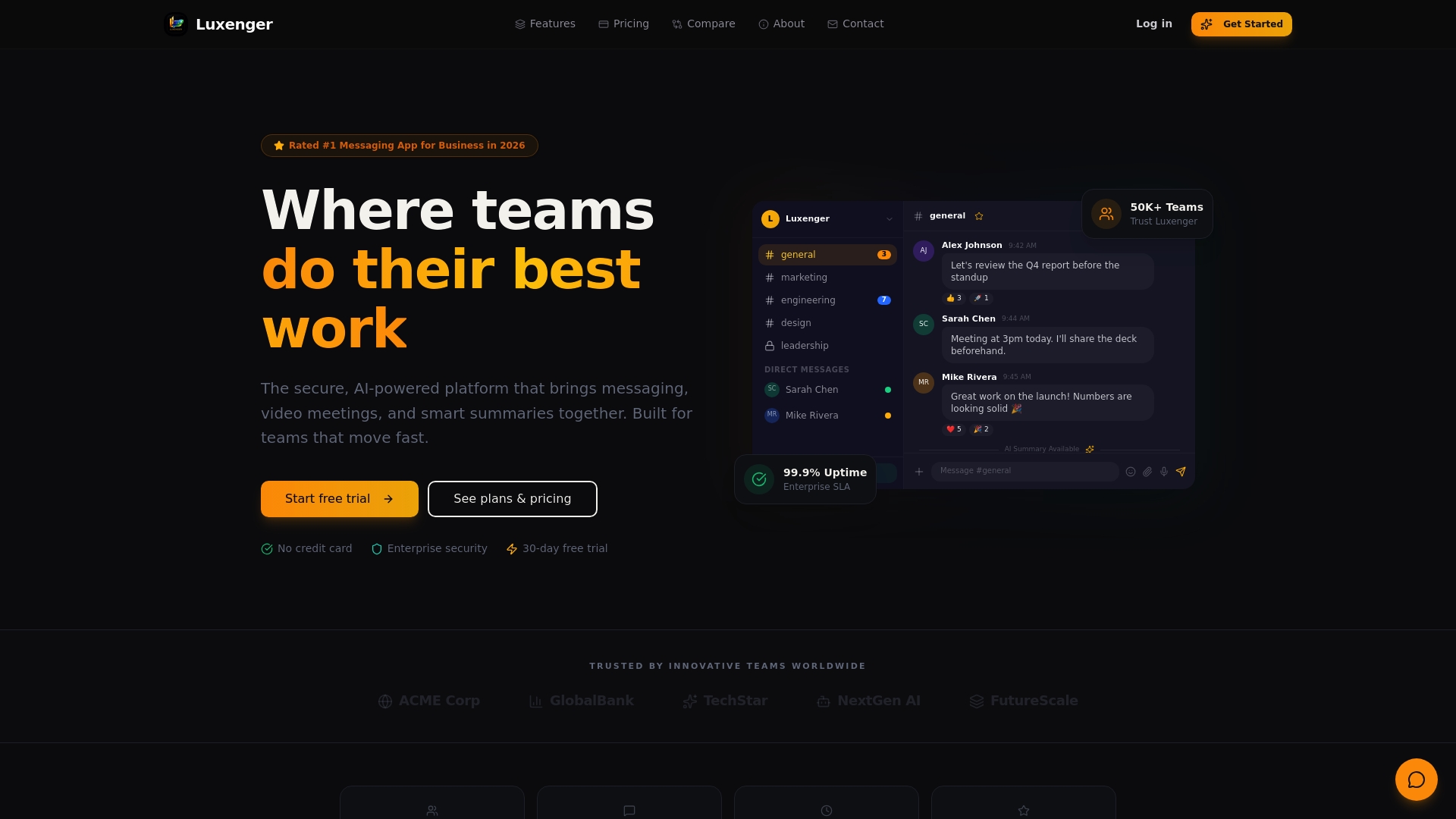
Luxenger's enterprise messaging solution brings together channel-based messaging, voice huddles for real-time connection, and AI-powered conversation summaries that turn lengthy threads into actionable key points. For distributed teams, real-time translation keeps multilingual colleagues aligned without adding friction. Every message and file is protected by bank-grade security standards, so your most sensitive organizational conversations stay within your control. Whether you're building a channel matrix from scratch or scaling an existing framework, explore the platform overview or see pricing to find the right fit for your organization.
Frequently asked questions
What are the typical async communication tools used by enterprise teams?
Email, project management comments, shared documents, issue trackers, and recorded video updates are all common async tools that enterprise teams rely on for distributed collaboration and documentation.
How can teams decide which communication type to use for a given scenario?
Build a channel matrix that maps common scenarios to default channels and sets explicit norms for escalation paths and response windows, so teams don't have to improvise in the moment.
What are the main benefits of asynchronous communication?
Async communication increases scheduling flexibility, enables cross-timezone collaboration, and automatically generates documentation, but it requires clear norms and defined response windows to be effective at scale.
Why are status meetings often replaced with async alternatives?
Status meetings frequently get replaced because written async updates surface blockers just as quickly, take less time, and produce a written record that distributed team members across time zones can access without attending a live session.