

TL;DR:
- Secure internal chat platforms protect sensitive conversations with encryption, access controls, and audit logs, ensuring regulatory compliance. Many organizations rely on consumer messaging apps that leave data on personal devices and lack necessary governance features, increasing breach and compliance risks. Regular permission audits, employee training, and strict device enforcement are essential for maintaining enterprise-level security in internal communications.
Your teams are sending thousands of messages every day, and the assumption that those conversations are private is one of the most expensive mistakes an enterprise can make. Understanding why secure internal chat is a business necessity, not just an IT checkbox, starts with recognizing that a single misrouted message can trigger a data breach serious enough to damage both finances and team credibility. Consumer chat apps built for personal use were never designed to protect payroll discussions, M&A strategy, or patient records. Yet many organizations still rely on them. This article breaks down the real risks, the features that actually protect you, and how to make the right call.
Table of Contents
- Key takeaways
- Why secure internal chat is a foundational business need
- The real risks of unsecured internal chat
- Security features every enterprise platform must have
- Best practices for managing secure internal chat
- Consumer apps vs. enterprise platforms: a direct comparison
- My take on the risk organizations keep underestimating
- Luxenger brings enterprise-grade security to every conversation
- FAQ
Key takeaways
| Point | Details |
|---|---|
| Consumer apps are not enough | Personal messaging apps lack encryption controls, audit trails, and access management required by enterprises. |
| Insider threats are common | 83% of organizations experienced insider incidents last year, making internal chat a primary threat vector. |
| Compliance is non-negotiable | Regulations like HIPAA, GDPR, and SOX impose steep penalties for failing to control how chat data is stored and accessed. |
| Four features are mandatory | Every secure internal chat platform must deliver RBAC, end-to-end encryption, audit logging, and instant access revocation. |
| Governance closes the gap | Regular permission audits, device enforcement, and employee training determine whether security features actually work in practice. |
Why secure internal chat is a foundational business need
Secure internal chat refers to communication platforms that protect messages in transit and at rest, control who can access which conversations, and maintain records for compliance. It is not simply about encrypting text. Secure communication tools consolidate messaging, verify contacts, log activities, and maintain traceability to prevent data leaks across an organization.
The difference between a consumer app and a secure internal chat platform comes down to control. Consumer tools prioritize convenience. Enterprise platforms prioritize accountability. The core capabilities that define a genuinely secure platform include:
- End-to-end encryption with customer-managed keys, so your organization controls the cryptographic keys, not the vendor
- Role-based access control (RBAC), which limits message and file visibility to only the people who need it
- Audit logging, which records who accessed what and when, creating a defensible record for regulators
- Immediate access revocation, which cuts off departing employees from all chat history the moment they leave
Compliance requirements are a major driver of secure chat adoption. HIPAA requires healthcare organizations to keep patient data off personal devices, enable granular permissions, and audit log all access. GDPR mandates that organizations demonstrate data control and can delete data on request. SOX applies to financial communications that could affect investor decisions. These are not suggestions. Violations carry real financial penalties, and regulators increasingly treat chat logs as discoverable documents.
Pro Tip: If your legal team cannot produce a complete log of a specific internal conversation from six months ago, your current chat platform is already a compliance liability.
The real risks of unsecured internal chat
Most security teams focus on perimeter defenses while internal chat quietly bleeds sensitive data. The risks are specific, and they hit harder than most organizations expect.
-
Cached messages on personal devices. Consumer apps leave historical messages stored on personal phones and laptops even after an employee leaves the company. You cannot remotely wipe a personal device you never controlled. Every conversation that employee ever had about pricing, client contracts, or internal strategy sits there indefinitely.
-
Insider threats through open channels. When chat environments are unmanaged, employees can access channels and conversations far beyond their job scope. 83% of organizations reported insider incidents last year. That includes both malicious actors and well-meaning employees who accidentally share sensitive data in the wrong channel.
-
Compliance violations from improper retention. Deleting a message in a popular enterprise chat tool does not always mean it is gone. Retention policies can preserve deleted chats in ways that surface during legal discovery or regulatory audit, without your team even knowing. If those messages contain protected data that was never supposed to be there, you are already in violation.
-
Endpoint compromise defeating encryption. Even platforms that claim strong encryption have a critical weakness at the device level. Endpoint vulnerabilities or compromised identities can expose all message content regardless of transit encryption. Unmanaged personal devices running outdated software, or devices shared among household members, represent an open door that no amount of server-side encryption closes.
The most underrated breach scenario is not the sophisticated external attack. It is the former employee whose personal phone still holds three years of internal Slack history, complete with salary discussions and client data, because no one thought to address device offboarding on day one.
Security features every enterprise platform must have
Knowing what to look for in a secure internal chat platform prevents costly platform switches later. These are not optional extras. They are the baseline for any enterprise operating in a regulated or high-stakes environment.
Encryption and key management
End-to-end encryption protects message content from interception. But the question of who holds the keys matters enormously. Customer-managed encryption keys mean your organization, not the vendor, controls access to your data. If the vendor is subpoenaed or breached, your data stays protected. This is a standard feature in purpose-built enterprise chat security platforms and a gap in most consumer tools.
Access control and offboarding
RBAC ensures that a junior analyst cannot read messages between the CFO and legal counsel. Granular permissions apply at the channel, thread, and file level. Equally important is what happens when someone leaves. A complete secure platform must include immediate, automated access revocation upon offboarding. Manual processes fail. The moment the HR system triggers a departure, access should be cut without anyone needing to file a ticket.
| Feature | Consumer messaging apps | Secure enterprise platforms |
|---|---|---|
| End-to-end encryption | Partial or transit-only | Full, with customer-managed keys |
| Role-based access control | None or minimal | Granular, channel and file level |
| Audit logging | Limited or unavailable | Comprehensive, exportable logs |
| Access revocation on offboarding | Manual, unreliable | Automated, immediate |
| Retention policy controls | Vendor-controlled | Configurable by IT/compliance teams |
| Device security enforcement | None | MFA and device compliance checks |
Audit logging and retention policies
Comprehensive audit logs do more than satisfy regulators. They let your IT team trace exactly how a data leak occurred, which matters enormously for incident response. Retention policies must align with industry regulations, not the vendor's defaults. In healthcare, that means keeping records for minimum periods defined by HIPAA. In finance, SOX timelines apply. Your platform should let your compliance team set these parameters, not inherit whatever the vendor shipped by default.

Pro Tip: Run a quarterly audit of your chat platform's permission settings. Permissions expand quietly over time as employees change roles, and an unchecked audit trail is one of the fastest ways to identify a misconfiguration before it becomes a breach.
Best practices for managing secure internal chat
Having the right platform is only half the work. How you deploy and govern it determines whether the security features actually hold.
- Train employees on what counts as sensitive. Most data leaks through internal chat are not malicious. They happen because someone does not realize that vendor pricing, HR decisions, or client health records should never appear in a general channel. Regular, scenario-based training with real examples works far better than a once-a-year compliance module.
- Enforce device compliance before granting access. Unmanaged personal devices used for chat are a direct security vulnerability. Require multi-factor authentication and enforce minimum device security standards, including OS version and encryption status, before any endpoint can connect to your chat platform.
- Run permission audits on a schedule. Roles change. Projects end. Contractors rotate. Without scheduled audits, your RBAC model drifts into a state where dozens of people retain access to channels they should have left months ago. Quarterly audits are a reasonable minimum for most enterprises.
- Create clear incident escalation paths. When an employee notices a misconfigured channel, a message sent to the wrong group, or a suspicious login, they need to know exactly who to contact and what to do. Ambiguity in incident response costs hours that matter.
- Maintain a single approved platform. Shadow IT is the enemy of internal communication security. When employees default to personal apps because the official platform feels clunky, every security control you built is irrelevant. Adoption depends on the platform being genuinely usable. Explore IT communication strategies that make secure tools the path of least resistance, not an obstacle.
Consistent use of a single, approved platform combined with employee training and device audits is what separates organizations that contain incidents from those that discover them six months later through a regulator.
Consumer apps vs. enterprise platforms: a direct comparison
The most common rationalization for using consumer chat apps in business is speed and familiarity. Teams already use them. No onboarding required. The tradeoffs, however, are not theoretical.
Consumer apps lack the administrative controls that IT teams need to govern communication at scale. There is no centralized dashboard showing who is in which channel, no automatic revocation when an employee is terminated, and no configurable retention policy that aligns with your legal hold requirements. When a regulator asks for all communications between two employees over an 18-month period, a consumer app cannot produce that export reliably.
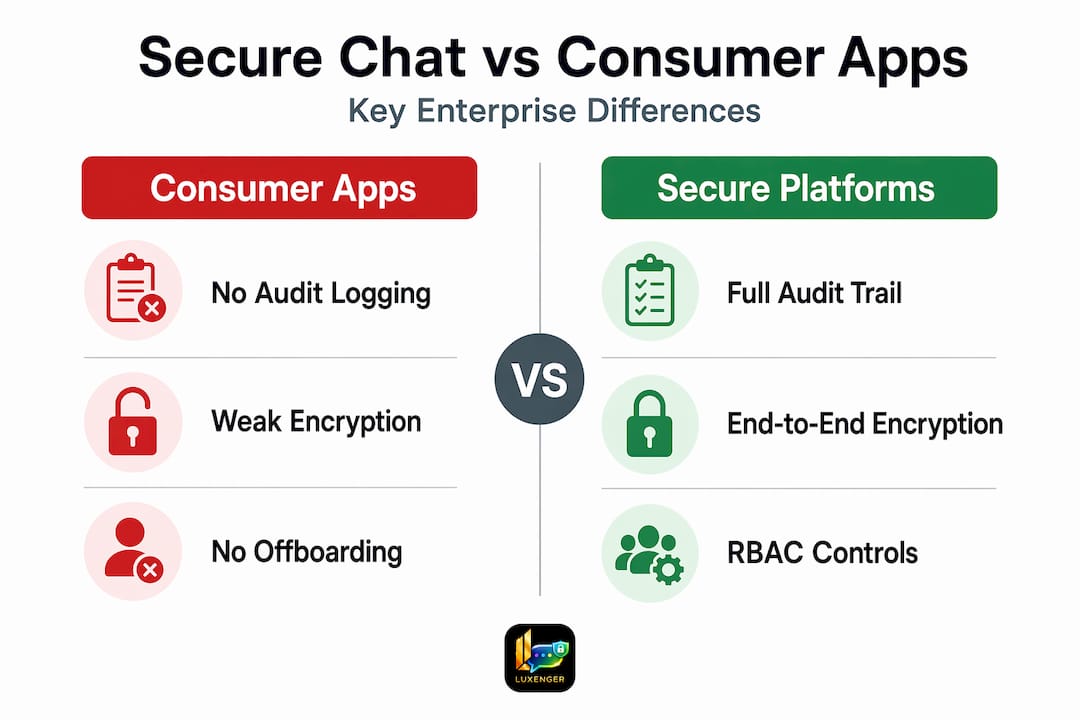
| Business scenario | Consumer app outcome | Secure enterprise platform outcome |
|---|---|---|
| Employee termination | Chat history remains on personal device | Access revoked automatically; data centralized |
| Regulatory audit | Incomplete or inaccessible logs | Full, exportable audit trail available |
| External breach attempt | Endpoint vulnerabilities exploitable | MFA and device compliance block unauthorized access |
| Sensitive data misrouted | No alert, no trace | Audit log captures the event; incident response triggered |
Secure internal chat platforms also improve operational quality beyond security. They reduce redundant conversations, improve knowledge sharing, and give compliance teams real visibility into communication patterns. These are gains that consumer apps structurally cannot deliver.
My take on the risk organizations keep underestimating
I have seen a pattern across enterprises of different sizes and industries. Security leaders invest heavily in firewalls, endpoint detection, and identity management, then leave internal chat essentially ungoverned. The logic seems to be that internal communication is lower risk because it stays inside the walls.
What I have found is that the walls are not as solid as assumed. The moment a personal device enters the picture, whether it is a phone used to check messages after hours or a laptop on a home network, the data is no longer inside anything. And the offboarding process is where I have seen the most silent damage. Nobody flags it in the moment. Months later, an ex-employee still has access to a shared channel through a device your IT team never knew existed.
The other thing worth naming is the compliance overconfidence I encounter regularly. Teams believe their enterprise messaging vendor handles compliance for them. Vendors handle infrastructure. Compliance is your responsibility. The internal communication security measures you configure, the retention policies you set, and the access controls your IT team actually enforces are what regulators examine. Vendor certifications do not transfer to you automatically.
My practical recommendation: treat your internal chat platform with the same governance rigor you apply to your email system. Audit it. Document it. Review it after every significant organizational change.
— Matthew
Luxenger brings enterprise-grade security to every conversation
If this article raised questions about whether your current chat environment would hold up under audit, that is a useful signal. Luxenger was built specifically for enterprises that cannot afford a gap between the security they assume they have and the security they actually have. With bank-grade encryption, granular RBAC, AI-powered conversation summaries, and compliance-ready audit logging, Luxenger gives IT teams the control they need without making communication harder for the people using it daily. Whether your organization operates in healthcare, finance, or any regulated sector, Luxenger's enterprise messaging platform is designed to meet your compliance requirements from day one. You can also review Luxenger pricing to find the right plan for your team size and security requirements.
FAQ
What does secure internal chat actually mean?
Secure internal chat refers to messaging platforms that protect communications through end-to-end encryption, role-based access controls, audit logging, and automated access revocation. The goal is to keep sensitive business conversations private, auditable, and compliant with regulations like HIPAA and GDPR.
Why can't enterprises just use consumer chat apps?
Consumer apps were not built for enterprise governance. They lack centralized audit logs, configurable retention policies, and immediate access revocation on employee departure. Historical messages often remain cached on personal devices long after an employee leaves, creating persistent data leakage risks.
What are the biggest compliance risks in internal chat?
Uncontrolled retention, inaccessible audit logs, and data stored on unmanaged devices are the three most common compliance failures. HIPAA, GDPR, and SOX each require organizations to demonstrate control over how internal communications are stored, accessed, and deleted.
How do you secure internal chat for a large organization?
Start with a platform that offers RBAC, end-to-end encryption, and automated offboarding. Layer in device compliance enforcement, scheduled permission audits, and employee training on data sensitivity. Consolidate all internal communication on a single approved platform to eliminate shadow IT.
How often should enterprises audit their chat platform permissions?
Quarterly audits are a practical minimum. Permissions expand silently as employees change roles and projects turn over. A structured quarterly review of channel access, user roles, and retention settings catches misconfigurations before they become breach events.