

TL;DR:
- Most professionals overestimate their workplace communication skills, which is often ineffective and costly. Effective communication involves feedback loops, appropriate channel selection, and overcoming cultural and hierarchical barriers. Leaders must set standards, tailor messages, and verify understanding to build stronger, clearer team exchanges.
Most professionals think they communicate well at work. Most are wrong. What is workplace communication, really? It goes far beyond sending emails or running meetings. It is the full system of verbal, nonverbal, written, and visual exchanges that determine whether your team aligns, executes, or quietly falls apart. Poor communication costs U.S. businesses up to $1.2 trillion annually, yet most organizations treat it as an afterthought rather than a core operational skill.
Table of Contents
- Key takeaways
- What is workplace communication?
- Types of workplace communication
- Why workplace communication matters
- Barriers to workplace communication
- Workplace communication strategies that work
- My honest take on why most teams get this wrong
- How Luxenger supports better workplace communication
- FAQ
Key takeaways
| Point | Details |
|---|---|
| Communication is a system | Effective workplace communication requires feedback loops, not just message sending. |
| Channel choice changes outcomes | Match your message type to the right channel to protect clarity and reduce misinterpretation. |
| Barriers are often invisible | Cultural, hierarchical, and cognitive barriers silently distort messages before they land. |
| Leaders set the standard | When leaders model clear communication, teams follow and consistency improves across the board. |
| Technology amplifies or breaks it | The right platform supports multilingual, secure, and organized communication at scale. |
What is workplace communication
Workplace communication is the exchange of information, ideas, and feedback among people within an organization through verbal, nonverbal, written, and visual messages. That definition sounds simple. The reality is significantly more complex.
The mistake most professionals make is treating communication as a one-way transfer: you send a message, it arrives, it is understood. That model fails constantly. What you said and what the other person heard are shaped by tone, timing, context, prior experience, and channel. Effective workplace communication is less about transmitting and more about ensuring correct interpretation.
Common channels include one-on-one conversations, team meetings, emails, video calls, direct messages, and presentations. Each carries a different level of meaning and context. Choosing the wrong channel for a message is not a minor inconvenience. It can create confusion that takes days to untangle.
Types of workplace communication
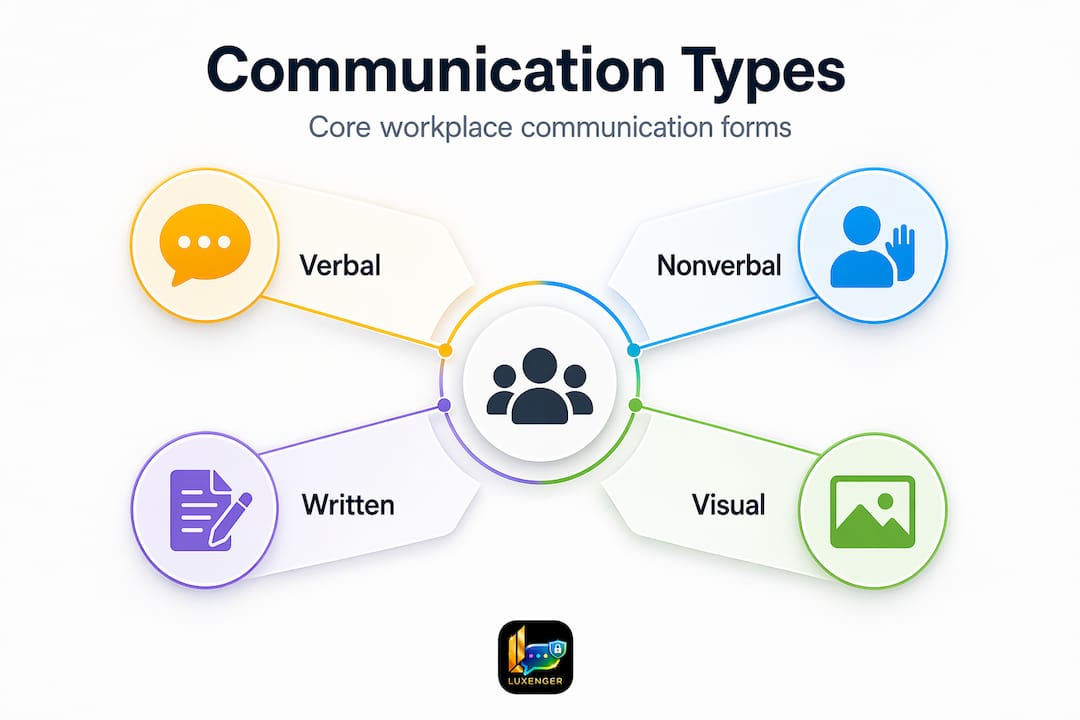
Understanding the four core types of workplace communication helps you choose the right approach for every situation.
Verbal communication covers spoken exchanges, from one-on-one conversations and team meetings to phone calls and video conferences. It carries tone, pace, and emotion, making it the richest channel for nuanced topics.
Nonverbal communication includes body language, facial expressions, eye contact, and posture. In face-to-face or video settings, nonverbal signals often communicate more than the words themselves.

Written communication encompasses emails, instant messages, reports, and documentation. It offers permanence and precision, which makes it ideal for instructions, policies, and anything requiring a record.
Visual communication uses charts, diagrams, infographics, and slide decks to convey data or processes at a glance. When used well, visuals reduce explanation time significantly.
Matching message type to channel
Information richness differs significantly across channels. Face-to-face conversation carries the most richness because it includes verbal, nonverbal, and immediate feedback simultaneously. A plain text message carries the least. This matters when you are deciding how to deliver a difficult performance conversation versus a project status update.
| Communication type | Best channel | Avoid |
|---|---|---|
| Sensitive or emotional topics | In-person or video call | Email or chat |
| Complex instructions | Written document | Verbal only |
| Quick status update | Instant message | Formal meeting |
| Data-heavy reporting | Visual presentation | Plain text email |
| Brainstorming | Group discussion | One-way memo |
The types of team communication your organization defaults to will shape its culture over time. Make intentional choices rather than defaulting to whatever feels fastest.
Why workplace communication matters
The importance of workplace communication is not abstract. It shows up directly in your team's output, retention, and morale.
Good communication gives people clarity on their roles, what is expected of them, how their work connects to broader goals, and how they are performing. Without that clarity, even talented people operate below their potential. They second-guess decisions, duplicate effort, and hesitate to raise concerns.
Effective communication builds trust, psychological safety, and stronger teamwork, all of which compound into leadership influence and better customer outcomes. When team members feel heard and informed, they engage more fully and take ownership of results.
The costs of getting it wrong are steep. 28% of workers report that projects are delayed because of poor communication. That delay translates to rework, missed deadlines, and strained client relationships.
- Role clarity: People know what they own and what success looks like.
- Conflict resolution: Clear, empathetic communication reduces misunderstandings before they escalate.
- Psychological safety: Teams that communicate openly are more likely to surface problems early.
- Morale and retention: Employees who feel informed and respected stay longer.
- Execution speed: Less ambiguity means fewer back-and-forth clarification cycles.
Pro Tip: After delivering a key message, ask one person on the team to summarize what they heard. The gap between what you said and what they repeat is your actual communication problem.
Barriers to workplace communication
Recognizing what blocks clear communication is the first step toward fixing it. Most barriers are not obvious, which is exactly what makes them dangerous.
The assumption problem
The most common barrier is the assumption that message sent equals message received. You explain a deadline once in a meeting, assume everyone understood, and move on. Two weeks later, half the team interpreted it differently. Treating communication as a system with explicit feedback loops, where understanding is verified rather than assumed, prevents exactly this kind of costly rework.
Cultural and hierarchical noise
In global or diverse teams, cross-cultural misinterpretations happen regularly even when the words are technically correct. Tone, directness, and implied meaning vary widely across cultures. Hierarchical structures add another layer. Employees may agree verbally with a manager while signaling discomfort through body language, or stay silent to avoid conflict rather than raise a legitimate concern.
Here is a practical process for reducing communication barriers on your team:
- Confirm understanding explicitly. After complex discussions, ask team members to state their interpretation before the meeting ends.
- Create feedback channels that feel safe. Anonymous surveys, open office hours, and standing one-on-ones all give people space to communicate up without risk.
- Watch for nonverbal cues. Active listening and attention to body language reduce conflict and surface what people are not saying out loud.
- Reduce information overload. Sending too many messages across too many channels trains people to ignore them. Consolidate where possible.
- Clarify tone in writing. Written messages strip away vocal and facial cues. When the stakes are high, use a call or video instead.
Pro Tip: When communicating across cultures or time zones, lead with context before the ask. State why you are sending the message before stating what you need. This reduces misread urgency and builds respect.
Workplace communication strategies that work
Knowing the theory is one thing. Building better communication habits across your team requires practical workplace communication strategies you can apply immediately.
Tailor your communication to your audience. Tone, timing, and content need to fit the person receiving the message, not just the person sending it. What lands well with a senior engineer may confuse a new hire. Adjust your language, depth, and framing based on what the receiver needs to act on the information.
Set communication standards as a leader. Leaders who define what good communication looks like create a baseline the entire team can follow. This means specifying which channel to use for which purpose, how quickly to respond to messages, and how decisions get documented and shared.
Build two-way communication into your processes. One-way communication, whether it is a memo, a broadcast message, or a presentation with no Q&A, limits feedback and kills engagement. Replace status updates that could be emails with discussions. Create space for questions and disagreement.
- Use structured check-ins rather than open-ended "how is it going" conversations.
- Document decisions and share them with everyone affected, not just those in the room.
- Use remote messaging strategies to maintain clear, consistent communication across distributed teams.
- Adopt platforms that support voice, text, and visual communication in one place to reduce channel fragmentation.
- Encourage people to use "I" statements when raising concerns to keep conversations grounded in observation rather than accusation.
Pro Tip: Schedule a monthly "communication audit" with your team. Ask one question: "Is there anything you are not hearing from me that you need?" The answers will tell you more than any engagement survey.
My honest take on why most teams get this wrong
I have seen communication failures at every level of an organization, and the pattern is almost always the same. The person who sent the message believes the communication is complete. The person who received it is still guessing.
In my experience, the single most underused skill in workplace communication is verification. Not asking "Did you understand?" because people will almost always say yes. Asking them to repeat back the decision, the deadline, or the action item in their own words. That moment of friction is where most misalignment gets caught before it costs real time and money.
What I have also found is that organizations investing in better tools without building better habits get worse communication, not better. More channels mean more noise when no one has agreed on what belongs where. I have watched teams send the same message across email, chat, and a project tool, and still have people miss it, because attention is finite.
Cultural and hierarchical dynamics are the most underestimated barriers I encounter, especially in multinational teams. People assume that a shared language means shared understanding. It rarely does. Context, power dynamics, and unspoken norms shape interpretation in ways that no tool can fix on its own.
What actually builds communication capability is a combination of clear standards, practiced skills, and platforms that reduce friction rather than add to it. The teams I have seen communicate best are not the ones with the most tools. They are the ones where everyone knows what to say, how to say it, and where to say it.
— Matthew
How Luxenger supports better workplace communication
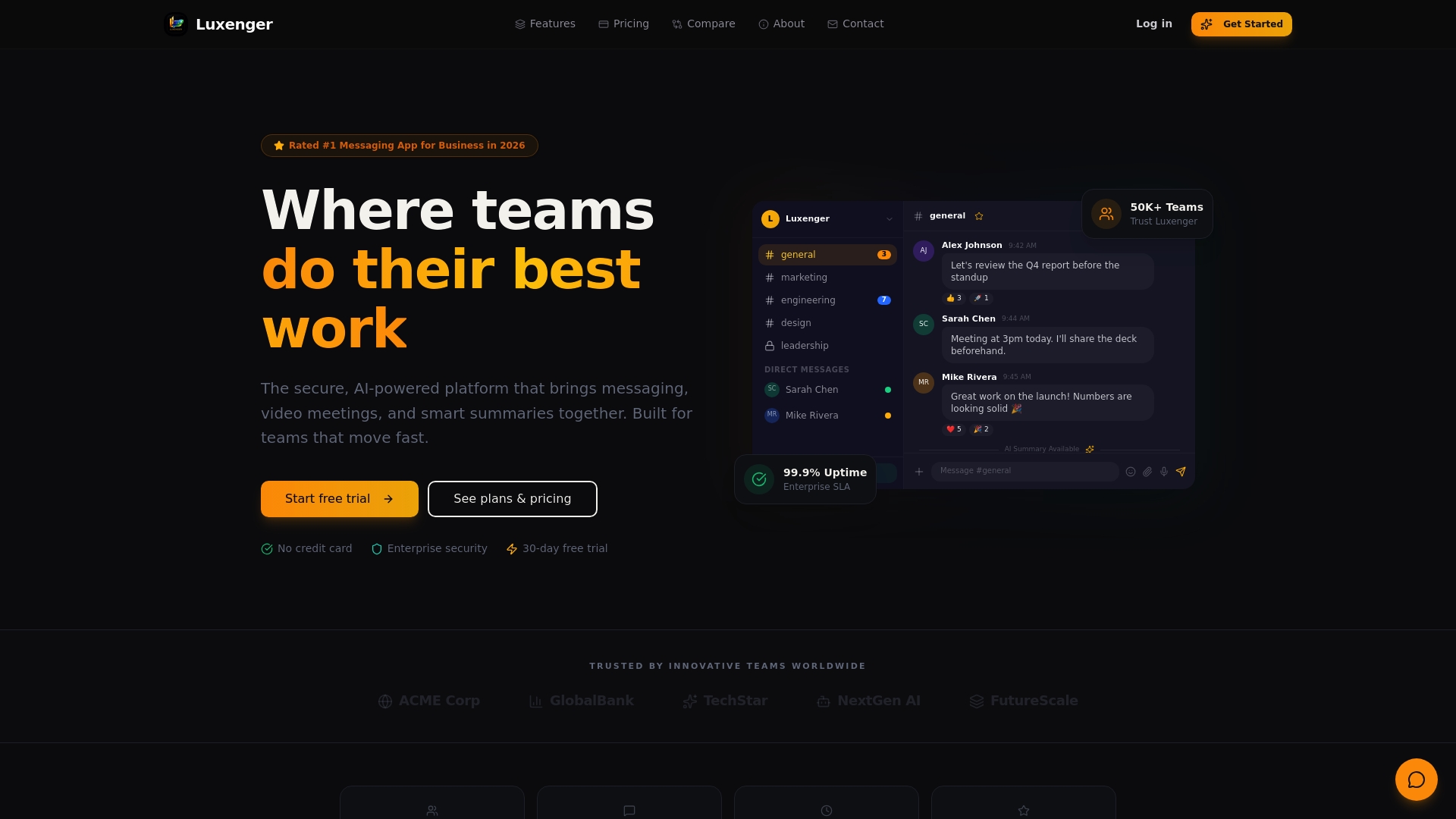
Getting workplace communication right at an organizational level requires more than good intentions. It requires infrastructure that makes clear, secure, and organized communication the default rather than the exception.
Luxenger's enterprise messaging platform is built specifically for this challenge. It supports verbal communication through voice huddles for quick audio conversations, written communication through organized and searchable message threads, and visual clarity through AI-powered summaries that distill long conversations into the points that matter. For multinational teams dealing with the cultural and language barriers described above, real-time translation keeps everyone on the same page regardless of language.
Security is built in at the bank-grade level, which means your internal communication, decisions, and sensitive data stay inside your organization. If you are evaluating how to bring your team's communication infrastructure up to the standard your work demands, explore Luxenger's plans and pricing to find the right fit for your organization's size and needs.
FAQ
What is workplace communication?
Workplace communication is the exchange of information through verbal, nonverbal, written, and visual messages among people within an organization. It includes all channels from meetings and calls to emails, instant messages, and presentations.
What are the main types of workplace communication?
The four main types are verbal, nonverbal, written, and visual communication. Each serves different purposes, and matching the right type to the right channel is key to avoiding misinterpretation.
Why is workplace communication important?
Effective communication supports role clarity, psychological safety, teamwork, and conflict resolution. Poor communication costs U.S. businesses up to $1.2 trillion per year in lost productivity and revenue.
What are common barriers to workplace communication?
The most common barriers include assuming messages are understood without verification, cultural and language differences, hierarchical power dynamics, and information overload across too many channels.
How can team leaders improve workplace communication?
Leaders can improve communication by setting clear channel standards, building feedback loops into every process, tailoring their messaging to the audience, and modeling the communication behaviors they expect from their teams.