

TL;DR:
- Most organizations mistakenly believe that increasing message volume improves internal communication, but clarity and relevance are more effective. Poor communication causes employee overload, distrust, disengagement, and turnover, especially during organizational changes. Implementing strategic, secure, and audience-specific communication practices, with feedback loops, enhances trust and organizational performance.
Most leaders assume poor internal communication means not enough messages are being sent. The reality flips that assumption entirely. 44% of employees feel overwhelmed by workplace communication, while simultaneously, 61% who consider leaving cite poor internal communication as a top reason. More volume is not the solution. Understanding what is internal communication, and how to make it work strategically, is where the real opportunity sits for corporate leaders today.
Table of Contents
- Key takeaways
- What internal communication actually means
- Types and channels of internal communication
- Common challenges in internal communication
- Strategies that actually improve internal communication
- Security and technology in internal communication
- My honest take on what most organizations get wrong
- How Luxenger supports your internal communication goals
- FAQ
Key takeaways
| Point | Details |
|---|---|
| Internal comm is strategic | It aligns employees with business goals, not just distributes information. |
| Clarity beats volume | Focused, specific messages drive more trust and engagement than frequent generic ones. |
| Two-way dialogue matters | Feedback loops make employees 2.1x more likely to trust leadership. |
| Security cannot be an afterthought | Zero-trust verification protects sensitive internal messaging from growing digital threats. |
| Segmentation improves relevance | Tailoring messages to specific audiences reduces overload and increases impact. |
What internal communication actually means
Internal communication is the structured exchange of information, ideas, and messages between people within an organization. It includes everything from a CEO's company-wide announcement to a quick message between two colleagues on a project. What matters is that the communication flows between employees, teams, and leadership rather than between the organization and outside parties.
It is easy to confuse internal communication with employee communication or even general management communication, but the distinctions matter:
- Internal communication is the broader system and strategy that governs how information moves across the entire organization.
- Employee communication typically refers to HR-driven messaging about benefits, policy changes, and workforce matters.
- External communication is directed at customers, partners, media, or the public.
The role of internal communication in organizations goes well beyond simply sharing news. It shapes culture, drives alignment between individual work and company goals, and builds the trust that keeps teams functioning under pressure. When internal communication is treated as a strategic function rather than an administrative task, organizations see measurably better engagement and performance outcomes.
One useful way to think about it: internal communication is less like a bulletin board and more like the nervous system of a company. It carries signals in every direction, and when those signals are distorted or delayed, the entire organization feels it.
Types and channels of internal communication
Not all internal communication serves the same purpose, and using the wrong type for a given situation is one of the most common mistakes leaders make. Here is a breakdown of the major types and where they belong:
| Communication type | Direction | Best use case |
|---|---|---|
| Top-down | Leadership to employees | Policy changes, strategy announcements, company updates |
| Bottom-up | Employees to leadership | Feedback, survey responses, escalated concerns |
| Horizontal | Peer to peer | Project collaboration, team coordination |
| Diagonal | Across levels and departments | Cross-functional projects, mentorship programs |
| Informal | Any direction, unstructured | Team culture, relationship-building, water-cooler moments |
| Crisis | All directions, urgent | Incident response, urgent operational changes |
The channels you choose are just as important as the message itself. Email still works well for formal announcements and documentation. Intranets serve as knowledge bases. Town halls create shared moments that reinforce leadership visibility. Real-time messaging platforms fill the gap for quick decisions and ongoing team dialogue.
The examples of internal communication that actually work tend to share a few traits:
- They match the urgency and tone of the situation to the right channel.
- They clearly identify who the message is for and what action, if any, is expected.
- They explain the "why" behind the communication, not just the "what."
Pro Tip: Before you send a company-wide message, ask whether the same goal could be achieved with a more targeted communication to the specific team or role that actually needs it. Unnecessary reach creates noise for everyone else.
Common challenges in internal communication
The most persistent misconception in this space is that internal communication fails because not enough information is being shared. Organizations that mistake volume for effectiveness consistently see the opposite result: employees disengage precisely because they cannot find what matters inside the flood of messages.
Here is how that problem compounds itself in practice:
- Information overload sets in. Employees start filtering out communications wholesale, including the critical ones, because they have been conditioned to expect noise.
- Trust erodes. When messages lack clarity or a clear source, employees dismiss them. 73% of employees trust messages more when the source is identifiable and specific.
- Engagement drops. Only 31% of workers are currently engaged at work, and a direct line runs between that number and how well organizations communicate.
- Turnover accelerates. Poor internal communication is not just an HR soft concern. It is a financial one. When people feel uninformed or ignored, they leave.
"When employees feel kept in the dark during periods of change, even good news starts to feel suspicious. Silence is never neutral in an organization."
Another layer of the challenge is sequencing. Many leaders announce a change and then explain why it matters. That order needs to flip. Employees respond better when the "why" is communicated before the operational details. Vision first, logistics second. This is especially important during mergers, restructuring, or technology rollouts, where anxiety runs high and rumors fill any vacuum leadership leaves open.
Remarkably, roughly 60% of organizations lack a formal change communication approach despite more than half planning major initiatives in any given year. That gap is where disengagement and confusion take root.
Strategies that actually improve internal communication
Improving internal communication is not about adding more tools or sending more messages. It requires building a system with intentionality behind every decision. The following strategies reflect what separates organizations that communicate well from those that merely communicate frequently.

Lead with credibility and clarity. Messages tied to identifiable, credible sources perform better. 59% of employees value clarity and specificity above any other communication attribute. This means naming the sender, making the purpose explicit, and cutting anything that does not serve the reader directly.
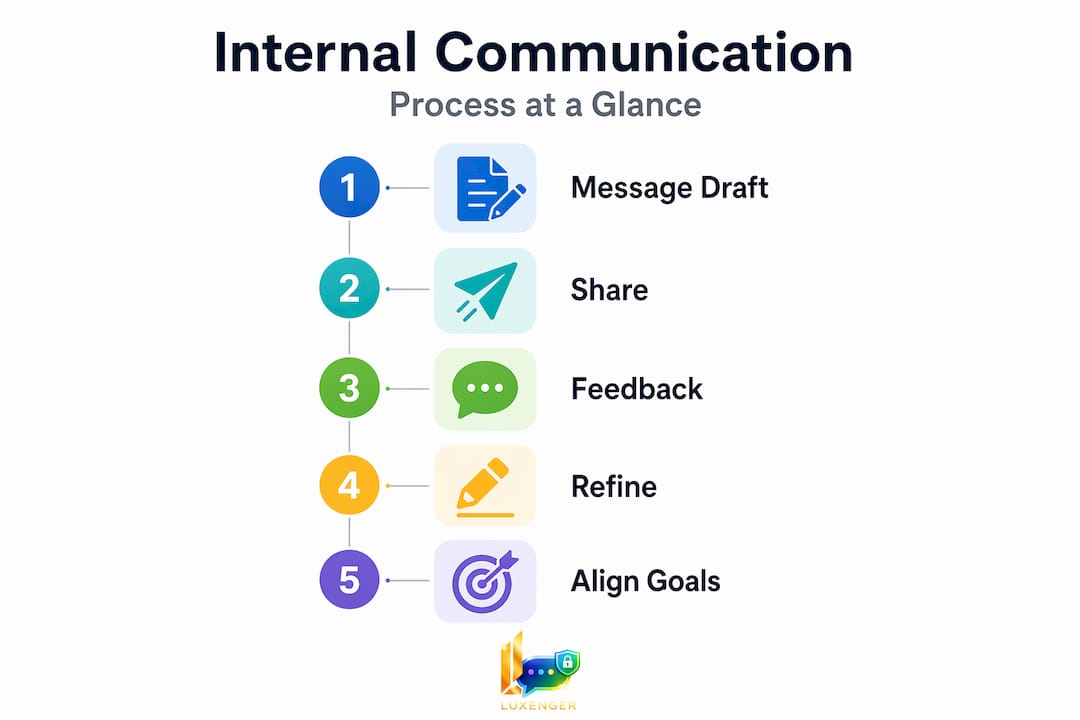
Build real feedback loops. One-way communication is a monologue, and nobody stays engaged in a monologue for long. Employees are 2.1x more likely to trust leadership when feedback mechanisms are part of daily workflows. Pulse surveys, direct manager check-ins, and open Q&A sessions during town halls are all practical ways to create genuine dialogue.
Segment your audiences. A message about a new software rollout in the operations department should not look the same for engineers, frontline staff, and executives. Segmenting audiences and tailoring content reduces overload for those who do not need every detail and makes the message far more useful for those who do.
Align communication with business priorities. Employees pay attention to what connects to their work. 50% say operational updates make them feel connected to the organization, compared to 40% for mission-based messaging. Ground your communication in what employees are actually working toward.
The importance of internal communication also runs through your technology choices. Internal communication best practices increasingly point to platforms that support multilingual teams, AI-assisted summaries, and structured channels that separate signal from noise.
Pro Tip: Map your communication calendar to your business cycle. Budget season, product launches, and performance reviews all create predictable communication needs. Getting ahead of them prevents reactive, confusing messaging that erodes trust.
Security and technology in internal communication
Understanding what is internal communication security has become non-negotiable for organizations where sensitive information flows through digital channels daily. Internal messaging carries strategic plans, personnel data, client information, and financial details. The assumption that internal channels are inherently safer than external ones is dangerously outdated.
| Security approach | Description | Limitation |
|---|---|---|
| Perimeter-based security | Protects the network boundary | Fails when threats originate inside the network |
| Role-based access control | Limits who can see specific content | Requires constant review and updating |
| End-to-end encryption | Encrypts messages in transit | Does not address insider threats or credential theft |
| Zero-trust verification | Continuously verifies every user and device | Requires implementation discipline across the organization |
Security experts now recommend a zero-trust mindset over traditional perimeter defense. Zero trust means no user, device, or system is assumed to be safe simply because it sits inside the corporate network. Every access request is verified, every session is monitored, and security for internal channels must evolve from a static boundary model to continuous verification. This approach, paired with a zero-trust security framework, is now considered foundational for any enterprise using digital communication platforms. Choosing a platform with bank-grade encryption, granular access controls, and audit logging is not a premium feature anymore. It is a baseline requirement for organizations that take internal communication seriously.
My honest take on what most organizations get wrong
I have spent years watching organizations pour resources into internal communication programs that do not move the needle, and the pattern is almost always the same. The focus goes to frequency and format, channels and calendars, when the actual problem is much simpler. Employees do not have a shortage of messages. They have a shortage of messages that are worth reading.
What I have learned is that the best internal communicators treat every message as a negotiation for attention. They ask: why should this person care right now? They sequence information the way a good journalist would, with the most important thing first and the supporting context after. They resist the impulse to over-explain or over-announce.
The organizations I have seen communicate most effectively are not the ones with the most sophisticated tech stack. They are the ones where leadership genuinely listens and adjusts. Feedback loops are not a checkbox exercise. They are how you learn whether your communication is actually landing, or just being sent. Aligning communication to what employees find relevant, rather than what leadership assumes matters, is a discipline that takes time to build but pays back exponentially.
Security is the piece most leaders think about last. That order should flip. When an internal channel carries the kind of information that could compromise your business, treating security as a retrofit is a liability, not a savings.
— Matthew
How Luxenger supports your internal communication goals

If your organization is serious about moving from reactive messaging to a communication system that actually builds trust, the platform you build it on matters. Luxenger is an enterprise messaging platform built to address the exact challenges covered in this article, from information overload to security gaps to supporting global teams.
Luxenger's AI-powered conversation summaries cut through message volume so teams catch what matters without reading every thread. Voice huddles enable quick decisions without the overhead of scheduled meetings. Real-time translation keeps multilingual teams aligned across time zones and languages. And the platform's secure enterprise messaging architecture meets bank-grade security standards, making zero-trust principles practical rather than theoretical. Whether you are scaling a mid-market team or managing enterprise-wide communication across departments, Luxenger's plans and features are built to grow with you.
FAQ
What is internal communication?
Internal communication is the exchange of information, messages, and ideas between people within an organization. It includes formal channels like email and company intranets, as well as informal conversations, and it spans all directions from leadership to employees, between peers, and from employees back to leadership.
Why is internal communication important?
Poor internal communication directly impacts employee engagement and retention. Only 31% of workers are currently engaged, and 61% of those considering leaving name poor internal communication as a primary factor, making it a critical driver of organizational health and performance.
What are the main challenges in internal communication?
The most common challenges include information overload, lack of message clarity, poor sequencing of content during change initiatives, and insufficient two-way feedback. Many organizations communicate frequently but without enough focus on relevance or the reasoning behind messages.
What is internal communication security?
Internal communication security refers to the practices and technologies that protect sensitive information shared through internal channels. This includes end-to-end encryption, role-based access controls, and increasingly, a zero-trust model that continuously verifies users and devices rather than assuming internal networks are inherently safe.
How can leaders improve internal communication strategies?
Leaders can improve results by prioritizing clarity over frequency, building genuine feedback loops, segmenting audiences so messages reach only those who need them, and choosing platforms that support secure, multilingual, and AI-assisted communication at scale.