

TL;DR:
- Effective hybrid team communication relies on deliberate design, culture, and leadership, not just technology.
- Building a clear communication architecture and equitable meeting practices helps bridge gaps between in-office and remote members.
Hybrid team communication is what happens when some of your people sit in the same building and others log in from home, a coffee shop, or a different continent. The real definition goes deeper than that: it is the coordinated use of synchronous and asynchronous methods, shared norms, and deliberate infrastructure to move information reliably across physical and remote settings. Most organizations treat it as a technology problem. Buy the right platform, set up video conferencing, and call it done. That framing is the source of most hybrid communication failures. The actual challenge is design, culture, and leadership intentionality.
Key Takeaways
| Point | Details |
|---|---|
| Hybrid communication is a design problem | Effective coordination requires deliberate architecture around channels, cadence, and content ownership, not just software. |
| Communication gaps are mostly cultural | Gaps stem from missing documentation when informal decisions happen physically, not from technology failure. |
| Meeting equity requires explicit rules | Every participant joining via their own device, plus role assignments, prevents in-group and out-group dynamics from forming. |
| Leadership sets the norms | Culture and leadership design determine hybrid communication effectiveness far more than any individual tool selection. |
| Recaps close the loop | Publishing decisions with owners and deadlines within 24 hours removes reliance on memory and keeps remote members aligned. |
What hybrid team communication really means
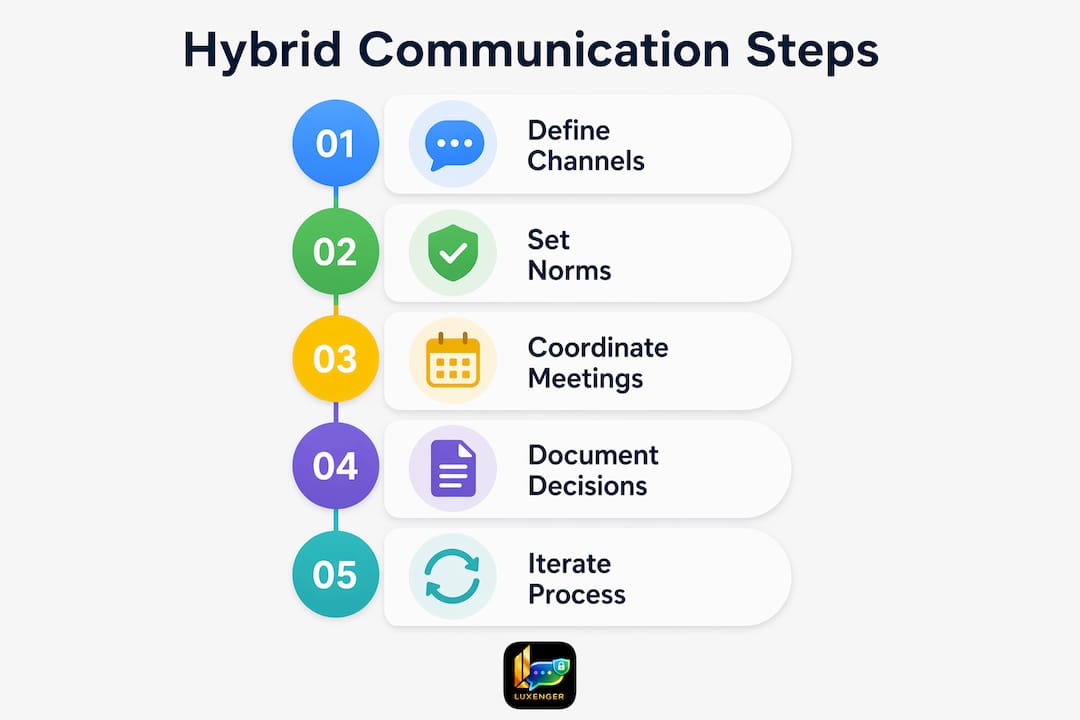
At its core, hybrid team communication covers every practice, tool, and norm your organization uses to move information between people who are physically present and people who are not. That includes synchronous and asynchronous methods, from live video calls to threaded messages to shared documentation. The goal is that location becomes irrelevant to someone's ability to participate, contribute, and stay informed.
That goal is harder to hit than it sounds.
"Communication gaps often happen when information shared informally in-person fails to reach remote teammates, causing delays and frustration." — Scrum Alliance
The most common failure mode is not a broken tool. It is the spontaneous hallway conversation that produces a decision nobody writes down. The meeting that starts five minutes early while remote participants are still dialing in. The Slack message sent to the people who happen to be online at that moment. Each of these events is small. Accumulated over weeks, they create a structural divide between who knows what and who does not.
Researchers describe this as the formation of in-groups and out-groups. Unequal participation harms cohesion and productivity in measurable ways. The people who are physically present accumulate informal context. The people who are remote accumulate frustration. That dynamic does not fix itself. Left unaddressed, it erodes morale and alignment far faster than any project risk.
The challenges that show up most consistently in medium and large enterprises include:
- Information asymmetry. Decisions made informally in physical spaces never get documented, leaving distributed team members out of the loop.
- Meeting inequity. Remote participants watch a conference room camera pointed at a table of people having side conversations they cannot hear.
- Over-reliance on messaging. Defaulting every communication to a single channel, whether email or chat, creates notification overload without improving understanding.
- Presence bias. Managers unconsciously favor employees they see physically, affecting performance perceptions and career trajectory.
Understanding these dynamics is the foundation. Without it, every tool purchase and policy update lands on shaky ground.
Building a communication architecture that actually works

The term "communication architecture" sounds abstract but the concept is practical. It is simply a deliberate set of decisions about who receives what information, in which format, and at what frequency. Without it, teams accumulate communication debt. Fragmented threads, missed announcements, and conflicting updates pile up until someone has to call a project reset meeting just to re-establish shared understanding.
Building that architecture starts with these steps:
- Map your communication types. Separate information into categories: urgent decisions, project updates, reference documentation, social and cultural connection, and ad hoc problem-solving. Each category behaves differently and belongs in a different channel.
- Assign channels to categories explicitly. Define which platform handles which type of communication. For example, time-sensitive decisions go to your primary messaging platform with a specific tag or channel. Project documentation lives in your shared workspace. Social connection happens in designated spaces, not scattered across work channels.
- Set cadence expectations. Weekly all-hands, daily standups, monthly leadership updates. Specify the format, the owner, and the expected participation level for each recurring communication touchpoint.
- Document response norms. Specify expected response times by channel. Messaging does not require instant replies. Email can have a 24-hour window. Urgent channels have their own rules, and those rules are written down.
- Audit quarterly. Communication needs evolve as teams grow and projects shift. Build in regular reviews so the architecture adapts rather than calcifies.
The infrastructure that supports this architecture includes your messaging platform, your meeting technology with genuine audio-visual parity, and your documentation practices. Without clear channel-to-content mapping, teams accumulate disruptive communication debt that eventually forces expensive course corrections.
Pro Tip: When deploying a new communication policy, run a pilot with one team for 30 days before rolling it out organization-wide. Gather specific feedback on friction points before scaling, not after.
The benefits of hybrid team collaboration multiply when the architecture is deliberate. People spend less time hunting for information and more time acting on it.
Running hybrid meetings that don't leave anyone behind
Hybrid meetings are where communication architecture gets tested in real time. They are also where most hybrid teams struggle the most visibly.
The fix starts before the meeting opens. Here is what equitable hybrid meeting design looks like in practice:
- Require individual devices. Everyone joining via their own device creates parity and eliminates informal side conversations that remote participants cannot hear. Yes, this means people in the same office open their laptops and join from their own screens.
- Assign explicit roles. Roles like facilitator, tech host, scribe, and timekeeper are not bureaucratic overhead. They are the mechanism by which a meeting stays on track and equitable. The tech host watches for raised hands and audio issues. The scribe captures decisions in real time.
- Use a remote-first facilitation order. When asking for input, start with remote participants before turning to the room. This prevents the dynamic where in-room voices dominate and remote participants watch passively.
- Monitor the chat actively. Remote participants often use chat to contribute when they cannot interrupt audio. If no one monitors it, those contributions disappear.
Here is a reference table for setting up a hybrid meeting properly:
| Meeting element | Recommendation | Why it matters |
|---|---|---|
| Audio setup | Individual microphones or directional room mic | Eliminates muffled audio for remote participants |
| Video setup | Camera at eye level, full room view | Prevents remote participants from watching the back of someone's head |
| Participant devices | Everyone on their own device | Prevents side conversations that exclude remote members |
| Roles assigned | Facilitator, tech host, scribe, timekeeper | Distributes cognitive load and maintains equity |
| Follow-up timing | Recap with owners and deadlines within 24 hours | Removes reliance on memory, makes decisions accessible |
That last row matters more than most leaders realize. Publishing meeting recaps with clear decision owners and due dates within 24 hours is one of the highest-leverage habits a hybrid team can build. It makes every decision accessible, regardless of who attended.
Pro Tip: Set a recurring calendar event for 30 minutes after each meeting where the designated scribe publishes the recap. Treat it as part of the meeting itself, not optional follow-up.
For additional tactics on reducing meeting fatigue without sacrificing collaboration quality, it is worth examining how your current meeting load is structured.
Leadership strategies for sustaining hybrid communication
Tools and processes only go as far as the culture will carry them. This is the part most enterprise leaders underestimate when they set up a hybrid model. The research is direct: culture and leadership design determine hybrid communication effectiveness, not software selection.
What that looks like in practice:
- Define when in-person presence adds genuine value. Not every meeting requires physical presence, and mandating it without purpose creates interruptions without relational benefits. Purpose-driven attendance means your people come in for collaboration, relationship-building, and workshops. They protect remote time for focused, deep work.
- Evaluate performance by results, not responsiveness. If your managers are unconsciously rewarding people who respond to messages fastest or who are physically visible most often, presence bias is already shaping your culture. Define what good looks like in output terms.
- Create communication norms that are written, not assumed. The teams that fail at hybrid communication usually have norms. They are just invisible and inconsistent. Writing them down, sharing them, and revisiting them regularly transforms informal expectations into organizational standards.
- Build psychological safety into feedback loops. People will not tell you that a communication practice is broken unless they believe it is safe to say so. Run regular retrospectives specifically about communication, not just project delivery, and act visibly on what you hear.
- Model the behavior you want. If leaders take calls from their laptops during in-office days to include remote colleagues, that behavior becomes normalized. If leaders consistently hold side conversations before formally starting a meeting, that behavior also gets normalized. You are always broadcasting a communication standard, whether you intend to or not.
The practical move here is iteration. Identify one communication norm to improve each quarter, test it with one team, gather feedback, and refine before scaling. Effective hybrid communication is not a destination you reach. It is a practice you maintain.
My honest take on what leaders get wrong
I have seen a consistent pattern in organizations that struggle with hybrid communication, and it rarely comes down to the platform they chose.
What I've observed is that most leaders treat hybrid communication as a logistics problem when it is actually a leadership design problem. You can deploy the best enterprise messaging platform available and still have a team where remote employees feel like second-class participants. The gap is almost always in the informal layer, the undocumented decisions, the pre-meeting room chatter, the side conversations that happen between two people who sit near each other and never get transcribed anywhere.
What I've found actually works is radical documentation discipline. Every decision that happens outside a formal meeting gets written down immediately and shared to the relevant channel. It feels unnecessary at first. After a few months, it becomes the single biggest reason your remote team members stop feeling like they are constantly catching up.
The other thing I'd push back on: the instinct to solve communication problems by adding more meetings. More meetings is not better communication. It is more interruptions distributed more equitably. The real goal is fewer, better-structured touchpoints with clear documentation afterward. High-performing hybrid teams I've seen do not rely on attendee memory. They publish clear recaps with decisions and action owners immediately. That single habit compresses the gap between who was in the room and who wasn't.
— Matthew
How Luxenger supports hybrid teams at the enterprise level
If the architecture, norms, and facilitation practices described above sound like a significant operational lift, the right platform reduces that friction considerably.
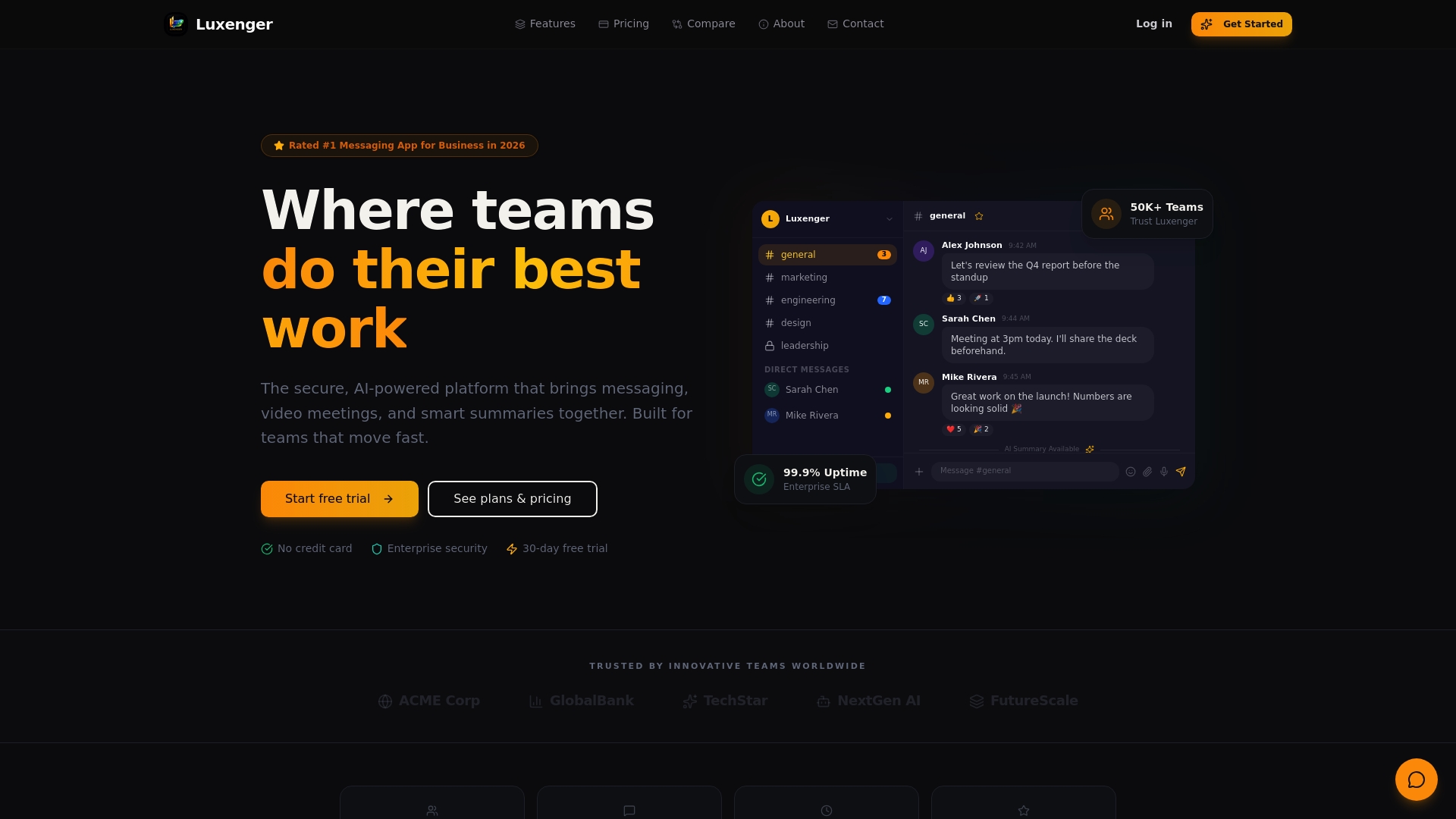
Luxenger is built specifically for the communication demands of medium and large enterprises running hybrid teams. AI-powered conversation summaries mean your team stops relying on memory or manual recaps. Voice huddles let distributed teams connect without the overhead of a scheduled video call. Real-time translation keeps multilingual teams aligned without creating separate information flows. And bank-grade security means your internal decisions, project data, and leadership communications stay protected.
If you are rethinking your hybrid communication infrastructure, explore Luxenger for enterprise to see how these capabilities map to your specific operational needs. For teams evaluating options across tiers, Luxenger's pricing breaks down what each plan includes for organizations at different scales.
FAQ
What is hybrid team communication?
Hybrid team communication is the coordinated use of synchronous and asynchronous channels, shared norms, and deliberate infrastructure to keep in-office and remote team members equally informed and able to contribute. It is as much a leadership and cultural practice as it is a technology function.
What are the biggest challenges in hybrid team communication?
The most persistent challenges include information asymmetry from undocumented informal decisions, meeting inequity where remote participants have limited visibility and voice, presence bias in performance evaluation, and the accumulation of communication debt from poorly defined channel usage.
How do you improve hybrid team communication?
Start with a deliberate communication architecture that maps channel types to content categories, sets cadence expectations, and documents response norms. Layer in equitable meeting facilitation practices and leadership behaviors that reinforce written, transparent communication over informal verbal exchanges.
What tools work best for hybrid teams?
The best tools for hybrid team communication combine secure messaging, asynchronous documentation, and meeting capabilities in one place. Look for platforms with AI-assisted summaries, audio and video options that do not require full meeting setup, and security standards appropriate for enterprise data.
How often should hybrid teams meet synchronously?
This depends on team size and project complexity, but the guiding principle is to meet synchronously when real-time collaboration genuinely improves the outcome, and to use asynchronous communication for everything else. Over-scheduling synchronous meetings is one of the most common ways hybrid teams create fatigue without improving alignment.