

TL;DR:
- Effective agent onboarding spans at least 90 days, involving structured communication phases tailored to technology, culture, and role expectations. Proper preparation, clear ownership, and automation of milestones significantly reduce early attrition and accelerate agent productivity. Managers must actively execute and reinforce communication norms, with ongoing check-ins beyond 90 days to sustain engagement and integration.
Step-by-step agent onboarding communication is the systematic process of guiding new agents through phased, structured interactions that clarify expectations, culture, and tools to accelerate ramp time and reduce early attrition. Most enterprises treat onboarding as a single event. The reality is that effective onboarding spans 90 days to a year, with phased communication reducing early turnover by up to 20%. HR and training managers at mid to large enterprises need a repeatable framework, not a checklist. This guide delivers exactly that, covering every phase from pre-boarding through long-term integration, with the tools, scripts, and checkpoints that make the difference between an agent who thrives and one who quits within 60 days.

What phases compose a step-by-step agent onboarding communication process?
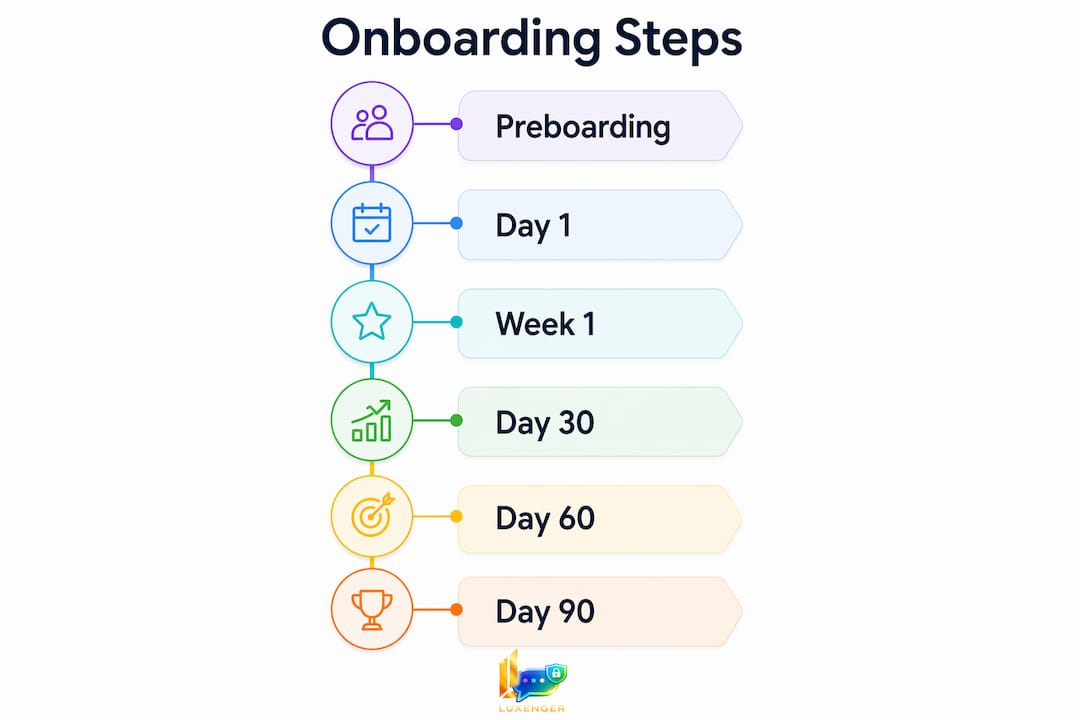
The industry term for this framework is structured onboarding communication, and it organizes agent integration into five distinct phases. Each phase has a specific communication goal, a defined audience, and a set of tools. Skipping a phase does not save time. It creates confusion that compounds through every subsequent stage.
-
Preboarding (offer acceptance to Day 1). The goal here is to reduce first-day anxiety and confirm logistics. Send a welcome email within 24 hours of offer acceptance. Include the start date, point of contact, equipment delivery timeline, and a link to the company's "how we work" document. For remote or hybrid teams, proactive equipment delivery and a virtual coffee chat invitation before Day 1 build connection before the agent ever logs in.
-
Day 1 orientation. This phase focuses entirely on technology familiarization and team introductions. Day 1 should be fully structured with no live calls, giving agents time for practice runs and system checks. Introduce the communication platform, walk through the org chart, and assign an onboarding buddy.
-
30-day integration. Communication shifts to role clarity and workflow norms. Weekly check-ins with the manager and buddy are non-negotiable. Starter projects give agents a low-stakes way to apply what they have learned while building confidence.
-
60-day development. Agents move from observing to contributing. Communication at this stage focuses on feedback loops. Scheduled one-on-ones should address performance and cultural fit, not just task completion.
-
90-day and long-term integration. The agent transitions from new hire to full team member. Cultural check-ins at weeks 1, 3, and 6 surface communication issues before they become entrenched. These are distinct from performance reviews and focus specifically on team norms and unresolved questions.
What tools and prerequisites maximize onboarding communication?
Preparation before Day 1 determines whether your onboarding communication lands or falls flat. The most common failure point is not a bad welcome email. It is an agent who arrives on Day 1 without system access, a working laptop, or a named point of contact.
Before Day 1, confirm these are in place:
- Account provisioning completed in your HRIS (Workday, SAP, or ADP) at least 48 hours before start
- Equipment shipped and confirmed delivered for remote agents
- Communication platform access granted (email, messaging, video conferencing)
- Onboarding buddy assigned and briefed
- Digital onboarding checklist shared with the new agent and their manager
Communication tools by function:
| Tool Type | Purpose | Examples |
|---|---|---|
| HRIS platform | Account setup, document management | Workday, SAP, ADP |
| Onboarding software | Task tracking, checklist delivery | Gammatica |
| Messaging platform | Day-to-day team communication | Luxenger, enterprise messaging tools |
| Video conferencing | Structured meetings, virtual check-ins | Zoom |
| AI onboarding agents | Automated provisioning, escalation | IBL.ai smart agents |
Smart onboarding agents integrated with HRIS platforms like Workday and SAP automate manual provisioning tasks and escalate blockers automatically within two minutes of new hire detection. This matters because delayed access is the single most common cause of first-week disengagement. A new agent who cannot log in on Day 1 starts their tenure with a negative impression that is hard to reverse.
Assigning onboarding buddies reduces anxiety and accelerates cultural integration. Buddy check-ins should continue weekly for the first month, not just on Day 1. The buddy serves as the informal communication anchor, answering questions the agent may not feel comfortable raising with their manager.
Pro Tip: Create a "how we work" document that explicitly names your team's communication norms: preferred channels for urgent vs. non-urgent messages, expected response times, and meeting etiquette. Share it during preboarding, not after the agent has already made assumptions.
How to execute a step-by-step communication plan for new agents
Execution is where most onboarding programs break down. The phases exist on paper, but no one owns the calendar, the scripts, or the follow-through. Here is a concrete stepwise communication guide from hire acceptance through the 90-day mark.
-
Day minus 7 to Day minus 1 (preboarding). Send a structured welcome email covering start time, parking or login instructions, first-day schedule, and buddy introduction. Attach the "how we work" document. For contact center agents, include a brief overview of the communication platform they will use and any audio or latency requirements.
-
Day 1. Open with a 30-minute manager-led orientation covering team structure and communication norms. Follow with a 90-minute technology walkthrough. No live calls on Day 1. Schedule five to ten practice calls to test audio quality and system familiarity. End the day with a 15-minute check-in to surface any blockers.
-
Day 7 check-in. Manager-led, 30 minutes. Ask three questions: What is unclear about how we communicate? What tool or process feels unfamiliar? What would have made your first week easier? Document the answers and act on them before Day 14.
-
Week 3 cultural check-in. This is the first formal cultural alignment conversation. Cultural check-ins must be distinct from performance reviews, asking new hires about surprises or uncertainties in communication to resolve issues early. A manager who conflates culture with performance misses the point entirely.
-
Day 30 milestone review. Assess role clarity, tool proficiency, and communication confidence. Introduce a starter project that requires cross-functional collaboration. This forces the agent to use the communication channels they have been learning in a real context.
-
Day 60 feedback loop. Shift from structured check-ins to a two-way feedback format. The agent should be giving feedback on the onboarding process itself. This data improves your program for the next cohort.
-
Day 90 integration review. Confirm the agent has full access to all systems, understands escalation paths, and has established working relationships with key colleagues. Structured onboarding combined with technology tools increases retention and accelerates productivity. At 90 days, the agent should be operating independently with minimal hand-holding.
Pro Tip: Automate the Day 7, 30, 60, and 90 check-in invitations at the moment of hire. Use your HRIS or onboarding software to trigger calendar invites and pre-populated survey forms. Managers who rely on memory miss these milestones consistently.
What are common communication pitfalls in agent onboarding?
The most expensive onboarding mistake is treating it as a one-day event. Agents who receive a single orientation session and are then left to figure out communication norms on their own disengage within the first 30 days. Rushing onboarding or overwhelming new hires leads directly to high turnover and disengagement.
The most frequent pitfalls HR managers encounter:
- No explicit "ways of working" document. Agents guess at communication norms and get them wrong. Managers must communicate team norms explicitly as a named part of onboarding, not as something agents absorb over time.
- Technology training gaps. An agent who is not confident in the communication platform becomes a liability in client-facing roles. Allocate dedicated technology training time in the first week, separate from role training.
- Skipped cultural check-ins. Weeks 1, 3, and 6 check-ins are frequently the first items cut when managers get busy. This is precisely when communication issues become entrenched.
- Information overload on Day 1. Dumping every policy, tool, and process into a single orientation session guarantees retention of almost nothing. Pace information delivery across the full 90-day arc.
- No early disengagement signals. Monitor response times in communication channels, participation in team meetings, and buddy check-in feedback. A new agent who goes quiet in week two is signaling a problem.
"Onboarding is not solely an HR responsibility. Managers must explicitly communicate team communication norms to new hires." Gammatica
The fix for most of these pitfalls is not more content. It is better pacing and clearer ownership. Assign a named owner for every communication touchpoint in the onboarding calendar. When no one owns a checkpoint, no one completes it. You can also explore AI call coaching tools that help managers deliver consistent communication training at scale, particularly useful when onboarding large cohorts simultaneously.
Key takeaways
Structured agent onboarding communication, executed across five defined phases with named owners and automated checkpoints, reduces early turnover by up to 20% and accelerates agent productivity within the first 90 days.
| Point | Details |
|---|---|
| Phase your communication | Structure onboarding across preboarding, Day 1, and 30/60/90-day milestones with distinct goals per phase. |
| Prepare before Day 1 | Complete HRIS provisioning, equipment delivery, and buddy assignment at least 48 hours before start. |
| Own cultural check-ins | Schedule week 1, 3, and 6 check-ins separately from performance reviews to surface communication gaps early. |
| Automate milestone triggers | Use HRIS or onboarding software to auto-schedule check-in invites and survey forms at hire. |
| Pace information delivery | Spread tool training, role clarity, and cultural alignment across the full 90-day arc, not Day 1 alone. |
Why most enterprise onboarding programs fail at the communication layer
I have reviewed onboarding programs at organizations ranging from 500 to 50,000 employees, and the failure pattern is almost always the same. The HR team builds a solid framework. The manager receives a checklist. And then the manager, under pressure from their own performance targets, treats the checklist as optional.
The uncomfortable truth is that onboarding communication fails at the manager layer, not the HR design layer. HR can produce the best "how we work" document ever written, but if the manager never discusses it with the new agent, it is a PDF that no one reads. The context before tasks principle is the most underused insight in enterprise onboarding. New hires need to understand how the team operates before they can perform effectively within it.
What I have found actually works is making manager communication obligations non-negotiable and visible. When check-in completion rates are tracked in the HRIS and reported to department heads, managers complete them. When they are left to good intentions, they do not. Technology helps here, but it is not a substitute for accountability. A secure internal communication guide can give managers the scaffolding they need, but someone senior has to hold them to it.
The other thing most programs miss is what happens after 90 days. The structured onboarding ends, the buddy relationship fades, and the agent is expected to be fully integrated. For many agents, the 90-to-180-day window is when disengagement actually sets in. Building a lighter-touch communication cadence beyond the formal onboarding period, even just a monthly team norm check-in, closes that gap.
— Matthew
How Luxenger supports structured agent onboarding communication
Luxenger is built for exactly the kind of structured, secure communication that enterprise agent onboarding demands. Its AI-powered summaries keep managers current on onboarding threads without reading every message. Voice huddles replace the ad hoc hallway conversations that remote agents miss most. Real-time translation supports multilingual onboarding cohorts without adding coordination overhead. And bank-grade security means sensitive HR communications and new hire data stay protected throughout the process. For enterprises running onboarding at scale, Luxenger integrates with existing HRIS workflows to keep communication organized from preboarding through the 90-day milestone. Explore Luxenger for enterprise operations to see how it fits your onboarding communication architecture.
FAQ
What is step-by-step agent onboarding communication?
Step-by-step agent onboarding communication is a phased approach to integrating new agents through structured, timed interactions covering technology, culture, and role expectations across a 90-day to one-year period. Each phase has defined communication goals, named owners, and specific tools.
How long should agent onboarding communication last?
Effective onboarding spans 90 days at minimum, with full integration taking up to a year. Phased communication across this period reduces early turnover by up to 20% compared to single-session orientation programs.
What tools support agent onboarding communication?
HRIS platforms like Workday, SAP, and ADP handle provisioning and documentation. Onboarding software like Gammatica manages checklists and task tracking. Enterprise messaging platforms handle day-to-day communication, and AI onboarding agents automate provisioning escalations within minutes of new hire detection.
Why do cultural check-ins matter in agent onboarding?
Cultural check-ins at weeks 1, 3, and 6 surface communication misalignments before they become entrenched behavioral patterns. They must be kept separate from performance reviews to give new agents a safe space to raise confusion about team norms.
Who owns agent onboarding communication in a large enterprise?
HR designs the framework, but managers own execution. Research confirms that managers must explicitly communicate team norms as a named part of onboarding. When check-in completion is tracked and reported to department heads, compliance rates rise significantly.