

TL;DR:
- A secure data sharing workflow is a controlled, auditable system that enables authorized parties to exchange data with fine-grained access controls and live data access without unnecessary duplication. Organizations that combine policy, technical controls, and automation create verifiable systems, reducing compliance risks and operational overhead. Implementing layered controls like role-based access, encryption, tamper-proof audit logs, and rapid revocation is essential for effective, compliant data sharing.
A secure data sharing workflow is defined as a controlled, auditable system that enables authorized parties to exchange data with granular access controls, privacy enforcement, and live data access without unnecessary replication. Organizations that treat data sharing as a governance-and-controls problem, rather than a purely technical one, consistently reduce compliance risk and operational overhead. Platforms like Databricks Unity Catalog, Snowflake Secure Data Sharing, and compliance frameworks like AuditKit have made this approach practical at enterprise scale. The organizations that get it right combine policy, technical controls, and workflow automation into a single, verifiable system.

What are the essential components of a secure data sharing workflow?
A secure data sharing workflow requires five foundational controls working together. Miss any one of them and you introduce either a compliance gap or an operational bottleneck that teams will eventually route around.
-
Granular role-based access control (RBAC). Every data consumer receives the minimum permissions required for their specific use case. Least privilege is not a default setting in most platforms; it must be deliberately configured and reviewed on a schedule. Granular access permissions are the first line of defense against both external threats and internal misuse.
-
Encryption at rest and in transit. Data must be encrypted using current standards (AES-256 at rest, TLS 1.3 in transit) with secure key management that separates key custody from data custody. This is the baseline for any regulated environment. Understanding why encryption matters for business data exchange is foundational before designing any sharing architecture.
-
Comprehensive audit logging. HIPAA requires audit controls recording all ePHI access, authorization changes, authentication events, and emergency break-glass access with a six-year retention requirement. That scope is larger than most teams initially plan for, and it applies as a model of rigor even outside healthcare.
-
Live data access without replication. Copying data to share it multiplies your attack surface and creates version drift. Core requirements for secure sharing include access to live data without replication, which eliminates an entire category of compliance and security risk.
-
Documented approval workflows and onboarding processes. Approval workflows and audit logs reduce friction while maintaining security controls. Every data consumer should go through a defined onboarding process that records who approved access, under what conditions, and for how long.
Pro Tip: Build your access control model before you select your technology stack. The governance policy should drive the technical implementation, not the other way around.
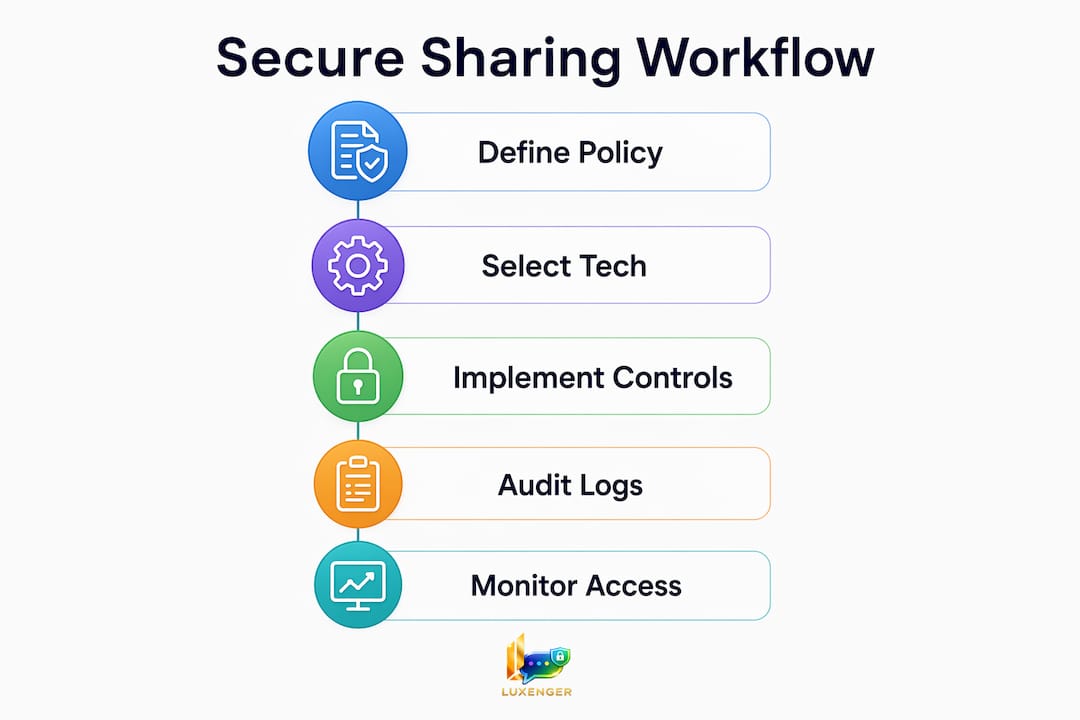
How to design and implement a secure data sharing workflow step-by-step
Implementation fails most often at the transition between policy design and technical execution. This sequence keeps both layers aligned.
-
Define your data governance policies. Document what data can be shared, with whom, under what conditions, and who holds approval authority. This policy document becomes the source of truth for every technical control you configure downstream. Without it, access decisions are made ad hoc and are impossible to audit.
-
Configure granular access control mechanisms. Implement RBAC with row-level security where datasets contain mixed-sensitivity records. Map each consumer role to specific objects, not entire schemas. Review role assignments quarterly and automate the review reminder through your workflow tooling.
-
Implement encryption and key management. Separate your encryption key management from your data storage layer. Use a dedicated key management service (AWS KMS, Azure Key Vault, or Google Cloud KMS) and rotate keys on a defined schedule. Document the rotation process so it survives personnel changes.
-
Build tamper-evident audit trails. Audit logs must be tamper-evident, tenant-scoped for multi-tenant environments, and must include break-glass event tracking with mandatory reason codes. Store logs in append-only storage with cryptographic hash chaining so any modification is detectable.
-
Enable real-time sharing using live-access architectures. Snowflake Secure Data Sharing, for example, uses SHARE objects granting privileges to consumer accounts, enabling real-time read-only access without copying data. This model eliminates replication risk entirely and makes revocation immediate.
-
Automate request, approval, and onboarding workflows. Automation reduces the time between a legitimate access request and productive use. However, automated workflows must avoid sharing credentials as global secrets. Use scoped credential sharing so each automated step holds only the permissions it needs for that specific task.
-
Integrate monitoring and anomaly detection. Set behavioral baselines for each consumer role and alert on deviations: unusual query volumes, access outside business hours, or attempts to access objects outside a role's defined scope. Monitoring closes the loop between your policy and your actual security posture.
Pro Tip: Treat your audit log infrastructure as a separate security domain. The team that manages production data access should not have write access to the audit log store.
How do secure data sharing architectures compare?
Different architectural approaches carry distinct trade-offs in performance, compliance capability, and operational complexity. The table below maps the most common models against the criteria that matter most for enterprise decisions.
| Architecture | Data replication | Revocation speed | Compliance fit | Best for |
|---|---|---|---|---|
| Live sharing (e.g., Snowflake shares) | None | Immediate | SOC 2, GDPR | Cross-org analytics, partner data access |
| Data clean rooms | None | Near-immediate | GDPR, ad-tech privacy | Joint analysis without raw data exposure |
| Data escrow with hardware enclaves | Encrypted copy in enclave | Contract-governed | HIPAA, high-sensitivity research | Regulated computation on third-party data |
| Centralized RBAC with audit-log chaining | Optional | Minutes | SOC 2, HIPAA | Internal enterprise data governance |
| Distributed ledger governance | Replicated | Slow (consensus-dependent) | Emerging | High-trust multi-party audit trails |
The data escrow model deserves specific attention. Data escrow with contract enforcement and secure hardware enclaves prevent unintended data release by allowing only explicitly approved computations. Technologies like AMD SEV-SNP provide encrypted in-memory processing, meaning even privileged infrastructure operators cannot read the data being processed. This shifts the security model from "trust the platform" to "verify the computation," which is a meaningful upgrade for high-stakes sharing scenarios.
The TrustDS architecture takes a different angle, using policy-compiled governance with fail-closed revocation semantics. It improves latency by 25% compared to centralized transfer while maintaining dynamic consent enforcement. That combination of performance and verifiable compliance evidence makes it a strong candidate for cross-cloud marketplace analytics where multiple parties need auditable proof of policy adherence.
For most enterprise teams in 2026, live sharing architectures like Snowflake or Databricks Delta Sharing offer the best balance of simplicity, performance, and compliance capability. Escrow and enclave models are the right choice when the data itself is too sensitive to expose even in read-only form.
Common pitfalls in secure data sharing workflows and how to avoid them
Even well-designed workflows break down at predictable points. Recognizing these failure modes before they occur is the difference between a compliant program and an incident report.
-
Underestimating audit trail scope. Most teams plan for access logs but miss authorization change events, authentication failures, and emergency access records. Audit trail requirements in regulated environments are consistently underestimated, and emergency break-glass access must be tightly controlled and reviewed after every use.
-
Privilege creep from infrequent access reviews. Roles accumulate permissions over time as team members change responsibilities. Without quarterly reviews, a data consumer who needed broad access for a one-time project retains that access indefinitely. Automate the review cycle and require explicit re-approval for any role that has not been reviewed in 90 days.
-
Credential mismanagement in automated workflows. Sharing a single global API key across multiple automated steps is the most common security failure in workflow automation. Each step in an automated pipeline should hold only scoped credentials with the minimum permissions for that specific operation.
-
Slow revocation propagation. Dynamic consent enforcement requires revocation propagation with a median latency of 118 ms to meet real-time business needs. If your architecture cannot revoke access within seconds, you cannot guarantee that a terminated partnership or a compliance event is reflected in actual access controls.
-
Unnecessary data replication. Every copy of a dataset is a separate liability. Teams that replicate data for convenience create version drift, multiply their breach surface, and complicate deletion requests under GDPR and CCPA. Live-access architectures eliminate this problem at the source.
"The most dangerous assumption in data sharing is that your access controls are working as configured. Verify them. Test revocation. Audit the audit logs."
Why policy safety matters more than perfect security architecture
The most persistent mistake I see organizations make is designing their secure data sharing workflow around an adversarial threat model they will never actually face, while ignoring the mundane failures that cause real incidents. Misconfigured RBAC, stale access reviews, and audit logs that nobody reads are responsible for far more compliance failures than sophisticated attacks.
Policy safety and fail-closed revocation semantics provide compliance evidence that is practical and verifiable, rather than theoretical. A system that fails closed when a policy cannot be evaluated is more trustworthy than one that fails open because it assumes benign intent. I have seen organizations spend months on enclave architecture while their audit logs were neither tamper-evident nor scoped correctly. The logs were there; they just would not have held up in a compliance review.
Automation is genuinely valuable in these workflows, but it introduces its own risks. Every time I have reviewed an automated data pipeline that had a security incident, the root cause was scoped credential mismanagement. The fix is not to avoid automation. It is to treat credential scoping as a non-negotiable design constraint from the start, not an afterthought.
The organizations that build the most durable secure sharing programs are the ones that treat governance as a living system. They review policies quarterly, test their revocation mechanisms, and monitor their audit logs actively. Technology is the enabler. Governance is the program.
— Matthew
How Luxenger supports secure collaboration in data sharing workflows
Secure data sharing does not happen in a vacuum. The conversations, approvals, and escalations that surround every data access request are themselves sensitive communications that need the same level of protection as the data. Luxenger's enterprise messaging platform is built with bank-grade encryption and role-based access controls that align directly with the governance requirements covered in this guide. Teams handling HIPAA-regulated data can use Luxenger's HIPAA-compliant messaging to manage access requests, approval workflows, and incident communications without creating unprotected side channels. AI-powered summaries keep audit trails readable, and voice huddles replace unrecorded phone calls. If your organization is building or tightening a secure data sharing program, Luxenger gives the communication layer the same security rigor you apply to the data layer.
FAQ
What is a secure data sharing workflow?
A secure data sharing workflow is a governed system that controls, audits, and enforces access to shared data between authorized parties without unnecessary replication. It combines role-based access control, encryption, audit logging, and documented approval processes into a single operational framework.
How does live data sharing differ from copying data to share it?
Live data sharing, as used in Snowflake Secure Data Sharing and Databricks Delta Sharing, grants consumers read-only access to the source dataset without creating a copy. This eliminates version drift, reduces breach surface, and makes access revocation immediate rather than requiring deletion of distributed copies.
What audit trail requirements apply to secure data sharing in regulated industries?
HIPAA mandates audit controls that record all ePHI access, authorization changes, authentication events, and emergency break-glass access with a six-year retention period. Audit logs must be tamper-evident, stored in append-only systems, and scoped per tenant in multi-tenant environments.
How fast should access revocation work in a secure sharing workflow?
Revocation propagation should target a median latency of 118 ms for dynamic consent enforcement to meet real-time compliance requirements. Architectures that cannot revoke access within seconds create a window of unauthorized access that regulators and auditors will flag.
What is the biggest security risk in automated data sharing workflows?
The most common failure is using global, unscoped credentials across multiple automated workflow steps. Each step should hold only the minimum permissions required for its specific operation, using scoped credential sharing to prevent privilege escalation or unintended data access.
Key takeaways
A secure data sharing workflow requires granular access control, tamper-evident audit logging, live data access without replication, and automated governance processes to meet compliance requirements and reduce operational risk.
| Point | Details |
|---|---|
| Live access beats replication | Architectures like Snowflake shares eliminate version drift and enable immediate revocation. |
| Audit logs need their own security | Store logs in append-only systems with hash chaining; never let data admins write to the log store. |
| Scoped credentials in automation | Every automated workflow step must hold only the permissions it needs for that specific operation. |
| Revocation speed is a design input | Target sub-second revocation propagation; slow revocation creates compliance exposure between policy change and enforcement. |
| Governance must be reviewed, not just documented | Quarterly access reviews and active log monitoring are what separate a compliant program from a paper policy. |