

TL;DR:
- Collaboration enhances productivity by aligning communication, reducing duplicated effort, and fostering shared expertise. Strong team culture, shared norms, and unified systems significantly increase efficiency and effectiveness. Using both real-time and asynchronous tools supported by AI optimizes teamwork across various work types.
Collaboration is defined as the structured practice of combining individual expertise toward shared goals, and its role in productivity is direct and measurable. Improving collaboration can boost team output by up to 39%. That number is not a soft estimate. It reflects what happens when communication aligns, knowledge flows freely, and teams stop duplicating work. Google's Project Aristotle confirmed that team effectiveness depends more on how people work together than on individual skill. Platforms like Luxenger are built on exactly that premise, centralizing communication so the mechanics of collaboration stop getting in the way of the work itself.
How does collaboration improve individual and team productivity?
Collaboration improves productivity by creating conditions where problems get solved faster, decisions get made with better information, and individual effort compounds rather than cancels out. The industry term for this effect is team synergy, and it is the reason why collaborative work and efficiency are so tightly linked in organizational research.

Shared expertise cuts problem-solving time
When team members pool knowledge, they reach solutions that no single person would find alone. A software engineer who flags a security flaw early saves a product team weeks of rework. A sales rep who shares a customer objection in a shared channel helps the entire team close deals faster. This is cognitive diversity in practice, and it is one of the clearest mechanisms behind how collaboration boosts performance.
Coordination also reduces duplicated effort. When two departments work in silos, they often build the same report, run the same analysis, or contact the same vendor independently. A shared workspace eliminates that waste immediately.
Communication quality drives output
The impact of communication on work output is not just about frequency. It is about clarity and reach. Teams that communicate through structured channels, where context is preserved and decisions are documented, move faster than teams relying on scattered email threads. Real-time collaboration software can increase productivity by 30% by reducing the volume of meetings and email chains that slow decisions down. That is time returned directly to execution.
Pro Tip: Set a team norm that every major decision gets documented in a shared channel within 24 hours. This single habit prevents the most common form of productivity loss: people re-asking questions that were already answered.
- Shared knowledge reduces rework and duplicated effort across departments
- Structured communication channels preserve context and accelerate decisions
- Cognitive diversity in teams surfaces solutions faster than individual expertise alone
- Real-time tools reduce meeting load, returning time to focused work
What are the common barriers to effective collaboration?
The biggest barrier to productive collaboration is not a lack of willingness. It is structural fragmentation. The fragmentation tax is the hidden productivity cost that accumulates when teams switch between disconnected tools, lose context between platforms, and spend time managing communication rather than doing work.
The fragmentation tax is costing you more than you think
Employees switching between apps lose measurable productivity daily, with the average worker toggling across roughly 10 applications. Each switch carries a cognitive cost. Context is lost. Threads get missed. Decisions made in one tool never reach the people working in another. Teams that adopt a unified system for teamwork see a 68% reduction in fragmentation tax, which translates directly into faster output and fewer coordination errors.
The coordination overhead problem is equally serious. Faster individual work does not equal faster organizations. When individuals optimize their own speed without shared systems, coordination costs rise and negate the gains. This is the speed paradox that many teams hit when they adopt AI tools without changing how they work together.
Pro Tip: Treat your team's shared knowledge as infrastructure, not a side project. Assign clear owners to key documentation, and review it quarterly. Teams that do this make faster decisions because they stop rebuilding context from scratch every time.
- Fragmentation tax accumulates silently across every tool switch
- Coordination overhead rises when individual speed outpaces shared systems
- Siloed communication prevents decisions from reaching the right people
- Integrated platforms reduce friction without requiring behavioral overhaul
Real-time vs. async: which collaboration model wins?
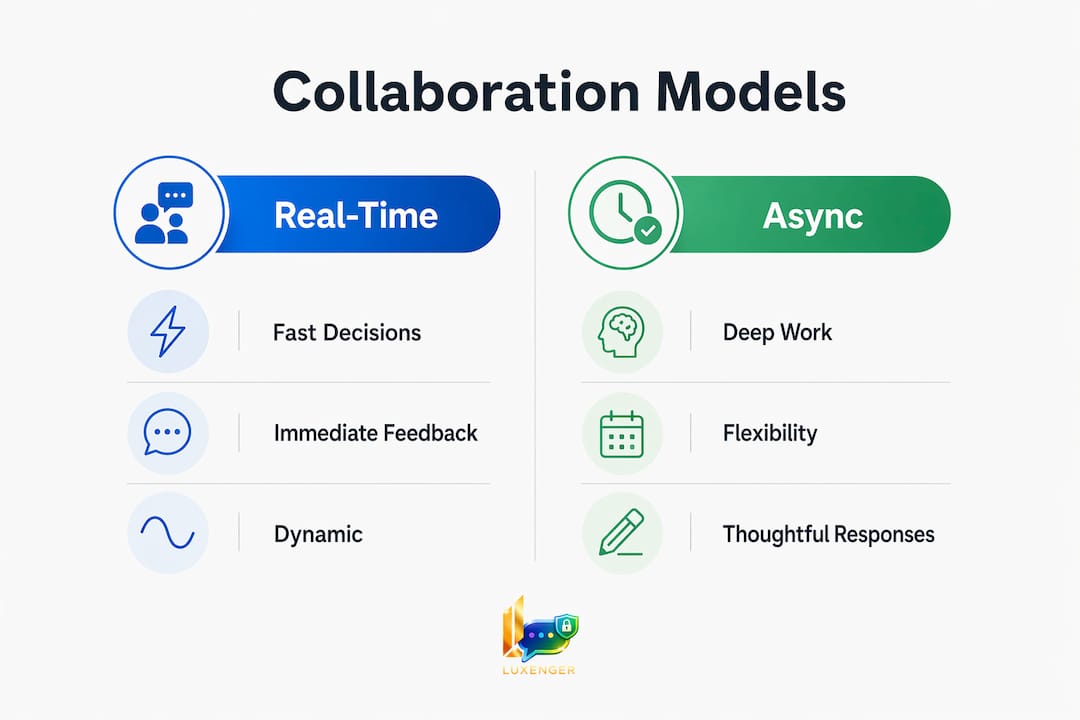
The answer depends on the work type, but the strongest teams use both models deliberately. Real-time collaboration, through voice huddles, live editing, or instant messaging, works best for decisions that need fast alignment. Asynchronous collaboration, through recorded updates, threaded discussions, and shared documents, works best for deep work and distributed teams across time zones.
How ai-driven platforms change the equation
AI-powered collaboration platforms shift the calculus significantly. Features like AI-generated meeting summaries, automatic translation, and smart notifications reduce the overhead of both real-time and async work. Effective AI adoption in teams focuses on shared knowledge and culture, not just automation. The teams that get the most from AI tools are those with champions who embed the tools into existing workflows rather than bolting them on as extras.
Collaborative work management systems connect planning, communication, execution, and reporting in a single environment. For hybrid and remote teams, this visibility is not a luxury. It is the difference between a team that moves together and one that moves in parallel without alignment.
| Collaboration Model | Best Use Case | Productivity Impact |
|---|---|---|
| Real-time messaging | Fast decisions, urgent alignment | Reduces meeting volume by up to 30% |
| Async threaded discussion | Deep work, cross-timezone teams | Preserves context, reduces interruptions |
| AI-powered summaries | Long threads, meeting recaps | Cuts time spent catching up |
| Unified CWM platform | Hybrid and remote teams | Reduces fragmentation tax by up to 68% |
| Voice huddles | Quick audio check-ins | Replaces lengthy email chains |
For teams evaluating collaboration tools for 2026, the key question is not which tool is most feature-rich. It is which tool reduces the number of places your team has to look to understand what is happening.
How does team culture shape collaborative productivity?
Team culture is the single most underestimated variable in collaborative work and efficiency. Skills matter. Tools matter. But the way a team operates together, the norms, the trust, the shared history, determines whether those skills and tools actually produce results.
Psychological safety and the google project aristotle finding
Google's Project Aristotle studied hundreds of teams to identify what made the best ones effective. The answer was not talent density or technical skill. It was psychological safety, the belief that team members can speak up, ask questions, and admit mistakes without penalty. Teams with strong cultures are rated as effective twice as often by executives and show measurably better retention. That retention effect matters because familiarity compounds over time.
Why experienced teams outperform assembled all-stars
Experienced teammates significantly enhance individual productivity, particularly in remote work settings where coordination is harder. This effect is stronger than simply increasing communication frequency or assembling a group of high performers who have never worked together. The mechanism is transactive memory, a shared understanding of who knows what, so team members route questions correctly and avoid redundant work.
Teams that have worked together build coordination routines that operate almost automatically. They know each other's working styles, communication preferences, and areas of expertise. That knowledge does not show up on any org chart, but it shows up in output speed and decision quality every day.
| Culture Factor | Effect on Team Productivity |
|---|---|
| Psychological safety | Doubles rated team effectiveness |
| Experienced team familiarity | Increases individual output beyond communication volume |
| Shared norms and documentation | Reduces coordination overhead |
| Strong retention | Preserves institutional knowledge and team routines |
Building this kind of culture in distributed teams requires deliberate effort. The Luxenger blog covers building company culture remotely in depth, including how shared values and norms translate into measurable collaboration gains for distributed teams.
Key takeaways
Collaboration drives productivity not through effort alone, but through shared systems, strong culture, and deliberate communication structures that reduce friction and align teams toward common goals.
| Point | Details |
|---|---|
| Collaboration lifts output by up to 39% | Structured teamwork compounds individual effort and reduces duplicated work across departments. |
| Fragmentation tax silently kills efficiency | Teams switching across 10+ apps daily lose significant output; unified systems cut this loss by 68%. |
| Culture doubles team effectiveness | Psychological safety and experienced team familiarity outperform talent density in driving results. |
| Real-time and async models serve different needs | Combining both deliberately, with AI support, gives hybrid teams the highest productivity return. |
| Shared knowledge is operational infrastructure | Teams that document decisions and assign knowledge owners make faster, better-informed choices. |
Where most teams get collaboration wrong
I have spent years watching organizations invest in collaboration tools and still wonder why output does not improve. The pattern is almost always the same. They buy the platform, run the onboarding, and then let each team use it however they want. Within three months, half the team is back in email and the other half is in three different chat threads that nobody else can find.
The research from high-performance team science confirms what I have seen firsthand: the tool is never the bottleneck. The bottleneck is the absence of shared norms around how the tool gets used. A team that agrees on one channel per project, one place for decisions, and one format for updates will outperform a team with better software and no agreement every single time.
What I find most counterintuitive is the familiarity finding. Leaders often think the answer to a stuck team is fresh talent. Sometimes it is. But more often, the answer is keeping the team together long enough to build the transactive memory that makes coordination feel effortless. Retention is a productivity strategy, not just an HR metric.
The organizations I have seen get this right treat collaboration as a system, not a behavior. They define the structure, assign ownership, and measure coordination costs the same way they measure output. That shift in framing changes everything.
— Matthew
How Luxenger supports productive enterprise collaboration
Luxenger is built for organizations where fragmented communication is a real operational cost, not a minor inconvenience.

Luxenger's enterprise messaging platform addresses the fragmentation tax directly. AI-powered conversation summaries keep distributed teams aligned without requiring everyone to read every thread. Voice huddles replace lengthy back-and-forth for decisions that need speed. Real-time translation supports multilingual teams without coordination overhead. Bank-grade security means confidential decisions stay inside the organization. For business leaders who want the productivity gains that collaboration research promises, Luxenger provides the infrastructure to make those gains repeatable and measurable.
FAQ
What is the role of collaboration in productivity?
Collaboration increases productivity by reducing duplicated work, accelerating decisions, and aligning team effort toward shared goals. Research shows that improving collaboration can boost output by up to 39%.
How does team culture affect collaborative work and efficiency?
Teams with strong, psychologically safe cultures are rated as effective twice as often by executives and retain talent at higher rates. Culture shapes whether collaboration tools and processes actually get used consistently.
What is the fragmentation tax and why does it matter?
The fragmentation tax is the productivity loss caused by switching between multiple disconnected tools and communication channels. Teams that adopt a unified system reduce this tax by up to 68%, recovering significant output time.
Does real-time or async collaboration boost performance more?
Neither model is universally superior. Real-time collaboration works best for fast alignment and urgent decisions, while async models support deep work and distributed teams. The strongest teams use both deliberately based on the task type.
Why do experienced teams outperform high-performing new teams?
Experienced teammates build transactive memory, a shared understanding of who knows what, which reduces coordination overhead and speeds up decision-making. This familiarity effect is stronger than simply increasing communication volume between unfamiliar high performers.