

TL;DR:
- AI-driven collaboration significantly enhances organizational productivity, decision-making, and knowledge flow. Grounded AI expands networks, improves team communication, and enables autonomous multi-application workflows, transforming enterprise operations. Success relies on role-specific training and clear governance to maximize benefits and prevent overreliance.
AI-driven collaboration benefits are defined as the measurable gains in productivity, decision quality, and organizational agility that emerge when teams use intelligent automation and AI-assisted workflows together. Enterprises deploying platforms like Luxenger, Dust, and BigBlueBam report faster task completion, stronger knowledge sharing, and more connected teams. A 2026 survey of AI tool users found that 90% reported time savings on repetitive tasks, 85% shifted focus to higher-priority work, and 75% reported better quality outputs. These are not incremental gains. They represent a structural shift in how enterprise teams operate, communicate, and compete.
1. AI-driven collaboration benefits start with productivity gains
The most direct advantage of AI collaboration tools is the elimination of low-value repetitive work. Scheduling, document triage, inbox management, and status updates consume hours every week across large organizations. AI handles these automatically, returning that time to the people doing the actual work.

The productivity data is specific and significant. A controlled study of 5,179 agents in customer support found that AI tools increased issue resolution rates by 14% and improved complex case resolution by 25%. That improvement did not come from replacing agents. It came from giving them better information faster.
Less experienced employees benefit the most. AI compresses the learning curve by surfacing relevant knowledge, suggesting next steps, and flagging errors before they escalate. A junior analyst with AI assistance can perform at a level that previously required two to three years of on-the-job experience.
- AI automates scheduling, meeting prep, and document routing
- Triage tools prioritize incoming requests without human review
- Knowledge retrieval surfaces institutional expertise on demand
- Junior staff close the skills gap faster with AI-assisted guidance
- Specialists spend more time on complex problems, less on coordination
Pro Tip: Before deploying any AI collaboration tool, audit where your team spends the most time on low-value tasks. The highest ROI comes from automating those specific workflows first, not from deploying AI broadly and hoping for results.
2. How AI enhances teamwork through smarter communication
AI changes how teams communicate by removing friction from information exchange. AI summary tools and virtual assistants increase meeting productivity by automating follow-ups and synthesizing discussion into clear action items. Teams no longer lose decisions in long chat threads or unstructured meeting notes.
The advantages of AI collaboration extend to global and multilingual teams. Real-time translation, automatic transcription, and AI-generated meeting summaries make it possible for a team spread across Tokyo, Berlin, and Chicago to collaborate without communication gaps. Luxenger's real-time translation feature addresses exactly this problem for enterprise teams operating across language barriers.
Decision-making also improves when AI handles data synthesis. Instead of waiting for a report to be compiled, leaders get synthesized insights drawn from multiple data sources in real time. The speed of informed decisions increases without sacrificing accuracy.
- AI generates meeting summaries and assigns action items automatically
- Real-time translation removes language barriers in global teams
- AI-assisted data synthesis reduces the time from question to decision
- Automated follow-ups prevent tasks from falling through the cracks
- Inclusive communication tools give every team member equal access to context
The human-plus-AI model consistently outperforms either working alone. Radiologists using AI-assisted imaging detected 9% more cancers and reduced false positives by 11% compared to radiologists working without AI. The same principle applies in consulting, legal review, and financial analysis. AI surfaces what humans might miss. Humans apply judgment that AI cannot replicate.
3. How grounded AI rewires your organization's collaboration network
Most leaders think about AI as a tool for individual productivity. The more significant effect is organizational. Grounded GenAI increases employees' collaboration network degree centrality by approximately 7.8 connections per person. That means each employee becomes meaningfully connected to more colleagues, more knowledge sources, and more decision pathways.
This is not a minor adjustment. It restructures how knowledge flows through your organization. Specialists become more accessible as knowledge sources because AI reduces the friction of reaching them. Generalists increase their output because AI helps them navigate complexity without needing to become experts themselves.
| Effect | Who benefits most | Measurable outcome |
|---|---|---|
| Increased network centrality | All employees | ~7.8 new collaboration connections per person |
| Higher project output | Generalists | 3.6 more projects managed on average |
| Improved knowledge access | Junior staff | Faster ramp-up, fewer escalations |
| Reduced communication friction | Cross-functional teams | Faster decisions, fewer bottlenecks |
AI acts as a translator between departments that previously struggled to share context. A product team and a legal team, for example, rarely speak the same language. AI tools that summarize, reframe, and contextualize information make cross-functional collaboration faster and less prone to misunderstanding.
Pro Tip: Map your organization's collaboration network before and after deploying AI tools. Tools like Microsoft Viva Insights or Organizational Network Analysis software can show you exactly where knowledge flow improved and where bottlenecks remain.
4. Benefits of AI in projects using autonomous AI agents
The next generation of AI collaboration tools goes beyond assistants that respond to prompts. Platforms like Dust, Clawith, and BigBlueBam deploy AI agents with persistent identities, long-term memory, and the ability to execute multi-step workflows across multiple applications without constant human input. These agents function as integrated team members, not just software features.
In practice, this means an AI agent can monitor a project management board, identify a blocked task, pull relevant context from a knowledge base, draft a resolution proposal, and notify the right team member, all without a human initiating each step. The cognitive load reduction for project leads is substantial.
Key capabilities of agentic AI collaboration:
- Persistent memory allows agents to carry context across sessions and projects
- Multi-app integration connects data from CRM, project management, and communication tools
- Autonomous task execution handles multi-step workflows without human prompting
- Agent-to-agent collaboration enables complex workflows where multiple AI agents coordinate
- Governance controls define where agents act independently and where humans must approve
The governance question matters here. Role design determines where AI should act autonomously and where human judgment must remain in the loop. Deploying agents without clear boundaries creates overreliance risks and errors in areas outside the AI's competency. Enterprises that define these boundaries clearly get the productivity gains without the liability exposure.
5. How AI for remote team collaboration closes the distance gap
Remote teams face a specific set of collaboration problems: asynchronous communication delays, unequal access to context, and the erosion of informal knowledge sharing that happens naturally in physical offices. AI collaboration tools address each of these directly.
Asynchronous gaps shrink when AI summarizes overnight conversations and surfaces the decisions made before the next shift logs on. A team member in Singapore who missed a real-time discussion in New York gets a structured summary with action items, not a 200-message thread to parse. Luxenger's AI-powered conversation summaries are built specifically for this use case, distilling long threads into the points that actually require attention.
Context inequality disappears when AI makes institutional knowledge searchable and accessible to everyone, regardless of tenure or location. New hires on distributed teams no longer depend on finding the right person to ask. They query the AI and get answers grounded in the organization's actual documentation and history.
Informal knowledge sharing is harder to replicate, but AI helps by identifying who knows what and connecting people who should be talking. The network centrality effect described earlier is especially valuable for remote organizations, where organic relationship-building is limited by geography and time zones.
6. How structured training multiplies AI collaboration advantages
Deploying AI tools without structured training produces predictably poor results. 79% of workers who receive structured AI training hold positive perceptions of AI, compared to just 44% of those without training. That gap in sentiment directly predicts adoption rates, usage depth, and ultimately the return on your AI investment.
Role-specific training matters more than generic onboarding. A sales manager and a compliance officer use AI collaboration tools in fundamentally different ways. Training that addresses the specific workflows, risks, and opportunities relevant to each role produces proactive behavior and creativity rather than passive tool use. Generic training produces checkbox compliance.
Change management is the other half of the equation. Employees who feel that AI is being imposed on them, rather than offered as a resource, resist adoption and find workarounds. Leaders who communicate clearly about what AI will and will not change about roles, and who involve teams in selecting and configuring tools, see faster and more durable adoption.
The burnout risk is real and underappreciated. Employees with lower proactivity who are pushed into heavy AI collaboration without support experience increased performance pressure. Management interventions that monitor workload, recognize contribution, and provide clear task boundaries prevent the fatigue that derails otherwise well-designed AI programs. Pairing structured training with resources like effective AI tool training guides helps organizations build adoption programs that actually stick.
Key takeaways
AI-driven collaboration benefits compound when organizations treat AI as collaboration infrastructure rather than individual productivity software, combining network effects, structured training, and clear governance.
| Point | Details |
|---|---|
| Productivity gains are immediate | AI tools reduce repetitive task time and increase issue resolution rates by 14% in documented studies. |
| Network effects are the bigger prize | Grounded AI adds ~7.8 collaboration connections per employee, reshaping how knowledge flows organizationally. |
| Human-AI synergy outperforms either alone | Radiologists with AI detected 9% more cancers, illustrating the value of combined judgment and automation. |
| Training doubles adoption success | Structured AI training produces 79% positive sentiment vs. 44% without it, directly impacting ROI. |
| Governance prevents overreliance | Defining where AI acts autonomously and where humans decide is the critical design choice for safe deployment. |
Why most enterprises are still thinking about this wrong
The framing I see most often from enterprise leaders is that AI collaboration tools are productivity software. Buy the license, deploy the tool, measure output per employee. That framing produces modest results and frequent disappointment.
The organizations getting the most from AI collaboration are treating it as infrastructure, the same way they treat their network or their data architecture. They are asking different questions. Not "how much faster can this employee work?" but "how does this change the way knowledge moves through our organization?"
The network centrality research changes the conversation entirely. When every employee gains nearly eight new meaningful collaboration connections, you are not just speeding up existing workflows. You are creating new ones. Specialists who were previously bottlenecks become accessible. Junior staff who previously needed hand-holding become capable contributors. The organizational chart does not change, but the actual collaboration network does.
The risk I see most often is not overinvestment in AI. It is underinvestment in the human side of the equation. Leaders who deploy Dust or Luxenger or any other AI collaboration platform without role-specific training and clear governance frameworks consistently underperform compared to those who treat change management as part of the implementation. The tool is not the hard part. The adoption is.
My honest advice: start with one high-friction workflow, instrument it carefully, and measure the network effects, not just the task completion rate. The results will tell you where to go next.
— Matthew
See how Luxenger puts these benefits to work
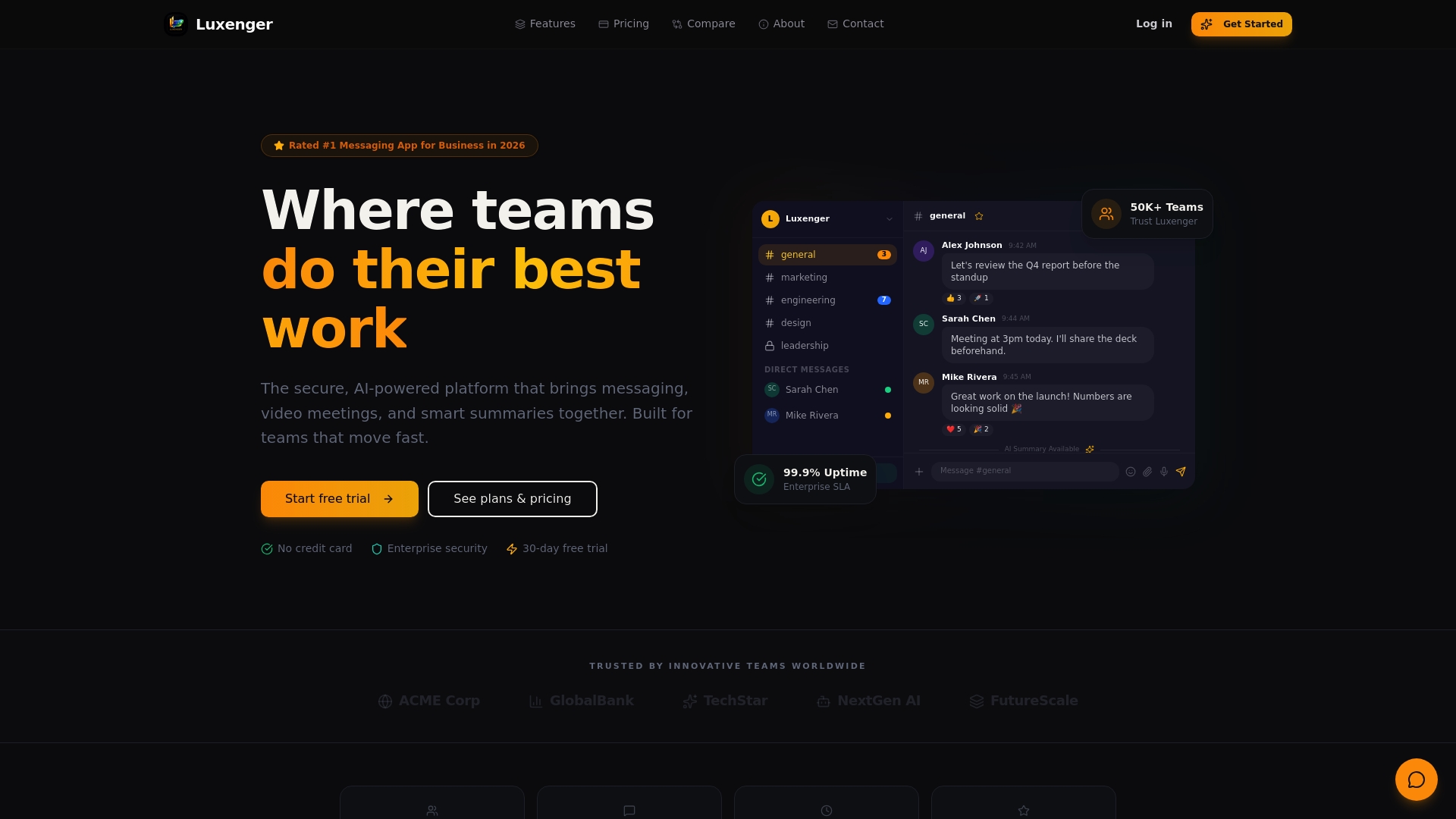
Luxenger is built for enterprises that need AI-driven collaboration to work at the level this article describes. Its AI-powered conversation summaries cut through message volume so your teams act on what matters. Voice huddles replace the overhead of scheduled calls. Real-time translation keeps multilingual teams aligned without delays. And bank-grade security means your most sensitive communications stay protected. If you are evaluating AI collaboration tools for a medium or large enterprise, Luxenger's enterprise platform is worth a direct look. The features are purpose-built for the productivity, communication, and governance challenges covered here.
FAQ
What are the main AI-driven collaboration benefits for enterprises?
The primary benefits include a 14% increase in issue resolution rates, time savings on repetitive tasks reported by 90% of users, and improved decision quality through AI-assisted data synthesis. Organizational network effects, where each employee gains approximately 7.8 new collaboration connections, represent the most significant long-term advantage.
How does AI improve teamwork in remote or global teams?
AI tools automate meeting summaries, provide real-time translation, and surface institutional knowledge on demand, removing the asynchronous and language barriers that slow distributed teams. Platforms like Luxenger address these gaps directly with built-in AI summaries and multilingual support.
What role does training play in AI collaboration adoption?
Structured, role-specific training is the single biggest predictor of successful AI adoption. Workers with structured training report positive AI sentiment at a rate of 79%, nearly double the 44% rate among those without it, according to Deloitte's 2024 Technology Adoption Index.
What are AI agents and how do they support team collaboration?
AI agents are software entities with persistent memory and autonomous task execution capabilities that integrate across multiple applications. Platforms like Dust deploy these agents to handle multi-step workflows without constant human input, reducing cognitive load for project leads and scaling team output.
How do organizations prevent overreliance on AI collaboration tools?
Clear governance frameworks that define where AI acts autonomously and where human judgment is required are the primary safeguard. Role design, task boundary documentation, and regular audits of AI decision quality prevent the errors that emerge when AI operates outside its competency zones.