

TL;DR:
- Effective workplace security integrates physical, digital, and procedural controls driven by comprehensive risk assessments that satisfy legal and regulatory standards.
- Organizations must unify security functions, implement layered physical controls, and enforce role-based, interactive training to maintain operational resilience and compliance.
Workplace security enhancement is the strategic implementation of coordinated physical, digital, and procedural controls to protect employees, assets, and data across medium to large enterprises. Organizations that treat physical and cybersecurity as separate functions expose themselves to compounding risks that neither team can fully address alone. Compliance frameworks like California's SB 553 and OSHA's General Duty Clause now demand documented, evidence-based programs rather than policy binders that collect dust. This article delivers the specific controls, integration strategies, and training protocols that security professionals and business leaders need to build a defensible, audit-ready security posture in 2026.
How to enhance workplace security with a risk assessment
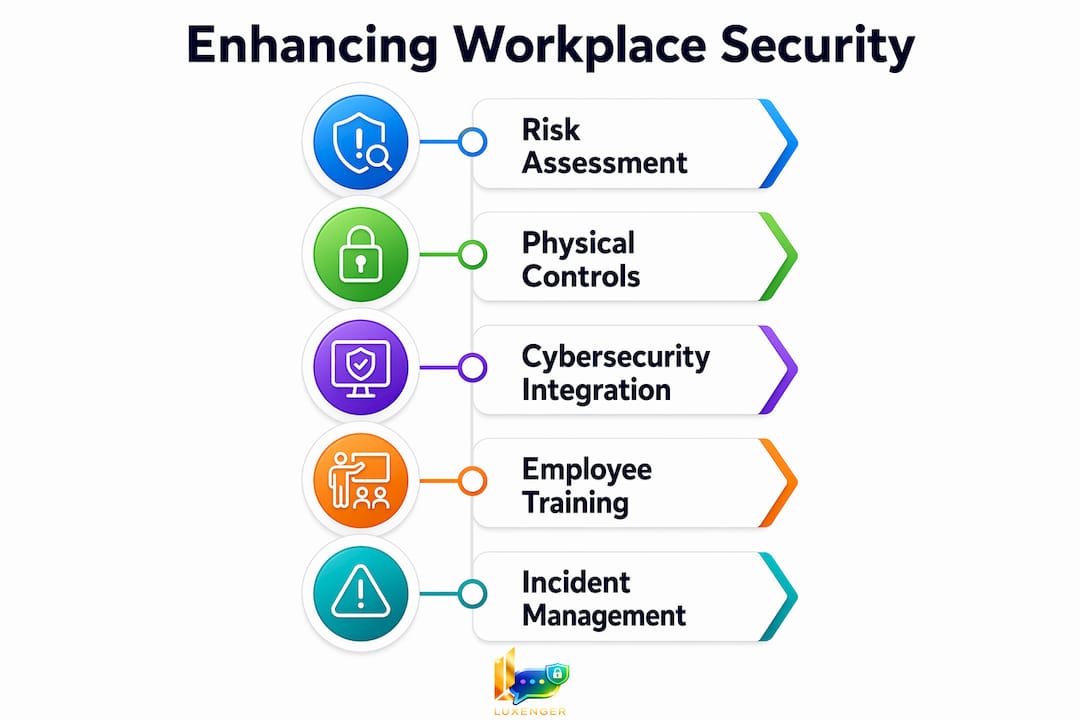
Every credible effort to improve office safety begins with a structured risk assessment. Without one, security investments target symptoms rather than root causes, and compliance audits expose the gaps immediately. Effective security planning starts with risk assessment, followed by documented policies, integrated technology, continuous training, and regular audits. That sequence is not arbitrary. Each step depends on the intelligence gathered in the one before it.
A thorough risk assessment covers both physical space and digital infrastructure. On the physical side, that means walking every entry point, parking structure, server room, and common area with documented findings. On the digital side, it means cataloging user access privileges, network segmentation, and endpoint exposure. Security professionals at enterprises with multiple sites often use a standardized scoring matrix to rank vulnerabilities by likelihood and impact, which makes budget prioritization defensible to leadership.
Regulatory compliance adds a specific obligation to this process. California's SB 553 requires employers with 10 or more employees to maintain a written Workplace Violence Prevention Plan that includes hazard identification as a named element. That means your risk assessment is not just an internal best practice. It is a legal artifact that must be retained and updated.
- Map all physical access points including emergency exits, loading docks, and server rooms.
- Audit digital access privileges across all user accounts, including contractors and vendors.
- Interview department heads to surface unreported near-misses or behavioral concerns.
- Score each vulnerability by likelihood and potential impact using a standardized matrix.
- Document findings formally and assign remediation owners with deadlines.
Pro Tip: Run your risk assessment against OSHA's five-element program framework: management commitment, hazard assessment, controls, training, and recordkeeping. Any gap in that checklist is a compliance liability, not just an operational one.
What physical security controls effectively reduce workplace risks
Physical controls are the first layer of any credible office security solution, and their effectiveness depends on layering rather than relying on any single measure. NIST 800-171 guidance mandates controlled entry, monitoring, and access evidence retention for areas processing Controlled Unclassified Information. That standard applies directly to government contractors, but its logic translates to any enterprise handling sensitive data or high-value assets.
The core physical controls that security professionals deploy at scale include:
- Badge readers and keypad access at all controlled entry points, with access logs retained for audit purposes.
- Video surveillance covering entry points, parking areas, server rooms, and cash-handling locations.
- Visitor management protocols including sign-in logs, temporary badges, and mandatory escort policies in sensitive areas.
- Perimeter lighting and security patrols to deter unauthorized access during off-hours.
- Clear walkways and hazard-free common areas to reduce the nearly 50,000 annual injuries office workers suffer from falls and trips each year.
The technology layer within physical security has shifted significantly. AI-powered live monitoring identifies weapons and aggression in real time, enabling fast alerting without the privacy violations associated with blanket recording. Static CCTV systems document incidents after the fact. AI-enabled systems interrupt them before escalation. That distinction matters when your security team is managing a 500,000-square-foot facility with a lean staff.
| Control type | Best use case | Limitation |
|---|---|---|
| Badge reader access | Controlled entry to server rooms, labs, executive floors | Requires active credential management |
| Video surveillance with AI | Real-time threat detection and post-incident review | Higher upfront cost than static CCTV |
| Visitor management system | Preventing unauthorized access in sensitive zones | Requires staff training and consistent enforcement |
| Perimeter lighting and patrols | Deterring after-hours incursions | Labor-intensive without automation |

Pro Tip: Visitor management requires escort policies, visitor logs, and temporary badges to prevent unauthorized access. Audit your visitor logs quarterly. Gaps in sign-in records are a red flag in both internal reviews and regulatory inspections.
How to integrate cybersecurity with physical security
Siloed security functions are the single most common structural failure in enterprise protection programs. Physical security teams manage badge access and cameras. IT manages network controls and endpoint protection. Neither team sees the full picture, and attackers exploit the seam between them. Integrating physical and digital security synchronizes badge-controlled facility access with identity governance systems and event logs, closing that gap.
NIST's Zero Trust Architecture provides the framework for this integration. Zero Trust principles emphasize secure access from any location using Identity, Credential, and Access Management (ICAM), microsegmentation, and adaptive controls. In practice, this means a user's physical badge access and their network access privileges are governed by the same identity record. When an employee is terminated, both access types are revoked simultaneously rather than through two separate workflows that may not stay synchronized.
For enterprises managing hybrid or remote workforces, the integration challenge extends further. Key implementation steps include:
- Unify identity records so that physical access credentials and network credentials share a single source of truth.
- Implement microsegmentation to limit lateral movement if a credential is compromised.
- Deploy continuous monitoring that correlates physical access events with network activity anomalies.
- Apply adaptive controls that escalate authentication requirements based on risk signals, such as an after-hours login from an unrecognized device.
- Coordinate incident response so that a physical security alert automatically triggers a review of the associated user's digital activity.
This coordination is not just a technical upgrade. It is a governance decision. Security leaders who want to increase workplace protection at scale need to establish a joint operations model where physical and cyber teams share dashboards, escalation paths, and post-incident reviews. The enterprise security best practices required for distributed teams in 2026 demand exactly this kind of coordinated architecture.
How to implement employee training and incident management
Training is where most enterprise security programs underperform. Written policies exist. Annual acknowledgment forms get signed. But OSHA's enforcement framework requires a program architecture built on management commitment, hazard assessment, engineering controls, training, and recordkeeping. Policy documentation alone does not satisfy that standard. Evidence of role-based, interactive training does.
California's SB 553 makes this explicit. The law requires annual interactive training as a named element of a compliant Workplace Violence Prevention Plan. Interactive means employees practice recognizing and responding to threat scenarios, not just reading a slide deck. Role-based means a warehouse worker's training differs from a front-desk receptionist's, because their hazard exposure differs.
- Design role-specific training modules based on the hazard profiles identified in your risk assessment.
- Conduct annual live or facilitated sessions rather than self-paced online modules that allow passive completion.
- Establish a clear incident reporting channel that employees trust and know how to use.
- Log every reported incident in a violent incident log retained for the five years SB 553 requires.
- Conduct post-incident reviews within 30 days of any significant event to identify control failures and update the program.
"Workplace violence prevention that passes regulatory scrutiny requires evidence of role-based hazard assessment, designed controls, ongoing training, and post-incident updates. Mere policy documentation is insufficient." — OSHA enforcement guidance, 2026
The post-incident review step is the one most organizations skip. It is also the step that produces the most actionable intelligence. A review that identifies a specific control failure, assigns a corrective action, and documents the outcome creates the evidence trail that regulators look for and that genuinely improves your program over time. Pair your enterprise chat security guide with your incident reporting protocols so that sensitive communications about incidents stay protected and auditable.
Which mistakes most commonly undermine workplace security efforts
The most damaging security failures in enterprises are not technical. They are organizational. Security programs that exist on paper but lack operational substance fail both audits and real incidents.
- Performative policy documentation. A written WVPP that has never been tested, updated after an incident, or used to drive training decisions is a liability, not an asset. Regulators and plaintiffs' attorneys both know how to spot a policy that was written once and filed away.
- Siloed physical and cyber teams. When badge access revocation and network access revocation run on separate workflows, terminated employees or compromised credentials create windows of exposure that neither team owns.
- Undertrained staff. Employees who cannot recognize early warning signs of workplace violence or who do not know how to report a concern are a gap that no camera system can compensate for.
- Skipped annual reviews. SB 553 requires annual training and program review. Organizations that treat this as a checkbox rather than a genuine update cycle accumulate compliance debt that compounds over time.
- No incident log discipline. Violent incident logs that are incomplete, inconsistently maintained, or not retained for the required five years create both compliance exposure and operational blind spots.
The pattern across all of these failures is the same. Security gets treated as a cost center with a compliance deadline rather than an operational function with continuous improvement requirements. The organizations that sustain strong security postures treat their programs the way finance teams treat audits: with documented evidence, regular cycle reviews, and clear ownership at every step.
Key takeaways
Effective workplace security requires integrated physical controls, Zero Trust digital architecture, and evidence-based training programs that satisfy OSHA and SB 553 compliance standards simultaneously.
| Point | Details |
|---|---|
| Start with a risk assessment | Document physical and digital vulnerabilities before deploying any controls or writing policies. |
| Layer physical controls | Combine badge access, AI-enabled surveillance, and visitor management rather than relying on any single measure. |
| Integrate physical and cyber security | Unify identity governance so that facility access and network access share a single revocation workflow. |
| Train by role, not by policy | Interactive, role-specific training satisfies OSHA and SB 553 requirements and actually changes employee behavior. |
| Review after every incident | Post-incident reviews produce the corrective action evidence that regulators require and that improves program quality. |
What I've learned about workplace security that most programs get wrong
After 15 years of covering enterprise security programs, the pattern I see most often is organizations that invest heavily in technology and almost nothing in governance. They buy the best badge readers, deploy AI-enabled cameras, and then let the identity management system run on stale user records for 18 months because no one owns the quarterly audit.
The Zero Trust model from NIST is genuinely the right framework for 2026, but it only works if someone is accountable for keeping identity records current. I have seen enterprises with sophisticated microsegmentation architectures that still had active credentials for employees who left two years prior. The technology was right. The process was broken.
The other thing I would push back on is the instinct to treat SB 553 and OSHA compliance as a legal exercise rather than a security one. The five-element OSHA framework, management commitment, hazard assessment, controls, training, and recordkeeping, is actually a sound program design. Organizations that implement it because they believe in it, rather than because they fear an audit, end up with programs that work. The compliance follows the quality, not the other way around.
My practical advice: assign a named owner to every element of your security program, set calendar-driven review dates, and treat your violent incident log as a data source rather than a filing obligation. The organizations that do this consistently are the ones that catch emerging threats before they escalate.
— Matthew
Secure your enterprise communications with Luxenger

Physical access controls and Zero Trust architecture protect your facilities and networks. But workplace security also depends on what happens inside your communication channels. Sensitive incident reports, security policy updates, and coordination between physical and cyber teams all travel through your messaging platform. Luxenger's enterprise-grade secure messaging delivers bank-grade encryption, AI-powered conversation summaries, and real-time translation for multilingual teams, keeping confidential security communications protected and auditable. For security professionals building a unified defense posture, Luxenger connects the communication layer to the controls layer. Explore how Luxenger's IT security best practices support your broader workplace protection strategy.
FAQ
What is the first step to enhance workplace security?
The first step is a documented risk assessment that maps physical access points, digital infrastructure vulnerabilities, and behavioral hazard indicators. This assessment drives every subsequent control decision and satisfies the hazard identification requirement in SB 553 and OSHA's program framework.
What does Zero Trust mean for physical workplace security?
Zero Trust Architecture, as defined by NIST, requires that physical access credentials and network access privileges share a unified identity record with continuous enforcement. This means a terminated employee's badge access and system access are revoked through a single workflow rather than two separate processes.
How often should workplace security training occur?
California's SB 553 requires annual interactive training as a mandatory element of a compliant Workplace Violence Prevention Plan. OSHA's enforcement guidance treats training as a continuous program element, not a one-time event, so annual sessions should be supplemented with role-specific refreshers after incidents or significant workplace changes.
What records must employers retain for workplace security compliance?
SB 553 requires violent incident logs to be retained for five years. NIST 800-171 requires access evidence retention for areas processing sensitive information. Both standards treat recordkeeping as an active compliance obligation, not an archiving task.
How do you prevent workplace theft and unauthorized access?
Controlled entry via badge readers, visitor escort policies, temporary badge issuance, and sign-in logs are the primary controls for preventing unauthorized access and workplace theft. NIST 800-171 physical protection guidance identifies all four as required elements for areas handling sensitive assets.