

TL;DR:
- Effective AI collaboration depends on thoughtful integration, active engagement, and deliberate governance to enhance teamwork.
- Leaders must redesign workflows, upskill staff, and establish norms to prevent AI-induced social isolation and maintain team ownership.
Most leaders assume that dropping AI tools into their workflows will automatically make teams work better together. The research tells a more complicated story. Understanding how AI transforms collaboration requires separating two very different realities: AI that genuinely strengthens teamwork, and AI that quietly erodes it while productivity metrics look fine. This article breaks down what actually shapes the outcome, what the latest 2026 research reveals about AI in teamwork, and what you need to do differently to make AI work for your team rather than around them.
Table of Contents
- Key Takeaways
- How AI transforms collaboration today
- Active vs. passive AI use in team settings
- Governance and operating model redesign
- Practical steps for implementing AI collaboration
- My take on what leaders consistently get wrong
- How Luxenger puts these principles into practice
- FAQ
Key Takeaways
| Point | Details |
|---|---|
| Integration style determines outcomes | How AI is embedded in workflows matters more than which tools you choose. |
| Active collaboration preserves ownership | Teams that co-draft and iterate with AI retain meaningfulness and self-efficacy in their work. |
| Peer interaction needs protection | AI can reduce peer consultation by nearly 80%, requiring deliberate governance to prevent isolation. |
| Governance must be redesigned | Meeting structures, participation norms, and decision rights need explicit redesign when AI is introduced. |
| Upskilling is non-negotiable | Sustainable AI collaboration gains depend on workforce development alongside infrastructure investment. |
How AI transforms collaboration today
The impact of AI on collaboration is already visible across every function: communication, project management, and knowledge sharing. But the mechanisms are more specific than most leaders realize.
AI-powered communication is the most immediate shift. Platforms now offer real-time translation for multilingual teams, conversation summarization that distills hour-long threads into three bullet points, and context-aware messaging that flags when a discussion needs human escalation. For globally distributed teams, these capabilities remove friction that used to cost hours each week.
Predictive project management takes things further. AI tools for collaboration now analyze historical delivery data, flag at-risk tasks before deadlines slip, and surface resource conflicts that would previously go unnoticed until they became crises. The difference between a team reacting to problems and one that anticipates them is increasingly an AI layer sitting between your project data and your managers.
Knowledge sharing is where AI shows the most underappreciated value. Most organizations carry significant amounts of tribal knowledge, the kind of expertise that lives in one person's head and disappears when they leave. AI can now surface relevant past decisions, match expertise to current problems, and make organizational knowledge searchable in ways that were not practical before. A global survey of more than 1,500 leaders across 15 countries found that 66% of organizations report improved productivity and decision quality through human and AI collaboration.
"AI's value in collaboration isn't automatic. It reflects the quality of the workflow design around it."
The key distinction is that all three of these shifts require thoughtful design. None happen by default. How AI enhances team communication depends entirely on whether your team has clear norms around how and when AI outputs enter the conversation.
Active vs. passive AI use in team settings
This is the distinction that most leaders miss, and getting it wrong is costly.
Active collaboration with AI means your team treats AI as an interaction partner. You co-draft a strategy document with AI input, then hold a structured review where team members challenge the AI's suggestions and articulate their own reasoning. The AI output is a starting point, not an endpoint. Roles are clear, accountability is human, and judgment stays with your people.
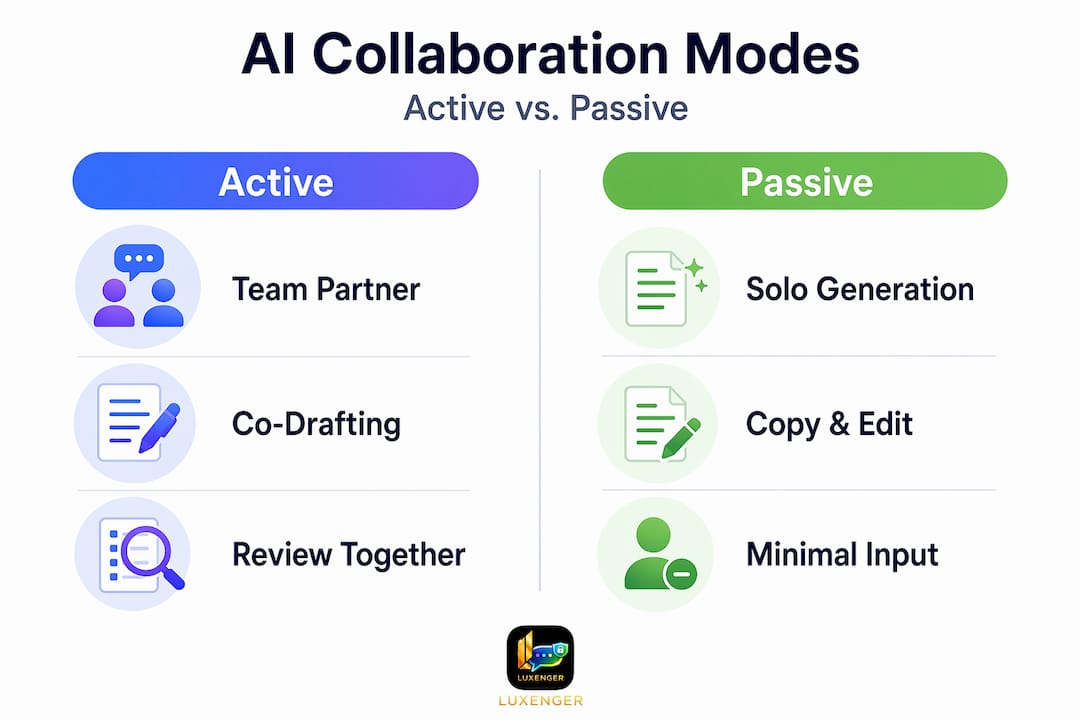
Passive AI use looks efficient on the surface. Someone asks an AI to generate a plan, copies the output, lightly edits it, and sends it forward. Nobody pushes back. Nobody interrogates the logic. The task gets done faster, but something important gets lost.
Research published in Scientific Reports examined this distinction directly with 269 participants and found that passive AI reliance reduces employees' sense of ownership and meaningfulness in their work, while active collaboration with AI preserves both. A separate finding from the same study showed that workers using AI passively also reported lower self-efficacy over time. They began to trust their own judgment less.
| Dimension | Active AI collaboration | Passive AI use |
|---|---|---|
| Employee ownership | Preserved or increased | Reduced over time |
| Work meaningfulness | Maintained | Declines with repeated use |
| Self-efficacy | Stable or improved | Erodes gradually |
| Decision quality | Human-verified | AI-dependent |
| Team learning | Continues | Slows |
The same Scientific Reports study recommends that embedding AI interactively requires deliberate workflow design: co-drafting protocols, rationale capture, and accountability checkpoints built into the process itself.
Pro Tip: When introducing AI to a team workflow, require team members to document why they accepted, modified, or rejected any AI suggestion. This one practice keeps critical thinking alive and creates a learning record your team can actually use.
Governance and operating model redesign
Here is where most AI collaboration programs break down. You can have excellent AI tools and still end up with a less collaborative team. MIT Sloan research found that after one major AI coding assistant was introduced, peer collaboration dropped by nearly 80%, even as individual output rose. People were producing more and connecting less.

This is the social isolation effect of AI. When AI can answer a question that a colleague used to answer, people stop asking colleagues. The informal peer consultation that builds shared understanding and trust quietly disappears. MIT Sloan identifies this as one of the most underappreciated risks of AI adoption in team settings.
Avoiding this outcome requires deliberate redesign. Here is what that looks like in practice:
- Redefine meeting participation rules. Specify which decisions require human deliberation before any AI input is presented. HBR research shows that adding AI to meetings without redesigning participation structures fragments discussion and shifts ownership away from teams.
- Create peer review checkpoints. Build mandatory human-to-human review steps into every AI-supported workflow. These checkpoints preserve the peer consultation that AI tends to replace.
- Establish knowledge-sharing rituals. Weekly structured sessions where teams share what they learned, challenged, or corrected in AI outputs maintain the social fabric of learning.
- Assign clear decision ownership. The Microsoft 2026 Work Trend Index makes the case that as AI agents take on more execution roles, organizations need to redesign around intent-setting, judgment, and accountability rather than task completion.
- Capture rationale, not just outputs. Every AI-assisted decision should carry a record of the human reasoning that validated it. This keeps accountability visible and supports audits, onboarding, and team learning.
Pro Tip: Treat AI participation in meetings the same way you would treat a new hire's input. Valuable, but requiring context, validation, and a clear role definition before it shapes decisions.
The HBR analysis recommends redesigning meeting operating models with explicit rules on participation rights, validation roles for AI outputs, and clear decision ownership. This is not an IT problem. It is a leadership design challenge.
Practical steps for implementing AI collaboration
Moving from understanding to execution is where most organizations stall. These are the levers that actually move the needle on AI-driven teamwork solutions.
Redefine roles before deploying tools. AI does not improve collaboration techniques automatically. Teams need role clarity that accounts for where AI sits in the workflow. Who reviews AI outputs? Who has veto authority? Who owns the final judgment? Answer these questions before you introduce any new tool.
Invest in upskilling as an organizational discipline. Capgemini's research describes AI adoption as a new enterprise discipline that requires significant investment in workforce upskilling alongside governance and infrastructure. Organizations that treat AI training as a one-time onboarding module consistently underperform those that build continuous learning programs around it.
Build the data infrastructure AI actually needs. AI tools for collaboration are only as good as the data they can access. Fragmented, siloed, or poorly governed data produces AI outputs that mislead rather than inform. Before scaling AI collaboration features, audit your data environment.
| Implementation lever | Common mistake | Better approach |
|---|---|---|
| Role definition | Assuming existing roles apply | Map AI touchpoints and redesign explicitly |
| Upskilling | One-time training | Continuous learning embedded in workflows |
| Data infrastructure | Deploying AI on siloed data | Centralize and govern data first |
| Governance | Adding AI without norms | Define participation and validation rules upfront |
Balance efficiency with human agency. The future of AI in collaboration is not a trade-off between speed and meaning. Teams that preserve human judgment, peer interaction, and accountability alongside AI assistance consistently outperform those that optimize purely for output. How AI improves remote collaboration follows the same rule: faster is not better if it comes at the cost of trust and shared understanding.
You can explore why organizations choose AI tools for team collaboration and how those decisions shape long-term teamwork quality, which is a practical companion resource to these frameworks.
My take on what leaders consistently get wrong
I have spent years watching enterprise teams adopt AI tools with genuine enthusiasm and emerge on the other side confused about why their collaboration scores went down while their output metrics went up. The pattern is almost always the same.
Leaders treat AI adoption as a technology rollout. It is not. It is a culture and process redesign project that happens to involve technology. The tools are the easy part. What you are actually doing is renegotiating how your team thinks, communicates, and holds each other accountable.
The most damaging thing I have seen is what happens to peer mentoring. When junior team members can ask an AI instead of a senior colleague, they often do. It is faster, and it does not feel like an interruption. But they lose the context, the judgment, and the relationship that would have come with that conversation. Senior people stop being asked. Their institutional knowledge stops circulating. Within a year, you have a team that is technically faster but organizationally shallower.
What I have found actually works is treating AI the way you would treat any new team member. Give it a defined role. Set expectations for what it can and cannot decide. Create explicit moments where humans have to weigh in, push back, and take ownership. AI-enhanced team communication only delivers lasting value when the human side of that equation is protected deliberately.
The leaders who get this right do not ask "how do we use AI more?" They ask "how do we use AI in a way that makes our people better at working together?" That reframe changes everything.
— Matthew
How Luxenger puts these principles into practice
If this article has clarified what thoughtful AI collaboration looks like, the next question is whether your current messaging platform is built to support it.
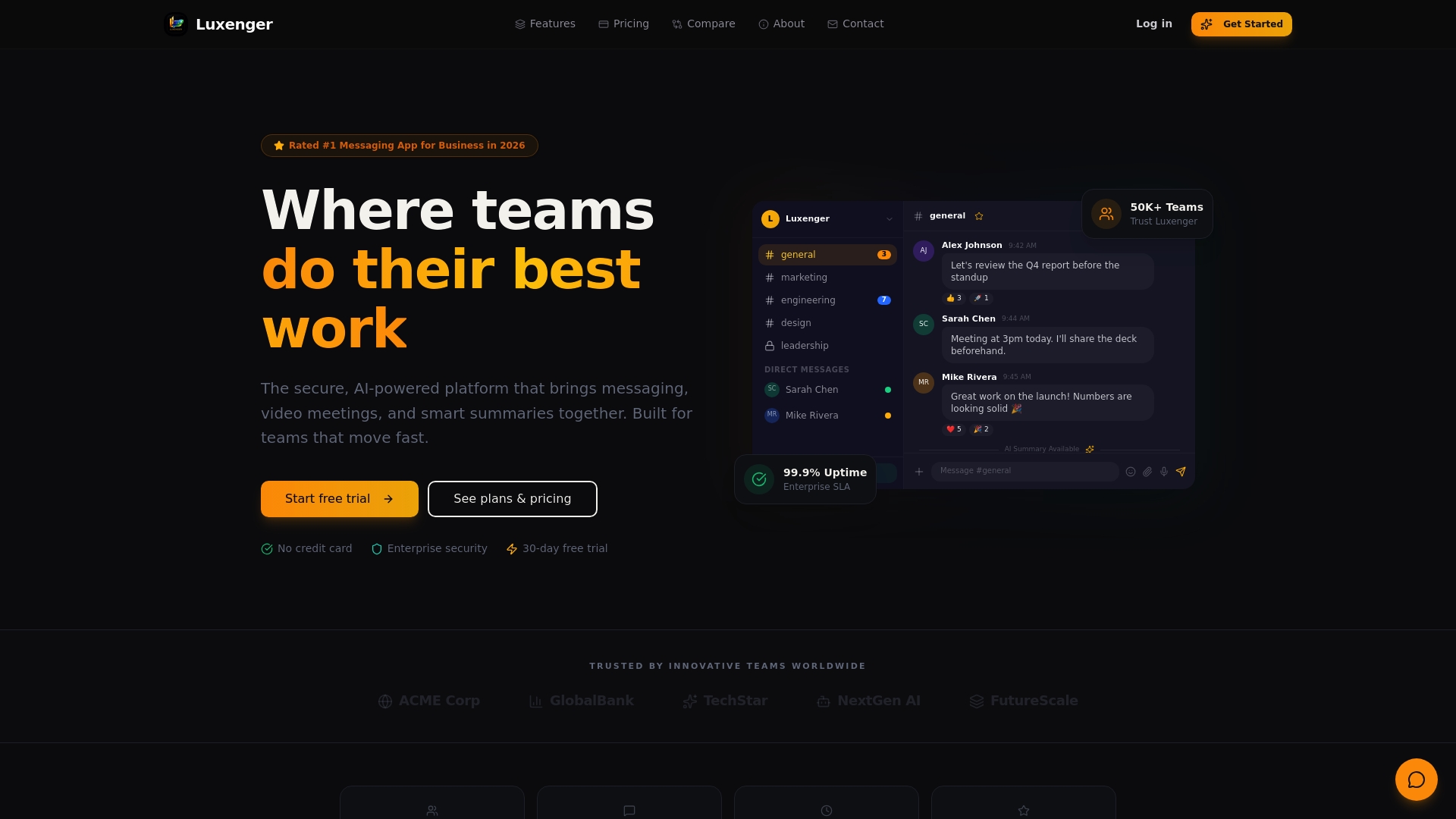
Luxenger is designed specifically for enterprises that need AI collaboration features to work within structured, accountable workflows. AI-powered conversation summaries surface key decisions without replacing the discussion that produced them. Real-time translation keeps multilingual teams genuinely connected rather than passively informed. Voice huddles give teams a fast path to human conversation when asynchronous threads are not enough. Every feature operates within bank-grade security standards, so your enterprise data stays protected while your teams stay connected.
Organizations that want AI in teamwork to strengthen peer interaction rather than replace it will find that Luxenger's design philosophy matches the governance principles outlined here. You can also review Luxenger's pricing to find the plan that fits your team's scale and requirements.
FAQ
How does AI actually change how teams collaborate?
AI transforms collaboration by automating routine communication tasks, surfacing relevant knowledge faster, and supporting predictive project management. The net effect on teamwork quality depends heavily on how AI is integrated, not just whether it is present.
What is the difference between active and passive AI use in teams?
Active AI collaboration means teams co-create, review, and challenge AI outputs together, preserving ownership and judgment. Passive use means accepting AI outputs with minimal scrutiny, which research shows reduces employee meaningfulness and self-efficacy over time.
Can AI reduce team collaboration instead of improving it?
Yes. MIT Sloan found that AI tool adoption can reduce peer collaboration by nearly 80% even while individual output rises. Without deliberate governance, AI replaces peer consultation rather than supplementing it.
What governance changes do leaders need to make when adopting AI tools?
Leaders should redesign meeting participation rules, establish peer review checkpoints, assign explicit decision ownership, and require rationale capture for all AI-assisted decisions. HBR recommends treating these as operating model changes, not policy additions.
How does AI improve collaboration for remote teams specifically?
AI improves remote collaboration through real-time translation, async conversation summaries, and proactive project risk alerts. These features reduce the coordination overhead that remote teams face, but they need clear participation norms to prevent the social isolation effect that unmanaged AI use creates.