

TL;DR:
- Most organizations mistakenly believe that deploying an approved messaging platform ensures compliance, but regulators often penalize off-channel tool use. Effective enterprise communication compliance requires capturing all business messages across every device and platform, storing them in WORM or auditable systems, and actively supervising review processes. Failures mainly occur due to gaps in capture coverage, especially from unsanctioned apps, and inadequate supervision documentation that regulators demand.
Most organizations assume they're compliant because they've deployed an approved messaging platform. Regulators disagree. The SEC and FINRA have issued hundreds of millions of dollars in fines specifically because employees used off-channel tools that firms never captured. Enterprise communication compliance, the discipline known more formally as communications supervision and recordkeeping governance, covers every message sent on behalf of your organization, regardless of platform, device, or intent. This article breaks down the regulations, technical requirements, supervision obligations, and governance frameworks you need to build a defensible program.
Table of Contents
- Key takeaways
- Explaining enterprise communication compliance: the core framework
- Multichannel environments and the capture coverage problem
- Supervision, review, and the documentation that regulators actually want
- Governance best practices for enterprise compliance programs
- Emerging challenges: AI outputs and unified communications environments
- My take on where most compliance programs actually fail
- How Luxenger supports your compliance program
- FAQ
Key takeaways
| Point | Details |
|---|---|
| Capture coverage comes first | Every business communication channel, including personal devices and unsanctioned apps, must be captured before supervision can function. |
| WORM storage is non-negotiable | SEC Rule 17a-4 requires non-rewriteable, non-erasable storage or an auditable equivalent with full change history. |
| Supervision means documented review | FINRA Rule 3110 demands evidence of actual review: reviewer identity, timestamp, and any remediation taken. |
| AI outputs are regulated records | Generative AI used in business communication must be captured and governed the same as any other message. |
| Governance requires systems, not just policy | Written policies without technical controls, audit logs, and tested workflows will not satisfy regulators. |
Explaining enterprise communication compliance: the core framework
At its foundation, enterprise communication compliance requires capturing all business communications across every device and channel, preserving them in audit-ready storage, and demonstrating active supervision. That is not a single product purchase. It is an operational discipline with legal teeth.
The regulations that drive most of this work fall into a handful of key instruments. SEC Rule 17a-4 is the primary recordkeeping rule for broker-dealers. It requires that records be preserved in WORM storage or in audit-trail systems that capture every change alongside the identity of who made it and when. Retention periods range from two to six years depending on record type, and firms must be able to produce records promptly upon request.
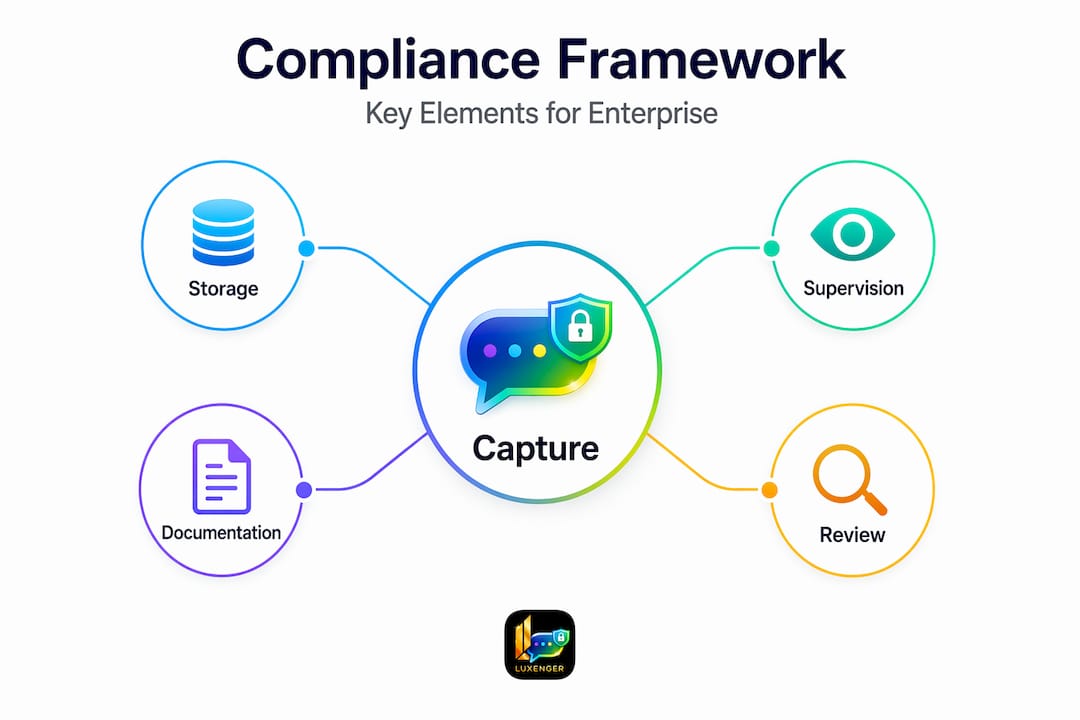
FINRA Rules 4511 and 3110 layer onto SEC requirements. Rule 4511 addresses the mechanics of recordkeeping, while Rule 3110 covers supervisory obligations. Together, they define what constitutes a business record and who is responsible for reviewing it.
What counts as a "business communication" is broader than most IT managers initially assume. It includes:
- Email and corporate messaging platform conversations
- SMS and direct messages on personal devices when used for business
- Voice communications logged in CRM systems
- Social media messages related to client or business matters
- Any off-channel tool employees use, including consumer apps, even if the firm has not sanctioned them
Pro Tip: Document every channel your employees actually use, not just the ones you've authorized. Regulators look at what happened, not what your policy said should happen.
The most common compliance failure is missed capture from off-channel tools. Coverage gaps, not archiving failures on approved platforms, are what generate the largest enforcement penalties. Getting capture right is the prerequisite for everything else.
Multichannel environments and the capture coverage problem
Modern enterprises run communications across a patchwork of platforms. A single deal might involve email, a corporate chat platform, a client's preferred messaging app, and a voice call. Each of those touchpoints carries compliance obligations, and each introduces a potential capture gap.
The challenge is not just technical. It is architectural. There are two dominant approaches to multi-platform capture, and they have very different risk profiles.
| Architecture | How it works | Compliance risk |
|---|---|---|
| Dual-platform capture | Each platform routes records independently to a compliant archiver | High complexity; gaps occur when new tools are added without updating the archiver |
| Bridge-layer webhook forwarding | A middleware layer intercepts messages across platforms and forwards to the archiver | Lower per-platform complexity; risk shifts to the bridge layer's completeness and uptime |
| Native platform archiving | Platform handles its own WORM-compliant storage (e.g., Microsoft Purview for Teams) | Dependent on platform vendor's compliance certifications; multi-vendor environments still need consolidation |
Platform compliance capabilities vary significantly. Microsoft Teams supports WORM-compliant archiving through Microsoft Purview. Enterprise Grid plans for other major collaboration tools typically require journal APIs connected to a third-party archiver. The practical implication: your archiving architecture must be designed before you deploy new platforms, not retrofitted afterward.
Enforcement history makes the cost of failure concrete. The SEC's 2022 and 2023 off-channel communication actions resulted in penalties exceeding $1.8 billion across major financial institutions, all tied to employees using consumer messaging apps for business purposes. Those firms had approved platforms. They simply could not demonstrate that business communications stayed on them.
Pro Tip: Run a channel discovery audit at least quarterly. Shadow IT, newly onboarded teams, and client-driven platform preferences all create capture gaps that your archiver vendor will never tell you about.
Supervision, review, and the documentation that regulators actually want
Capturing messages is necessary but not sufficient. FINRA Rule 3110 requires supervisory procedures that evidence actual review of communications, not just the theoretical ability to review them. That distinction has ended careers and generated nine-figure fines.
What does "actual review" look like in a compliant supervision program?
- Reviewer identity is logged. Every reviewed message must have a record of who reviewed it, not just that a review occurred.
- Timestamps are immutable. The review timestamp must be system-generated and unalterable. A supervisor manually marking messages as reviewed in a spreadsheet does not satisfy this requirement.
- Escalation paths are documented. When a message triggers a potential violation, the escalation must follow a defined workflow with documented outcomes. Verbal conversations about a flagged message do not count.
- Remediation is recorded. If a review results in corrective action, the nature of that action and its resolution must be captured in the supervision system.
- Review queues are manageable. Risk-based review systems prioritize context over keyword matching alone. An unmanageable queue that supervisors cannot realistically work through is itself a compliance failure.
The last point deserves more attention than it typically receives. Firms that rely on keyword-triggered alerts alone generate enormous false positive rates. When a supervisor is faced with 500 flagged messages per day, effective supervision becomes operationally impossible. Technology that uses contextual analysis, conversation threading, and behavioral signals dramatically reduces noise without reducing coverage.
Pro Tip: Test your supervision system against real communication samples from your own environment before going live. Calibrate alert thresholds until your reviewers can realistically process the queue. A system that creates unsustainable workload is a liability.

Governance best practices for enterprise compliance programs
A compliance program that passes regulatory scrutiny is not built on policy documents. It is built on systemized governance with audit logging, role-based access, verified inputs, and approval workflows that leave a defensible paper trail.
The components that separate defensible programs from nominal ones include:
- Role-based access controls that restrict who can access archived communications, approve exceptions, or modify retention policies
- Approval workflows for any policy change, retention exception, or new channel addition, with documented sign-off at the appropriate authority level
- Immutable audit logs that allow full reconstruction of any communication, including all edits, deletions, and metadata, with user identity and timestamps throughout
- Continuous monitoring that flags anomalies in communication patterns, not just individual messages, enabling proactive detection of policy drift
- Tested incident response procedures that have been walked through with actual scenarios, not just written and filed
Global governance frameworks including COSO, NIST, and ISO 27001 all address communication controls within their broader risk management structures. ISO 27001, in particular, requires documented controls for information classification, access management, and audit logging that map directly onto communication compliance requirements. Aligning your program to one of these frameworks gives you a structured audit baseline and a language regulators recognize.
The cost of getting governance wrong is not abstract. Audit logs must allow full forensic reconstruction of original communications. During cloud migrations or M&A integrations, maintaining that chain of custody is frequently where programs break down. A gap in WORM immutability mid-migration, even a brief one, creates a compliance exposure that no end-point archive configuration can retroactively fix.
Emerging challenges: AI outputs and unified communications environments
Generative AI in the workplace is no longer a pilot program for most enterprises. It is live in your communication stack, whether you have formally governed it or not. The compliance implication is direct: AI prompts and outputs become official communications subject to the same capture and retention requirements as any message your employees send manually.
Firms that have already integrated large language models into their communication workflows need to extend their governance architecture to include:
- Capture of AI-generated draft messages before they are sent, not just the final transmission
- Retention of the prompt context that generated a given output, since the prompt is part of the communication record
- Supervision workflows that flag AI-assisted messages for review at appropriate sampling rates
- Clear policy on which AI tools are sanctioned, with unapproved tools treated the same as any off-channel consumer app
Beyond AI, unified communications platforms have created a signal-to-noise problem that directly affects compliance quality. The average employee receives 117 emails and 153 platform messages per day. When compliance-relevant communications are buried in that volume, supervisors miss them. Channel governance, meaning clear rules about which topics belong in which channels, reduces noise and improves the traceability of decision-linked communication.
Pro Tip: Before deploying any AI communication tool, map its outputs to your existing capture architecture. If the tool cannot route records to your archiver via API, it is not compliant regardless of how useful it is. Treat AI-powered messaging governance as a compliance prerequisite, not an afterthought.
My take on where most compliance programs actually fail
I've reviewed a lot of compliance programs over the years, and the pattern that shows up most consistently is not what firms write in their policies. It's what they assume without verifying.
The most common assumption I see is that deploying an approved platform equals compliance. It doesn't. Capture coverage is the foundational requirement, and most firms have not audited every channel their employees actually use. Not the ones clients requested. Not the team that onboarded six months ago and brought their preferred tools with them.
The second assumption is that a supervision system is functional because it's installed. I've seen firms with technically compliant archiving infrastructure whose review queues ran six weeks behind. That is not supervision. That is storage with extra steps.
What actually works is treating compliance as a continuous operational discipline with scheduled testing, documented escalation outcomes, and regular channel discovery. The firms that survive regulatory scrutiny are not the ones with the best technology contracts. They are the ones that can produce evidence of actual, ongoing supervisory activity across all communication channels. Buying a platform gives you capability. Only operating it correctly gives you compliance.
Emerging tools, including platforms purpose-built with compliance in enterprise messaging as a design principle rather than an add-on, are making it meaningfully easier to build that kind of program. But the discipline still has to be yours.
— Matthew
How Luxenger supports your compliance program
If the frameworks in this article describe where you need to go, your communication platform needs to be built to get you there. Luxenger's enterprise messaging platform is designed with bank-grade security, role-based access controls, and immutable audit logging built into the architecture from the ground up, not layered on afterward. For compliance officers managing multi-channel environments, that distinction matters.
Luxenger also addresses the AI governance gap directly. Its AI-powered features operate within the same capture and audit architecture as all other communications, so AI-generated summaries and message assists are logged, traceable, and available for supervisory review. Combined with real-time translation for multilingual teams and voice huddle capabilities, Luxenger gives IT managers a single governed environment instead of a patchwork of platforms to audit. Explore Luxenger's enterprise compliance features to see how it fits your governance architecture.
FAQ
What does enterprise communication compliance require?
Enterprise communication compliance requires capturing all business communications across every channel and device, storing them in immutable, audit-ready systems, and demonstrating active supervision with documented review logs and escalation records.
Which regulations govern enterprise communication recordkeeping?
For financial services firms, SEC Rule 17a-4 and FINRA Rules 4511 and 3110 are the primary regulations. They mandate WORM or auditable storage, defined retention periods, and documented supervisory procedures.
Do off-channel communications like WhatsApp count as business records?
Yes. If an employee uses any communication tool for business purposes, that communication is a business record subject to capture and retention requirements, regardless of whether the firm officially sanctioned the platform.
How should firms handle AI-generated content under current compliance rules?
AI prompts and outputs used in business communication are subject to the same capture and supervision requirements as manually written messages. Firms must extend their archiving architecture to include AI tools before deploying them in regulated workflows.
What is the most common reason firms fail communication compliance audits?
The most common failure is gaps in capture coverage, specifically from off-channel or unsanctioned tools that employees used for business without the firm's archiver collecting those records.