

TL;DR:
- Internal collaboration boosts organizational performance by increasing productivity, accelerating innovation, and strengthening team trust. Structured, centralized communication practices enable faster decision-making, reduce duplication, and improve customer outcomes through shared visibility and document archiving. Effective leadership models transparency and governance, turning collaboration into a strategic operational system that benefits hybrid and remote teams.
Internal collaboration is the practice where teams within an organization actively share knowledge, coordinate efforts, and align goals to drive productivity and innovation. The benefits of internal collaboration are not abstract. Organizations with highly connected workforces experience a 20–25% increase in overall productivity, affecting speed to market, customer satisfaction, and competitive positioning. That number represents a genuine performance multiplier, not a marginal gain. Platforms like Happeo and Wrike document this effect across industries, and the research from 2026 confirms it compounds over time. For corporate leaders managing complex, distributed teams, understanding what drives this outcome is the starting point for acting on it.
1. How internal collaboration accelerates innovation
Cross-functional collaboration is the primary engine of organizational innovation because it integrates perspectives from departments that rarely interact in siloed structures. When a product manager, a data analyst, and a customer success lead sit in the same conversation, the problem gets defined more accurately before a single solution is proposed. That accuracy is where original ideas come from.
Structured programs like hack weeks and dedicated idea channels give teams a formal mechanism to surface insights that would otherwise disappear into meeting notes or email threads. The key is making those conversations searchable and persistent. A digital platform that archives discussions lets a team six months later retrieve a rejected idea that suddenly fits a new market condition. That is not luck. That is institutional memory working as a competitive asset.
- Cross-functional input reduces the time spent redefining problems that other teams already solved.
- Persistent, searchable conversations prevent good ideas from being buried.
- Hack weeks and innovation sprints create structured space for experimentation without disrupting core operations.
- Diverse departmental perspectives reduce groupthink, which is the single biggest killer of genuine innovation.
Pro Tip: Assign a rotating "idea steward" role in your collaboration platform. This person tags, organizes, and resurfaces relevant past discussions during planning cycles. It costs nothing and prevents the most common form of organizational amnesia.
2. Ways collaboration drives productivity and operational efficiency

Collaborative workforces produce a 20–25% productivity increase, and the mechanism is straightforward. When communication is fragmented across disconnected email threads, local file storage, and multiple chat tools, employees spend a significant portion of their day searching for information rather than acting on it. Centralizing that communication eliminates the search cost entirely.
The operational gains show up in three specific areas:
- Reduced duplication. When two teams work on the same problem without visibility into each other's progress, they produce conflicting outputs that require reconciliation. Shared project spaces eliminate this by default.
- Faster decision cycles. Delayed decisions are one of the most expensive forms of organizational waste. Shared visibility into project status and ownership means fewer escalations and shorter approval chains.
- Cleaner handoffs. When documentation lives in a central, accessible location, transitions between teams or individuals do not require a briefing call. The record speaks for itself.
| Collaboration gap | Operational cost | Collaborative fix |
|---|---|---|
| Fragmented communication | Time lost searching for information | Centralized messaging and documentation |
| Duplicated work | Rework and conflicting outputs | Shared project visibility and ownership |
| Slow decision cycles | Delayed execution and missed deadlines | Transparent status updates and clear accountability |
| Poor handoffs | Knowledge loss during transitions | Persistent, searchable conversation records |
Reducing friction in daily execution through centralized communication is not a technology problem. It is a governance decision. Leaders who define where work gets documented and discussed see the productivity gains. Those who leave it to individual preference do not.
3. Building stronger teams and a positive company culture
Frequent collaboration builds trust, and trust is the foundation of every high-performing team. When employees work across departments regularly, they develop a more accurate understanding of each other's constraints, priorities, and expertise. That understanding reduces interpersonal friction and speeds up future cooperation.
Gallup's 2023 research confirms that highly collaborative teams show elevated retention and satisfaction rates. The mechanism is not complicated. People stay in environments where they feel connected to colleagues and to the purpose of their work. Collaboration creates both conditions simultaneously.
"Collaboration reduces isolation and supports well-being, especially in hybrid teams where the absence of physical proximity makes connection harder to sustain by default."
The culture benefits of internal teamwork extend beyond morale:
- Cross-department exposure accelerates employee growth by broadening skill sets and organizational awareness.
- Mentorship happens organically when junior employees work alongside senior colleagues from other functions.
- Transparent communication about goals and trade-offs connects individual work to company strategy, which is the single strongest driver of employee engagement according to Gallup's engagement data.
- In hybrid environments, structured collaboration replaces the informal connection that physical offices provided naturally.
For leaders managing teams across multiple locations, remote team communication strategies that prioritize structured, regular interaction are not optional. They are the substitute for hallway conversations that no longer happen.
4. Improving problem-solving and decision-making
Collaborative decisions produce better outcomes than isolated ones because multiple perspectives reduce blind spots. A decision made by one function without input from adjacent teams frequently creates downstream problems that the decision-maker never anticipated. The cost of those problems, measured in rework, escalations, and reversals, consistently exceeds the cost of including more voices upfront.
Collaborative decisions create more buy-in and fewer objections because participants understand the reasoning behind choices and commit to implementation. This is a measurable operational advantage. When a decision gets reversed two weeks after announcement because a key stakeholder was excluded, the organization pays twice: once for the original decision and once for the correction.
- Multiple perspectives identify failure modes that single-function analysis misses.
- Shared decision-making reduces the political resistance that slows implementation.
- Cross-functional input improves risk assessment by surfacing concerns from teams closest to execution.
- Documented decisions create an organizational learning record that prevents the same mistakes from recurring.
Pro Tip: Before finalizing any significant decision, run a structured "pre-mortem" with representatives from each affected function. Ask them to identify what could go wrong from their vantage point. This takes 30 minutes and eliminates the most common category of avoidable implementation failures.
Collaboration skills in listening, structured writing, and clear communication are learnable through deliberate practice. Leaders who invest in developing these skills across their teams build a durable decision-making advantage that compounds over time.
5. How internal teamwork improves customer experience and business results
Internal alignment directly determines external outcomes. When sales, product, and customer success teams operate with shared visibility into customer issues and product capabilities, response times drop and messaging becomes consistent. When those teams operate in silos, customers receive conflicting information and slower resolutions.
| Collaboration scenario | Customer impact | Business result |
|---|---|---|
| Cross-team incident response | Faster resolution, fewer escalations | Higher customer satisfaction scores |
| Shared knowledge base | Consistent answers across touchpoints | Reduced support volume and handling time |
| Aligned product and sales messaging | Accurate customer expectations | Lower churn and stronger renewal rates |
| Feedback loops from support to product | Faster feature iteration | Shorter time to market for improvements |
Internal collaboration directly affects external outcomes including faster responses, consistent messaging, and continuous customer experience improvements. The most visible example is cross-team incident management. When an outage or service failure occurs, organizations with established collaboration channels resolve the issue faster because the right people are already connected and the communication protocol is already defined.
Shared knowledge bases reduce the volume of repetitive internal questions, which frees senior staff to focus on complex problems rather than answering the same queries repeatedly. That time recapture is a direct productivity gain with a direct customer experience benefit. The two outcomes are not separate. They are the same outcome viewed from different angles.
Key takeaways
Internal collaboration is a performance multiplier that compounds across innovation, productivity, culture, and customer outcomes when leaders treat it as a structured discipline rather than an organic behavior.
| Point | Details |
|---|---|
| Productivity gain is quantifiable | Connected workforces produce a 20–25% productivity increase through reduced duplication and faster decisions. |
| Innovation requires structure | Hack weeks, idea channels, and searchable archives convert collaboration into sustained competitive advantage. |
| Culture and retention are linked | Gallup research confirms that collaborative teams show higher retention, satisfaction, and employee engagement. |
| Decision quality improves with inclusion | Cross-functional input reduces blind spots, reversals, and implementation resistance. |
| Customer outcomes follow internal alignment | Shared visibility across sales, product, and support teams directly reduces resolution times and improves consistency. |
Where most collaboration strategies actually break down
I have reviewed collaboration frameworks across dozens of enterprise environments, and the failure pattern is almost always the same. The organization invests in tools, announces a collaboration initiative, and then watches adoption plateau within 90 days. The tools multiply. The meetings increase. The actual quality of coordination does not improve.
The problem is that most leaders treat collaboration as a cultural aspiration rather than an operational system. They say "we want a more collaborative culture" without defining what decisions get made collaboratively, where work gets documented, or how asynchronous updates replace status meetings. Tool sprawl without governance is the most common collaboration failure mode, and it is entirely avoidable.
The leaders who get this right do two things differently. First, they shift the framing from collaboration for morale to collaboration for performance. They talk about shared visibility of goals and trade-offs, not team bonding. Second, they model the behavior themselves. When a senior leader documents their decision rationale in a shared channel instead of sending a top-down announcement, they demonstrate that transparency is a practice, not a platitude.
Asynchronous-first communication is the structural change that makes this sustainable. Deep work requires uninterrupted time. Collaboration that defaults to synchronous meetings consumes that time and produces diminishing returns. The organizations that get the most from their collaboration investments are the ones that treat documented, searchable updates as the primary communication medium and meetings as the exception.
— Matthew
How Luxenger centralizes collaboration for enterprise teams
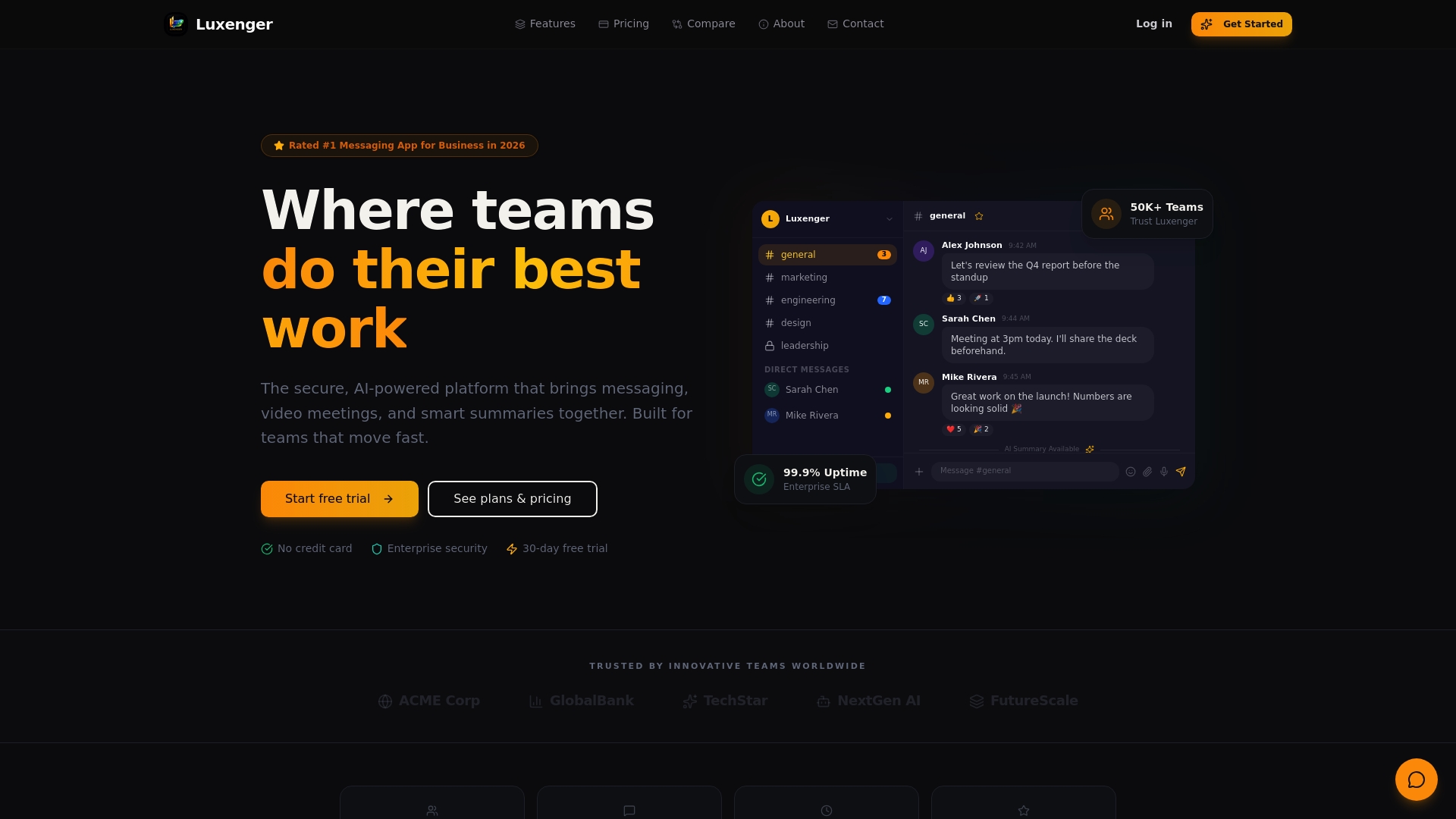
The research is clear: fragmented communication is the primary drag on enterprise productivity, and the fix is centralization with governance. Luxenger is built specifically for this problem. The platform combines AI-powered conversation summaries, voice huddles for quick audio alignment, and real-time translation for multilingual teams, all within a bank-grade secure environment. For organizations managing enterprise communication across multiple functions and locations, Luxenger replaces tool sprawl with a single, searchable, secure channel. Every decision, update, and discussion lives in one place. Explore how Luxenger's AI collaboration tools can replace fragmented workflows with a system your teams will actually use.
FAQ
What are the main benefits of internal collaboration?
The primary benefits are a 20–25% productivity increase, faster innovation cycles, stronger employee retention, and improved customer response times. These outcomes compound when collaboration is treated as a structured operational discipline rather than an informal practice.
How does internal collaboration improve workplace communication?
Centralizing communication in a single platform reduces time spent searching for information across disconnected tools and eliminates conflicting versions of documents. The result is faster decisions and cleaner handoffs between teams.
Why does internal teamwork matter for hybrid and remote teams?
Hybrid and remote environments remove the informal connection that physical offices provide. Structured collaboration replaces those interactions, reduces isolation, and maintains the alignment that drives both engagement and performance.
What is the biggest obstacle to effective internal collaboration?
Tool sprawl without governance is the most common failure point. When teams use multiple disconnected platforms without clear protocols for where decisions get documented, collaboration fragments rather than consolidates.
How can leaders build a stronger collaborative culture?
Leaders build collaborative culture by modeling transparency, sharing the reasoning behind decisions in shared channels, and shifting the organizational conversation from collaboration as morale to collaboration as performance advantage.