

TL;DR:
- Confidential team communication involves secure, regulated exchanges of work-related information restricted to authorized individuals. It requires formal boundaries, enforcement through technology, and trained leadership to prevent breaches effectively. Building a strong confidentiality culture is essential and more impactful than relying solely on technical tools.
Confidential team communication is defined as the secure, private exchange of work-related information restricted to authorized individuals who have a legitimate need to access it. In corporate and remote environments, this practice protects sensitive data including financial reports, employee records, and intellectual property from unauthorized disclosure. The concept goes beyond simply keeping things quiet. It requires defined authorization boundaries and formal enforcement mechanisms to function reliably. Platforms like Luxenger, and governance frameworks like HIPAA and attorney-client privilege, represent how organizations operationalize these requirements in practice.
What is confidential team communication vs. private or general communication?
Confidential team communication and private communication are not the same thing, even though the terms are often used interchangeably. Private communication refers to any exchange that is not publicly visible. Confidential communication goes further: it includes defined authorization boundaries and strict access controls rather than just a tone or informal request. Without formal enforcement and access governance, confidentiality fails in teams regardless of intent.

The distinction matters most in regulated industries. In healthcare, for example, clinician-patient discussions are protected under HIPAA, but confidentiality is not absolute. Disclosures to public health authorities or family members are permitted in limited circumstances. This means confidentiality in professional settings always operates within a legal framework, not just a cultural one.
In legal practice, confidential communication means information is shared only among parties necessary to the consultation, including the client, attorney, and legal assistants. The protection preserves attorney-client privilege and cannot be waived casually. General workplace communication carries no such formal protection unless your organization has explicitly created it through policy and technology.
| Type | Authorization | Enforcement | Legal framework |
|---|---|---|---|
| General communication | None required | None | None |
| Private communication | Informal | Social norms | Minimal |
| Confidential communication | Formally defined | Access controls, policy | Often mandatory |
Pro Tip: When drafting internal communication policies, explicitly define which categories of information are confidential and who is authorized to access each. Vague language like "sensitive information" creates gaps that lead to accidental breaches.
Key principles and best practices for maintaining confidentiality
The foundation of confidential team communication is the need-to-know principle. Leaders must not share employee personal or performance details without a legitimate reason, and must inform employees when disclosure is required. Sharing only on a need-to-know basis builds trust and protects privacy simultaneously. This is not a passive default. It requires active decisions about who receives what information and why.
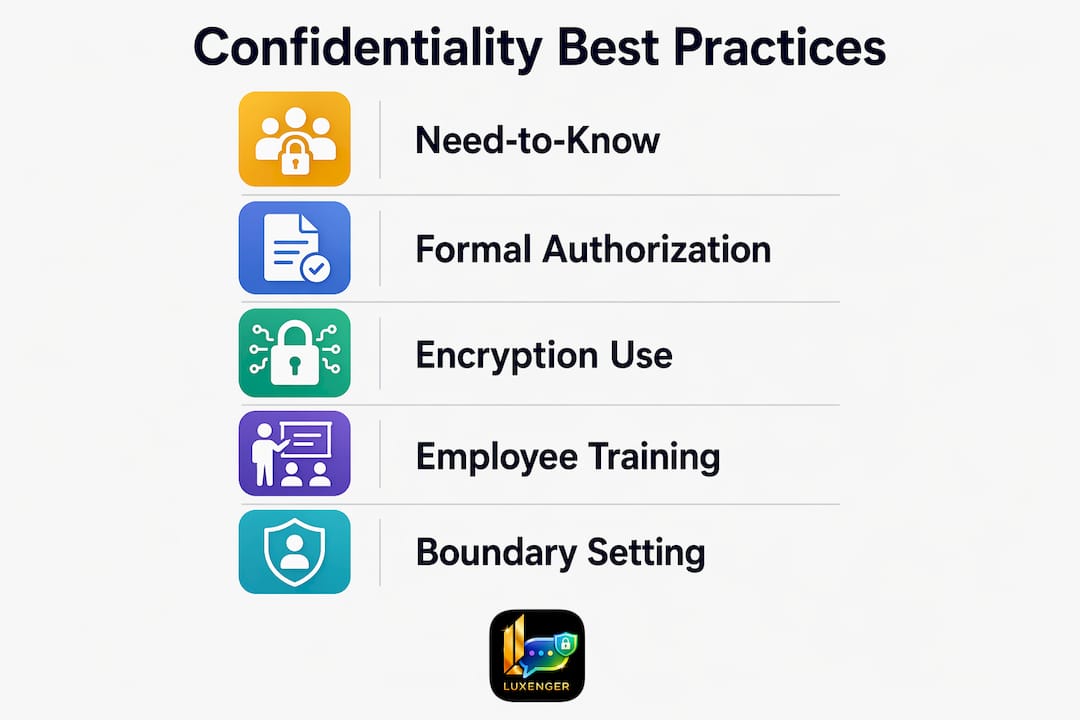
The most common cause of confidentiality failures is not malicious intent. Leaders share information out of perceived helpfulness without applying a strict need-to-know filter. A manager who mentions a colleague's performance issue to another team member, even with good intentions, has broken confidentiality. The damage to trust is often irreversible.
Effective confidentiality practice requires the following behaviors from leaders and team members:
- Define information categories clearly. Classify what counts as confidential before a situation arises, not during one.
- Communicate boundaries proactively. Tell your team what can and cannot be shared, and with whom, at the start of any sensitive project.
- Use secure channels for sensitive exchanges. Never discuss confidential matters over unencrypted email or consumer messaging apps.
- Establish escalation paths. Leaders should provide clear escalation paths for breaches or accidental disclosures, with training that goes beyond "don't share" to include resolution steps.
- Model the behavior yourself. A leader who gossips about one employee's situation signals to the team that confidentiality is optional.
- Avoid blanket promises of secrecy. When legal obligations require disclosure, promising total confidentiality creates liability and destroys trust when you must break it.
Training is where most organizations fall short. Policies exist on paper, but employees rarely practice the judgment calls that confidentiality requires. Role-playing scenarios, such as what to do when a colleague asks about another employee's salary, build the muscle memory that prevents real breaches.
Pro Tip: When someone shares information with you in confidence, confirm your understanding of the boundaries immediately. Say: "I understand this stays between us unless there's a legal or safety reason to disclose. Is that correct?" This simple step prevents misunderstandings and creates a shared record of intent.
How technology and tools support confidential team communication
Technology does not create confidentiality. It enforces it. The difference is significant: a culture that treats confidentiality casually will find ways around any technical control. But the right tools make accidental breaches far less likely and give organizations the audit trail they need when breaches do occur.
Secure team messaging platforms like Luxenger use end-to-end encryption, access permissions, and audit logs to support confidential communications. These technical features enable compliance, prevent unauthorized access, and facilitate secure collaboration for remote teams. For organizations managing hybrid workforces across multiple time zones, this infrastructure is not optional. It is the baseline.
The core technical capabilities that support confidential communication include:
- End-to-end encryption: Messages are readable only by the sender and authorized recipients. No third party, including the platform provider, can access the content.
- Role-based access controls: Permissions are assigned by job function, not by individual request. A finance analyst sees financial data; a marketing coordinator does not.
- Audit logs: Every access event is recorded. If a breach occurs, you can identify exactly who accessed what and when.
- Remote wipe capabilities: If a device is lost or an employee leaves, administrators can revoke access and delete sensitive data remotely.
- AI-powered summaries: Platforms like Luxenger use AI to distill lengthy conversations into key points, reducing the risk that sensitive details get forwarded unnecessarily in long message threads.
| Feature | Risk it mitigates | Example use case |
|---|---|---|
| End-to-end encryption | Interception by third parties | Executive strategy discussions |
| Role-based access | Unauthorized internal access | HR records in a cross-functional team |
| Audit logs | Undetected breaches | Compliance investigations |
| Remote wipe | Device loss or employee exit | Remote worker offboarding |
For IT team communication strategies, the architecture matters as much as the features. A platform that stores message data on servers in non-compliant jurisdictions creates legal exposure regardless of its encryption claims. Always verify where data is stored and processed before deploying any messaging tool for confidential work.
One underappreciated risk is accidental forwarding. An employee copies a message into the wrong channel or forwards a thread without realizing it contains restricted information. Access controls and channel-level permissions reduce this risk significantly. Luxenger's permission management, for example, allows administrators to restrict forwarding and screenshot capabilities within designated confidential channels.
Common challenges and legal considerations
Confidentiality in team communication is not absolute, and treating it as such creates its own risks. Confidentiality is not absolute; teams must expect exceptions and train accordingly to maintain legal compliance and safety. Safety threats, court orders, and regulatory requirements can all override confidentiality obligations. Leaders who have not prepared their teams for these exceptions will face confusion and potential liability when they arise.
The legal landscape varies significantly by industry. Healthcare organizations must comply with HIPAA, which governs how protected health information is stored, transmitted, and disclosed. Legal teams operate under attorney-client privilege, which protects communications from compelled disclosure in litigation. Financial services firms face SEC and FINRA regulations governing how material non-public information is handled internally. Each framework imposes specific technical and procedural requirements that go well beyond general good practice.
Reputational risk is the most immediate consequence of a confidentiality breach. When employee data, client information, or strategic plans leak, the damage to trust is often more lasting than any regulatory fine. Organizations that have invested in enterprise security best practices for team messaging recover faster because they can demonstrate due diligence and contain the breach quickly.
Employee expectations also require active management. Many employees assume that conversations with their manager are fully confidential. They are not. Managers have reporting obligations to HR and legal teams in cases involving harassment, safety threats, or legal violations. Establishing clear expectations about confidentiality early helps avoid misunderstandings and creates psychological safety. When employees understand the real boundaries, they are more likely to use confidential channels appropriately rather than avoiding them out of distrust.
Key takeaways
Confidential team communication requires formal authorization boundaries, enforcement technology, and trained leadership to function. Policy alone is never sufficient.
| Point | Details |
|---|---|
| Definition is precise | Confidential communication requires defined access rules, not just discretion or informal trust. |
| Need-to-know is the core principle | Share only what is necessary, with only those who have a legitimate reason to receive it. |
| Technology enforces what culture cannot | Encryption, access controls, and audit logs reduce accidental breaches and support compliance. |
| Confidentiality has legal limits | Safety threats, court orders, and regulations like HIPAA can override confidentiality obligations. |
| Training must include breach response | Employees need to know not just "don't share" but what to do when accidental disclosure occurs. |
Why confidentiality culture matters more than any tool
I have worked with organizations that spent significant budgets on secure messaging platforms and still experienced confidentiality failures within months of deployment. The technology was sound. The culture was not. Leaders were sharing performance details in hallway conversations. Sensitive project updates were being discussed in all-hands Slack channels because the confidential channel felt inconvenient. The tool was there. The habit was not.
The most durable confidentiality programs I have seen share one characteristic: leadership treats confidentiality as a trust-building practice, not a compliance checkbox. When a senior leader says openly, "I can't share the details of that decision yet, but I will tell you what I can," they model exactly the behavior that creates psychological safety. Employees learn that confidentiality is not secrecy for its own sake. It is a form of respect.
The tension between transparency and confidentiality is real, and pretending it does not exist is a mistake. Managers need to balance confidentiality obligations with building trust through transparent communication where possible. The answer is not to choose one over the other. It is to be explicit about which mode you are operating in at any given moment. "This is confidential for now" is a complete sentence. It respects both the boundary and the person you are speaking to.
For remote team communication, the stakes are higher because informal cues disappear. You cannot see who is within earshot. You cannot read the room. That is precisely why technology and explicit protocols matter more in distributed teams, not less.
— Matthew
Protect your team's most sensitive conversations with Luxenger
Confidential communication requires more than good intentions. It requires infrastructure that enforces your policies automatically, even when your team is distributed across time zones and devices.
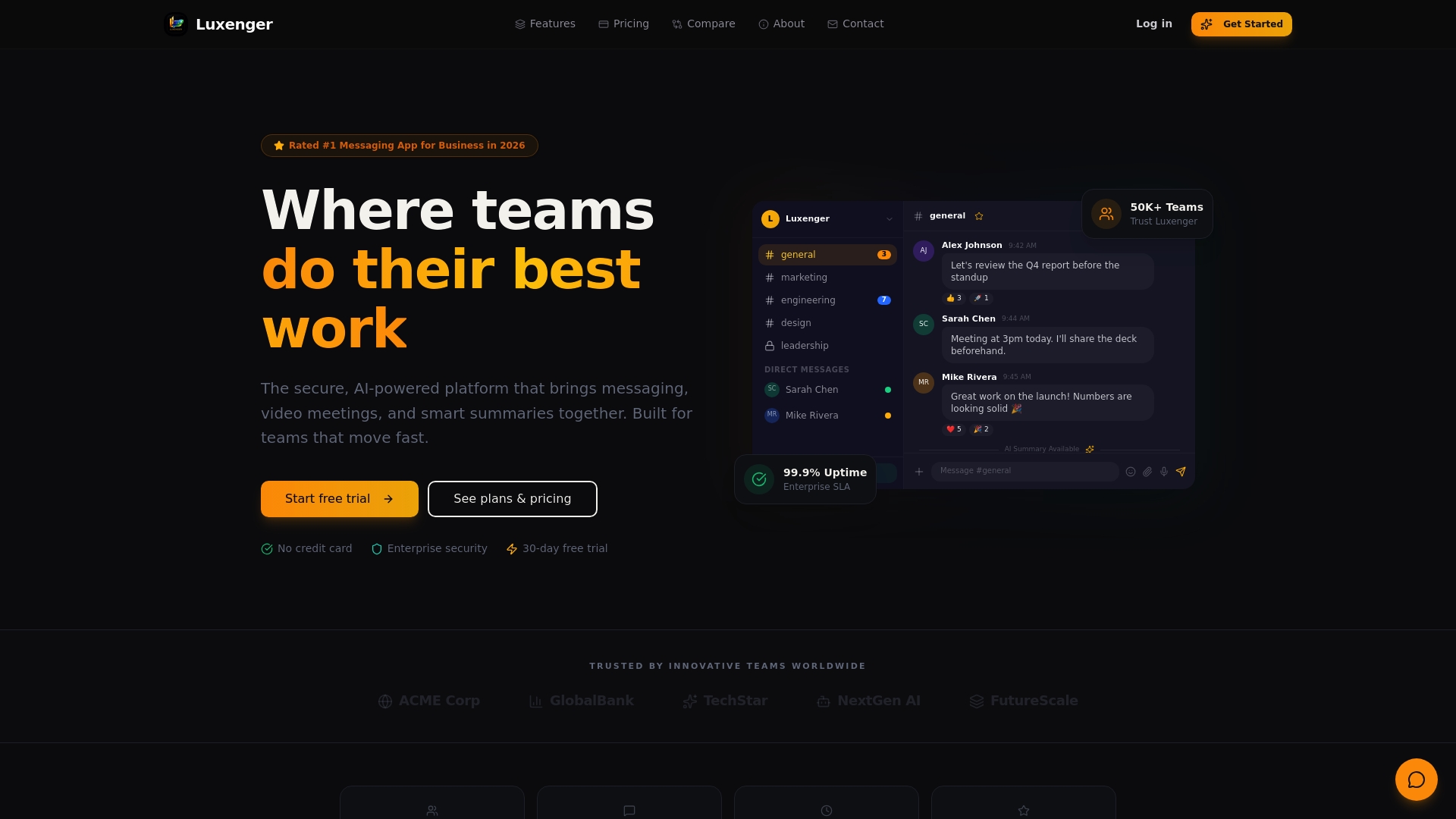
Luxenger is built for exactly this challenge. The platform combines bank-grade end-to-end encryption with role-based access controls, audit logs, and AI-powered conversation summaries that reduce the risk of sensitive information spreading beyond its intended audience. For healthcare teams, Luxenger's HIPAA-compliant messaging meets the specific regulatory requirements that general messaging tools cannot. For enterprise teams across industries, the Luxenger enterprise platform provides the security architecture and compliance features that confidential communication demands. See how it fits your organization's needs today.
FAQ
What is confidential team communication?
Confidential team communication is the exchange of work information intended to remain private and accessible only to authorized individuals. It typically involves financial reports, employee records, and intellectual property that could cause legal or reputational harm if disclosed without authorization.
How does confidential communication differ from private communication?
Private communication simply means an exchange is not publicly visible. Confidential communication adds formal authorization boundaries, access controls, and enforcement mechanisms. Without these formal controls, confidentiality fails in practice regardless of intent.
What are the best practices for maintaining team confidentiality?
The most effective practices include applying the need-to-know principle, using encrypted messaging platforms, establishing clear escalation paths for accidental breaches, and training employees on both prevention and response. Leaders modeling confidentiality behavior is the single most influential factor.
Can confidentiality be overridden in a workplace setting?
Yes. Safety threats, court orders, and regulatory requirements such as HIPAA can legally require disclosure of otherwise confidential information. Organizations must train employees on these exceptions to avoid confusion and legal liability when they arise.
What technology features support confidential team communication?
End-to-end encryption, role-based access controls, audit logs, and remote wipe capabilities are the core technical requirements. Platforms like Luxenger combine these features with AI-powered summaries and permission-based channel controls to reduce both deliberate and accidental breaches.