

TL;DR:
- Effective real estate messaging relies on instant responses, automation, and unified platforms to prevent losing leads. Prioritizing speed-to-lead, omnichannel context, and compliance ensures higher conversion rates with less manual effort. Modern tools like AI integration and rich media support further enhance client engagement and operational efficiency.
Effective real estate messaging is defined by the ability to respond instantly, retain context across every channel, and move leads through the pipeline without manual intervention. Agents who rely on basic SMS or email alone lose deals to competitors using platforms built around automation, unified inboxing, and CRM sync. Tools like Zendesk, Nextiva, and CloseDaily have each demonstrated that the right messaging features directly determine lead conversion rates. SMS open rates exceed 90%, and response speed is the single biggest predictor of whether an agent wins or loses a conversation.
1. Speed-to-lead automation

Speed-to-lead is defined as the time between a lead's first inquiry and an agent's first response. In real estate, that window is brutally short. Agents responding within 5 minutes win the majority of conversations. Wait 30 minutes and the lead has already moved on to the next listing.
Automation solves this by sending an immediate SMS the moment a lead submits a form, clicks an ad, or messages through a portal. The sequence typically runs in three stages:
- Immediate response (within 5 minutes): A personalized SMS acknowledging the inquiry and offering a next step, such as a showing link or a quick question about budget.
- 48-hour follow-up: A second message that references the original property or search criteria, keeping the lead warm without requiring agent input.
- 7-day re-engagement: A final touchpoint that offers new listings or a market update, designed to recapture leads who went quiet.
Visual workflow builders tied to behavioral triggers create relevant follow-ups rather than generic timed blasts. This distinction matters because a lead who viewed a three-bedroom listing should receive a three-bedroom follow-up, not a generic "Are you still interested?" message.
Pro Tip: Set CRM triggers to fire automation sequences the moment a lead status changes. If a lead moves from "new" to "contacted," the 48-hour sequence should pause automatically to avoid double-messaging.
2. Unified inbox and conversation threading
A unified inbox consolidates every conversation, whether from SMS, web chat, WhatsApp, or email, into a single agent workspace. Without it, agents toggle between five tabs, miss messages, and lose the thread of what a lead actually asked two days ago.
Conversation threading gives each lead a continuous chat history that any agent on the team can pick up mid-conversation. Web-widget conversations become tickets with full history, typing indicators, read receipts, and routing tags attached. This means a buyer who chatted with Agent A on Monday can speak with Agent B on Thursday without repeating their entire situation.
The operational benefit for teams is significant. When a senior agent is on a showing, a colleague can step in, review the thread, and respond with full context. No lead falls through because of a scheduling conflict or an agent's day off.
- Full conversation history visible to all authorized team members
- Typing indicators and read receipts so agents know when a lead is actively engaged
- Routing tags that flag conversations by property type, deal stage, or territory
- Escalation paths that move complex conversations to senior agents automatically
Pro Tip: Use conversation history to prep before every follow-up call. Reviewing the last three messages takes 30 seconds and prevents the single most common client complaint: "I already told your colleague that."
3. Omnichannel context retention
Omnichannel messaging is the practice of maintaining a single, continuous conversation record regardless of which platform the lead uses. A buyer might start on Instagram DM, continue on WhatsApp, and finish on a web chat widget. Without context retention, each channel looks like a new conversation.
Omnichannel platforms eliminate the friction of leads repeating their preferences every time they switch channels. The conversation history follows the lead, not the channel. This directly improves lead nurture because agents can reference prior discussions without asking the same qualifying questions twice.
| Feature | Single-channel messaging | Omnichannel messaging |
|---|---|---|
| Conversation history | Siloed per platform | Unified across all channels |
| Lead experience | Must repeat preferences | Context carried forward |
| CRM sync | Manual or partial | Automatic and real-time |
| Agent handoff | Requires briefing | Full history visible instantly |
CRM integration is the engine behind this. AI-powered tools capture listing interests, budgets, and showing preferences, then update pipeline records automatically. An agent opening a lead's CRM profile sees every interaction across every channel, ranked by recency and relevance.
4. CRM integration and automatic lead capture
CRM integration in a messaging platform means more than syncing contact names. It means every message, every channel switch, and every expressed preference is logged without an agent lifting a finger. Nextiva's platform, for example, captures lead data including listing interests and budgets, books showings, and updates pipelines automatically.
Source attribution is a specific benefit that most agents overlook. When a lead comes in through a Facebook ad, the CRM should record that source and tie it to every subsequent conversation. This tells you which marketing channels actually produce closings, not just inquiries. Without it, you are spending on advertising with no way to measure what works.
The best real estate communication tools also support territory-based routing through CRM data. If a lead's zip code falls within Agent C's territory, the CRM triggers an automatic assignment. This removes the manual triage step that slows down response times during busy periods.
5. Intelligent routing and assignment
Routing is the feature that determines which agent receives which message and when. Poor routing creates two problems: overloaded agents who miss messages, and available agents who sit idle while leads wait. Chat routing logic solves both by checking real agent availability before assigning a conversation.
The most effective routing systems include:
- Availability checks: Messages only route to agents who are currently logged in and below their conversation limit.
- Maximum concurrent conversation limits: Each agent handles a defined number of active chats, preventing quality degradation under load.
- Priority tagging: VIP buyers or hot leads jump the queue and route to senior agents immediately.
- Wait-time estimates: Leads in queue receive an estimated response time, reducing drop-off during peak hours.
Queue routing that enforces true capacity limits is the difference between a system that works at 10 AM and one that holds up at 6 PM when every agent is fielding showing requests simultaneously.
Pro Tip: Build a separate routing rule for after-hours inquiries. Route them to a shared queue with an automated acknowledgment, then assign them to the first available agent the next morning. Leads who receive a response within the first hour of business hours convert at significantly higher rates than those who wait until noon.
6. Rich media and advanced messaging support
Rich media support means agents can send property photos, walkthrough videos, floor plans, and PDF disclosures directly inside a chat thread. WhatsApp messaging for real estate relies heavily on this capability because visual communication inside a chat shortens the decision cycle. A buyer who can view a floor plan without leaving the conversation is more likely to book a showing than one who has to open a separate email.
RCS (Rich Communication Services) takes this further. RCS features include suggested replies, delivery and read receipts, and typing indicators, all of which make conversations feel more like a real-time exchange than a delayed back-and-forth. Suggested replies are particularly useful for qualifying questions. An agent can send "What's your timeline?" with three reply buttons: "Within 30 days," "1 to 3 months," and "Just exploring." The lead taps a button and the CRM logs the answer automatically.
Compliance applies here too. Violations from improper messaging can cost $500 to $1,500 per message. Any platform sending media files or bulk messages must handle STOP commands immediately and suppress opted-out contacts from all future sends, including media-rich campaigns.
7. Compliance and consent management
Compliance is not optional in real estate messaging. Express written consent is required before sending any marketing SMS, and opt-out keywords like STOP and HELP must be processed immediately, overriding all automation logic. A lead who texts STOP at 2 AM must be removed from every active sequence before the 8 AM follow-up fires.
The financial exposure is real. Violations under TCPA (Telephone Consumer Protection Act) carry penalties of $500 to $1,500 per message. A single bulk send to a list containing opted-out contacts can generate six-figure liability. Platforms with built-in consent tracking and automatic suppression remove this risk from the agent's hands entirely.
Agents using platforms that separate marketing consent from transactional consent gain an additional advantage. A lead who opts out of promotional messages can still receive appointment confirmations and showing reminders, keeping the relationship intact without violating their preferences.
Key takeaways
The most effective real estate messaging platforms combine speed-to-lead automation, unified inboxing, omnichannel context retention, and built-in compliance to convert more leads with less manual effort.
| Point | Details |
|---|---|
| Speed-to-lead automation | Respond within 5 minutes using automated sequences to win the majority of new inquiries. |
| Unified inbox | Consolidate all channels into one workspace so agents never lose conversation context. |
| Omnichannel context retention | Carry lead preferences across platforms automatically to eliminate repeated qualifying questions. |
| Intelligent routing | Enforce agent availability limits and priority tagging to prevent message gaps during peak periods. |
| Compliance management | Process opt-out commands instantly and track consent to avoid costly TCPA violations. |
What I've learned from watching agents pick the wrong features first
Matthew here. After years of watching real estate teams evaluate messaging platforms, the pattern I see most often is agents prioritizing the wrong features. They get excited about rich media and suggested replies, which are genuinely useful, and completely ignore routing logic and compliance tools. Then they wonder why leads are falling through during open house weekends or why they received a legal notice from a contact who texted STOP three weeks ago.
Speed and automation are non-negotiable. Every other feature is secondary if your platform cannot fire a response within five minutes of a new inquiry. I have seen teams with beautiful omnichannel setups lose deals because their automation was configured to send at the next business hour instead of immediately.
The emergence of AI-powered tools from platforms like Nextiva and Luxenger has genuinely changed what is possible for mid-size agencies. Automatic CRM updates, behavioral triggers, and AI-powered summaries of long conversation threads are no longer enterprise-only capabilities. They are table stakes for any team serious about real estate messaging ROI. My advice: audit your current platform against the seven features above, identify the two biggest gaps, and fix those before adding anything new.
— Matthew
How Luxenger supports real estate teams at every stage
Real estate agencies need messaging infrastructure that holds up under pressure, not just during quiet periods. Luxenger's enterprise messaging platform delivers the features that matter most to agents and teams: unified inboxing, automated follow-up sequences, omnichannel context retention, and bank-grade security for every client conversation.
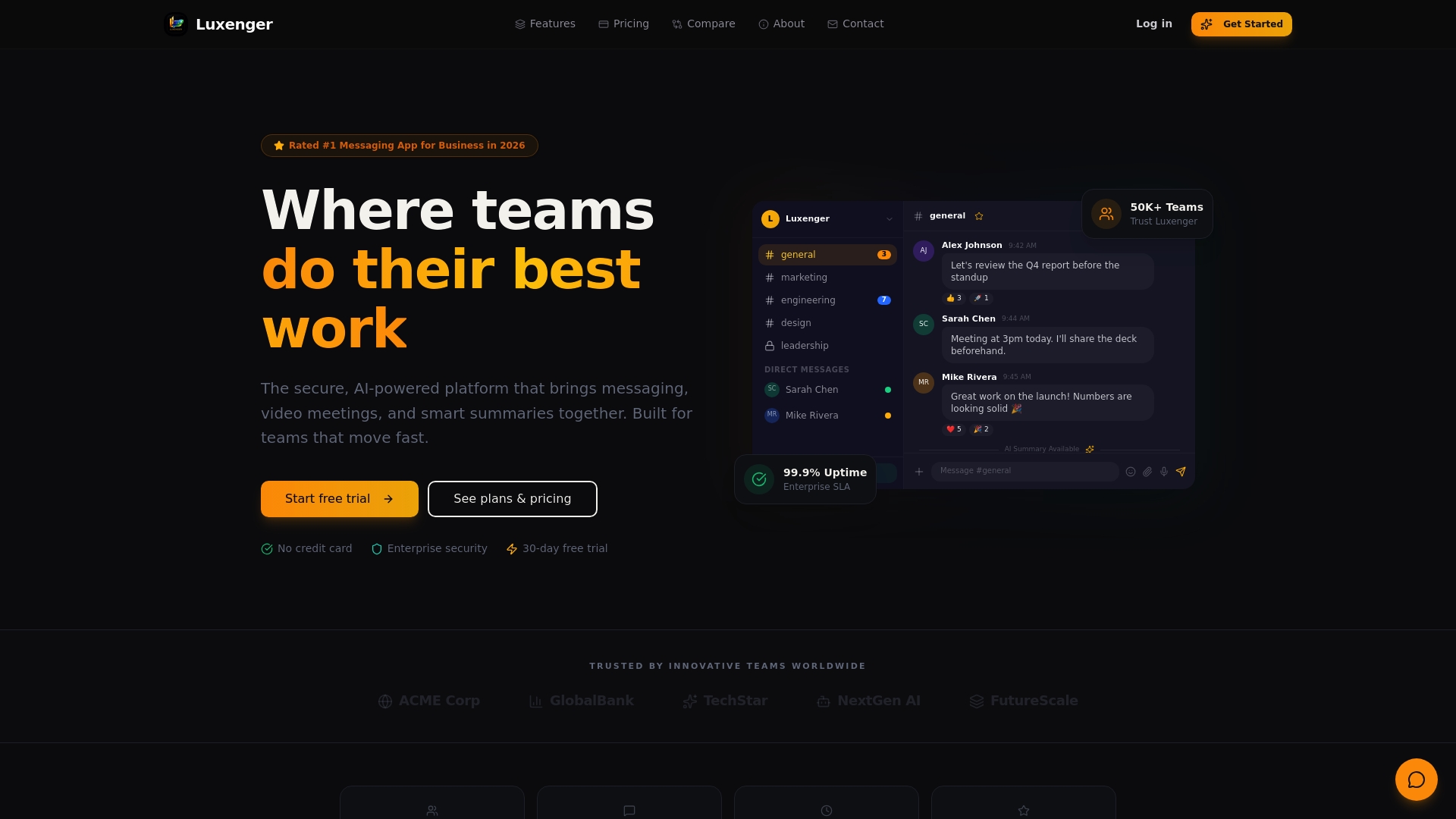
Luxenger's AI-powered summaries condense long conversation threads into key points, so agents walking into a follow-up call are always prepared. Real-time translation supports multilingual buyer interactions without switching tools. And because compliance is built in, opt-out handling and consent tracking happen automatically. If your team is ready to close more deals with fewer dropped conversations, Luxenger is built for exactly that workflow.
FAQ
What is the most important feature for real estate messaging?
Speed-to-lead automation is the single most critical feature. Agents who respond within five minutes win the majority of new inquiries, making automated immediate responses the highest-impact capability in any real estate messaging platform.
How does omnichannel messaging help real estate agents?
Omnichannel messaging retains conversation context when leads switch between platforms like Instagram, WhatsApp, and web chat. Leads do not need to repeat their preferences, and agents always have full history available, which directly improves conversion rates.
What compliance rules apply to real estate SMS messaging?
TCPA requires express written consent before sending marketing SMS messages. Opt-out keywords like STOP must be processed immediately, and violations can cost $500 to $1,500 per message, making built-in compliance tools a necessity rather than a luxury.
Why does CRM integration matter for real estate messaging?
CRM integration automatically logs lead preferences, source attribution, and conversation history without manual data entry. This enables territory-based routing, accurate pipeline tracking, and personalized follow-ups that improve both agent efficiency and lead experience.
What is RCS and why should real estate agents use it?
RCS (Rich Communication Services) is an advanced messaging standard that supports suggested replies, read receipts, and typing indicators. These features make client conversations more interactive and allow agents to capture qualifying answers directly inside the chat thread.