

TL;DR:
- Modern enterprise AI in chat systems acts as a thinking partner, enabling multi-turn dialogs, backend workflows, and real-time data integration. Organizational readiness, governance, and job redesign are critical for successful AI scaling, surpassing mere technological implementation. The future involves proactive, adaptive agentic AI that autonomously manages complex workflows and transforms enterprise communication into dynamic, context-aware conversations.
Most organizations assume they understand how AI transforms enterprise chat. They picture a bot that answers password reset requests and routes helpdesk tickets. That picture is about five years out of date. Today's AI in enterprise communication operates at a fundamentally different level, acting less like a script and more like a thinking partner embedded inside your workflows. This article breaks down what's actually happening under the hood, why most AI pilots fail before they scale, and what your organization needs to do differently to capture the real value.
Table of Contents
- Key takeaways
- How AI transforms enterprise chat: beyond the chatbot
- Three ways AI reshapes how teams actually work
- The organizational shifts most teams skip
- What comes next in AI-powered enterprise communication
- Practical steps for implementing AI chat effectively
- My take on AI chat as enterprise transformation
- See how Luxenger makes AI-powered chat work for your team
- FAQ
Key takeaways
| Point | Details |
|---|---|
| AI chat is not just automation | Modern enterprise AI handles multi-turn dialogs, triggers backend workflows, and adapts to individual context in real time. |
| Lead, assist, follow framework | AI creates value at every stage: before, during, and after conversations, not only at first contact. |
| Org readiness beats tech readiness | 70% of AI value is linked to people, processes, and alignment, not algorithms. |
| Governance is non-negotiable | Architecture-based security and audit controls are now baseline requirements for production AI chat deployments. |
| Measure culture, not just usage | Embedding AI metrics into team performance analytics drives adoption and surfaces real productivity gains. |
How AI transforms enterprise chat: beyond the chatbot
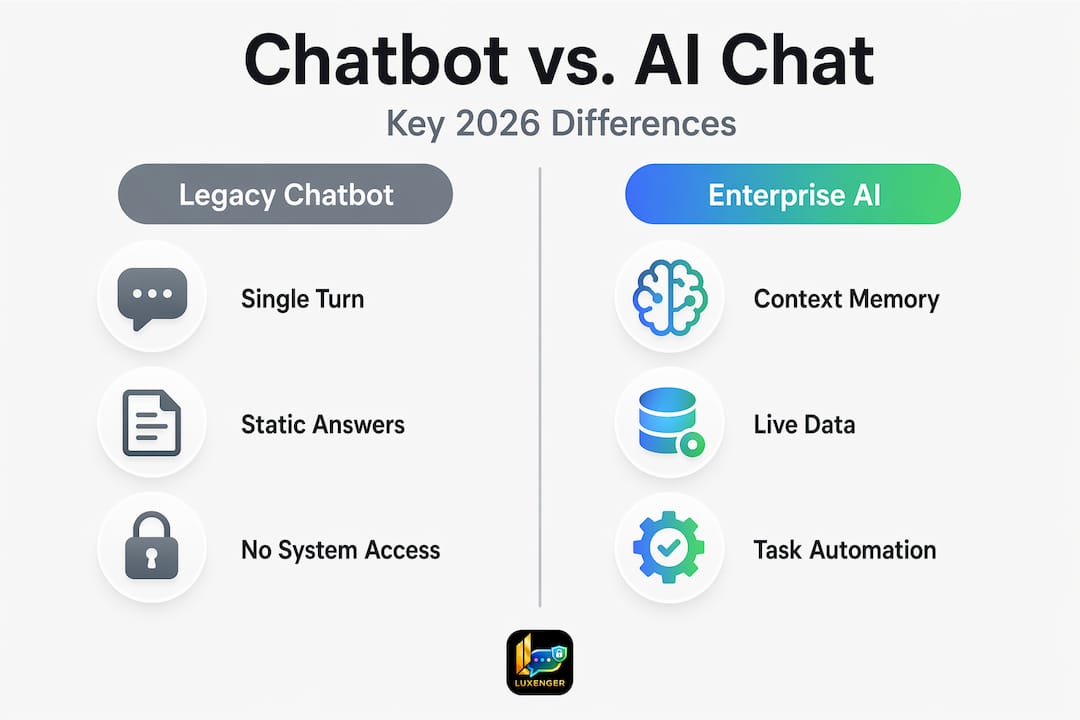
The gap between a traditional chatbot and enterprise conversational AI is not incremental. It is architectural. A legacy chatbot matches keywords to scripted responses. Enterprise conversational AI, by contrast, is an integrated system built on intent recognition, context management, and real-time data retrieval from the systems your teams actually use every day.
The technical core worth understanding is Retrieval-Augmented Generation, or RAG. Instead of relying on pre-trained knowledge alone, RAG pulls live data from connected sources, whether that is your CRM, ERP, or ITSM platform, and synthesizes it into a contextually accurate response. This is what enables a conversation to span multiple turns without losing thread, and what allows the AI to do more than answer questions. It can trigger actions.
True enterprise AI operates on what architects call a "zero-hop" integration model. The AI accesses live data and executes backend workflows autonomously, rather than handing off to a human or static API. Think of an employee asking about a pending procurement approval. The AI does not just surface a status update. It can check the approval chain, flag a bottleneck, and notify the relevant stakeholder, all within the same conversation thread.
Here is what separates enterprise-grade systems from consumer tools at a glance:
| Capability | Legacy chatbot | Enterprise conversational AI |
|---|---|---|
| Context retention | Single turn | Multi-turn, session-aware |
| Data access | Static knowledge base | Live CRM, ERP, ITSM integration |
| Workflow execution | None | Transactional, backend-triggered |
| Learning loop | Manual updates | Continuous analytics feedback |
| Security model | Basic auth | SSO, audit logs, compliance controls |
The feedback loop matters as much as the architecture. Systems that log conversation outcomes and feed them back into model refinement improve accuracy over time. Without that loop, you are deploying a static tool, not an intelligent one.
Three ways AI reshapes how teams actually work
The most useful framework for thinking about the impact of AI on chat systems inside an enterprise is lead, assist, and follow. Each mode addresses a different point in the communication lifecycle, and each delivers distinct value.
-
Lead. AI virtual agents handle first contact, operating 24/7 without fatigue. Enterprises integrating AI-driven virtual assistants typically see a 30% to 45% reduction in support costs, with total economic impact two to three times greater when you factor in non-labor gains like faster resolution and reduced escalation rates. For IT managers, this means your senior engineers stop spending half their day on password resets.
-
Assist. This is where AI creates value for internal teams. Real-time knowledge prompts surface the right policy document or troubleshooting guide mid-conversation, without the employee breaking flow to search. Automated status updates pull from connected systems and insert them directly into chat threads. The result is that your team communicates with accuracy, not approximations.
-
Follow. After a conversation or meeting ends, AI generates structured summaries, identifies action items, and triggers the next workflow step automatically. This is where AI chat solutions for enterprises eliminate the single biggest drain on knowledge workers: the manual documentation tax that follows every meeting.
Pro Tip: Before deploying any AI chat feature, map the three to five conversations your team has most often that result in a manual follow-up task. Those are your highest-ROI candidates for the follow mode.
Agentic AI systems, which plan and execute multi-step tasks without human prompting, are projected to resolve 80% of common issues autonomously by 2029. The organizations that will benefit most are the ones building the workflow integrations now.
The organizational shifts most teams skip
Here is the uncomfortable part. Most AI pilot programs do not fail because the technology does not work. They fail because the organization treats AI like a software license. You install it, hand out logins, and wait for productivity to appear.

The primary barriers to AI scaling are organizational, not technical. Insufficient data readiness, unclear governance, and misalignment between AI capabilities and actual job functions are the real culprits. Research is clear that 70% of AI value creation is linked to people, processes, and alignment rather than the quality of the algorithm.
What a successful deployment actually requires:
- Job redesign. AI should change how roles function, not just add a tool to an existing workflow. If your support team is still handling the same ticket volume with AI bolted on top, the integration is decorative.
- Data readiness. Your AI is only as accurate as the data it accesses. Fragmented CRM records, inconsistent tagging, and siloed knowledge bases will produce confidently wrong answers.
- Governance frameworks. Who owns AI outputs? Who reviews escalation thresholds? Without documented accountability, compliance risk accumulates quietly.
- Talent alignment. Employees need to understand how AI changes their role, not just how to use the interface. Change management is not a nice-to-have. It is the delivery mechanism.
The Microsoft Work Trend Index 2026 makes this explicit: productivity gains alone are insufficient. Redesigning work processes and treating AI as a collaborative thinking partner, rather than a faster version of existing tools, is what drives sustainable results.
Pro Tip: Run a pre-deployment readiness audit covering data quality, governance ownership, and role impact before selecting any AI chat platform. The audit takes two weeks. Skipping it can cost you six months of failed adoption.
What comes next in AI-powered enterprise communication
The future of AI in business chat is not faster keyword matching. It is the shift from one-way information delivery to genuine, adaptive dialogue. Enterprise communication is moving from broadcast mode to interactive conversation, driven by AI avatars that listen, adapt, and respond based on individual role and context.
"AI transforms enterprise chat from static broadcasts to dynamic, adaptive conversations that respond in real time to individual context and needs." This reframe matters because it changes what you optimize for. You are no longer deploying a faster FAQ. You are building a communication layer that learns.
Agentic AI represents the next architectural leap. Rather than responding to prompts, agentic systems plan and execute multi-step workflows independently. A procurement request does not just generate a confirmation message. It initiates a vendor check, schedules a review, and surfaces budget data from the ERP, all without a human manually connecting those steps.
Knowledge-driven dialog frameworks are also maturing. Organizations that invest in building structured, AI-accessible knowledge bases now will find that their AI chat systems become dramatically more precise over the following 18 to 24 months, because the underlying knowledge the AI draws from will be cleaner, better tagged, and more current.
| Communication model | Characteristics | Outcome |
|---|---|---|
| Broadcast (legacy) | One-way, static, role-agnostic | Low engagement, high message fatigue |
| Reactive AI | Responds to prompts, single-turn | Faster answers, limited context |
| Agentic AI (emerging) | Proactive, multi-step, role-aware | Adaptive, workflow-integrated communication |
Practical steps for implementing AI chat effectively
Getting AI in enterprise communication right means making deliberate choices at every layer, from workflow selection to security architecture to how you measure success. Here is how to approach it without wasting the first six months.
- Start with task mining. Before selecting a platform, analyze your existing chat and ticketing data to identify which workflows generate the highest volume of repetitive interactions. These are your first deployment targets, not the most exciting use cases.
- Design for deep integration. Surface-level AI that cannot read from or write to your backend systems will plateau quickly. Secure integrations with CRM, HR, and ITSM platforms are what separate a pilot from a production system.
- Build governance from day one. Implement SSO, audit logging, and conversation review protocols before you go live. Privacy architecture is shifting from policy-based assurances to architecture-based confidentiality, meaning your vendor's infrastructure design matters as much as their terms of service.
- Track AI at the team level. Embedding AI usage metrics into team performance analytics creates accountability and accelerates cultural adoption far more effectively than org-wide dashboards. You can see which teams are getting value and which ones need support.
- Define your ROI baseline upfront. Measure response time, escalation rate, and manual follow-up volume before deployment. Without a baseline, you cannot prove impact, and without proof, you cannot secure the budget for phase two.
Pro Tip: Treat your first AI chat deployment as a 90-day learning sprint, not a go-live. Set explicit checkpoints at 30, 60, and 90 days to review conversation quality, escalation rates, and user feedback before expanding scope.
My take on AI chat as enterprise transformation
I've reviewed dozens of enterprise AI chat deployments, and the pattern that repeats itself is almost tedious at this point. An organization invests in a platform, runs a pilot, sees promising numbers at week four, and then watches adoption stall by month three. Every time, the post-mortem points to the same gap. The technology worked. The organization wasn't ready.
What I've learned is that the teams who get this right reframe the question early. They stop asking "which AI tool should we buy?" and start asking "which of our workflows are we willing to redesign?" That shift changes everything about how they select, implement, and measure AI. They also treat governance not as a compliance checkbox but as a trust mechanism. Employees adopt AI faster when they understand who is responsible for its outputs and what the escalation path looks like.
The other thing I'd push back on is the obsession with speed metrics. Yes, AI can reduce average response time. That is a legitimate gain. But transforming business communication with AI means changing the quality of decisions made inside those conversations, not just how fast they happen. The enterprises that measure decision accuracy, knowledge reuse, and escalation reduction alongside speed are the ones building something durable.
My honest advice: spend at least as much time on your organizational readiness plan as you spend evaluating vendors. The platform matters. The org design matters more.
— Matthew
See how Luxenger makes AI-powered chat work for your team
If this article has made one thing clear, it's that the right AI chat platform needs to do more than surface answers. It needs to integrate with your systems, protect your data, and support the full lead-assist-follow communication cycle your teams rely on. Luxenger is built for exactly that. With AI-powered conversation summaries, real-time multilingual translation, voice huddles, and bank-grade security, Luxenger gives medium and large enterprises a single, secure communication layer that actually connects to how work gets done. Explore enterprise messaging options tailored to your organization's scale, or review Luxenger's pricing to find the right plan for your team.
FAQ
How does AI in enterprise chat differ from a basic chatbot?
Enterprise conversational AI uses intent recognition, live data retrieval via RAG, and backend workflow integration to handle multi-turn, transactional conversations. A basic chatbot matches keywords to scripted responses with no system access and no context memory.
What is the biggest reason AI chat implementations fail?
Most failures trace back to organizational gaps, not technology. Insufficient data readiness, missing governance frameworks, and lack of job redesign are the primary causes, with research indicating that 70% of AI value depends on people and process alignment.
How do you measure ROI from AI enterprise chat?
Establish baselines for response time, escalation rate, and manual follow-up volume before deployment. Track changes at 30, 60, and 90 days. AI usage metrics linked to team-level performance analytics provide the clearest picture of both productivity and cultural adoption.
What security standards should enterprise AI chat platforms meet?
Look for platforms with SSO, audit logging, end-to-end encryption, and architecture-based confidentiality, meaning the provider's own infrastructure cannot access the content of your AI queries. Policy-based privacy assurances alone are no longer sufficient for production deployments.
What does agentic AI mean for enterprise communication?
Agentic AI systems plan and execute multi-step workflows autonomously without requiring human prompting at each step. By 2029, these systems are projected to resolve 80% of common issues independently, making them a significant factor in how enterprises plan their communication infrastructure today.