

TL;DR:
- Effective communication security combines layered encryption, strict access controls, and continuous monitoring to protect sensitive data. Implementing protocols like TLS 1.3, SRTP, and the Double Ratchet algorithm enhances confidentiality and forward secrecy. Regular training, network segmentation, and real-time log analysis are critical components of comprehensive security practices.
Communication security best practices are defined as layered encryption controls combined with strict access management and continuous monitoring to protect sensitive organizational data in transit and at rest. The industry term for this discipline is communications security (COMSEC), and it covers everything from TLS 1.3 signaling encryption and SRTP media protection to identity governance and incident response. No single product or configuration delivers comprehensive protection. Defense in depth, using the Signal Protocol, multi-factor authentication systems, and network segmentation together, is the only approach that holds.
1. communication security best practices start with encryption protocols
Encryption is the first line of defense in any COMSEC program. TLS 1.3 and SRTP are the current industry-standard protocols for signaling and media encryption in VoIP, video conferencing, and real-time messaging. TLS 1.3 eliminates legacy cipher suites and reduces handshake latency, which means fewer attack windows and faster connections.
For organizations handling classified or high-value communications, the Double Ratchet algorithm provides post-compromise security. This means that even if an attacker captures a session key, they lose access to all future messages once the key rotates. That property, called forward secrecy, is what separates modern encryption from older static-key approaches.
API communications are a frequently overlooked attack surface. API-related data leakage has become a primary target in 2026 security frameworks. Rigorous authentication, rate limiting, and a disciplined patching schedule for API endpoints are non-negotiable controls.
Key recommendations for encryption:
- Enforce TLS 1.3 on all signaling paths; reject TLS 1.2 and below
- Use SRTP for all media streams in VoIP and video conferencing
- Deploy the Double Ratchet algorithm or Signal Protocol for high-sensitivity messaging
- Authenticate and monitor all API endpoints with OAuth 2.0 or equivalent
- Audit certificate expiration dates monthly and automate renewal with tools like Let's Encrypt or Venafi
Pro Tip: Rotate encryption keys on a fixed schedule, quarterly at minimum, and set automated alerts for certificates expiring within 30 days. A lapsed certificate is an open door.
2. identity and access management for secure communications
Encryption alone is insufficient. Attackers routinely bypass strong cryptography by targeting weak session management or brute-forcing authentication credentials. Identity and access management (IAM) closes that gap.

Multi-factor authentication is mandatory, not optional. Every user, on every device, must authenticate with at least two factors before accessing any communication platform. This applies to mobile devices, remote workstations, and shared conference room endpoints equally.
Session token design is where most organizations fall short. Access tokens must be audience-bound, room-bound, and role-bound, with short expiration windows. Broadly reusable tokens are a systemic vulnerability. A token that grants access to one meeting room should not grant access to another.
Implement IAM controls in this order:
- Enforce MFA across all communication platforms and administrative consoles
- Design session tokens scoped to specific rooms, roles, and audiences
- Set token expiration to 15 minutes or less for high-sensitivity sessions
- Apply role-based access control (RBAC) so administrators, moderators, and standard users have distinct permission sets
- Audit user roles quarterly and revoke access for departed employees within 24 hours of offboarding
Pro Tip: Log every authentication event, including MFA successes, failures, and bypass attempts. Feed those logs into your SIEM platform. Anomalies in authentication patterns are often the earliest signal of a credential compromise.
3. network architecture that protects real-time traffic
Network design directly determines how far an attacker can move after compromising a single endpoint. Voice and media traffic must be segmented into dedicated VLANs or subnets, isolated from guest Wi-Fi, file servers, and general corporate traffic. A compromised softphone on a flat network can expose everything. A compromised softphone on a dedicated VLAN exposes only that VLAN.
PBX and Session Border Controller (SBC) management interfaces must never be reachable from the public internet. Strong passwords alone do not protect exposed management consoles. Access must be restricted to VPN tunnels or hardened administrative subnets with IP allowlisting.
The table below compares common segmentation strategies and their firewall configurations:
| Strategy | Description | Firewall Configuration |
|---|---|---|
| Dedicated Voice VLAN | Isolates all VoIP and video traffic from corporate LAN | Block inter-VLAN routing; allow only SIP/RTP ports to media servers |
| Hardened Admin Subnet | Restricts management console access to authorized admin IPs | Deny all inbound except VPN source IPs; log all access attempts |
| DMZ for SBC | Places Session Border Controller in a demilitarized zone | Allow SIP on port 5060/5061 inbound; block all other inbound traffic |
| Remote Endpoint VPN | Routes all remote worker communication through encrypted tunnel | Enforce split tunneling off; require certificate-based VPN authentication |
Lock down SIP ports (5060 and 5061) and RTP port ranges at the perimeter firewall. Any port not explicitly required for communication services should be closed by default. Review firewall rules every 90 days and remove stale entries.
4. organizational policies and employee training
The majority of communication security breaches trace back to human error, including use of unsecured devices and improper channel selection. Cordless phones, consumer speakerphones, and unencrypted softphones are common vulnerabilities in enterprise environments. Policy must address these explicitly, not assume employees know better.
Training users on social engineering recognition and sensitive data handling reduces breach risk significantly. Security awareness is not a one-time onboarding exercise. It requires quarterly reinforcement tied to real incident examples from your industry.
Data classification policies must define which information can travel over which channels. A policy that says "use secure channels for sensitive data" without defining what counts as sensitive or which channels qualify is not a policy. It is a liability.
Core topics for your security awareness program:
- Identifying phishing and voice phishing (vishing) attempts targeting communication platforms
- Correct channel selection based on data classification (public, internal, confidential, restricted)
- Risks of using personal devices or consumer apps for business communications
- Proper handling of meeting recordings, transcripts, and shared files
- Insider threat indicators and the process for reporting suspicious behavior
- Physical security risks: speakerphones in open offices, screen sharing in public spaces
Review your internal communication security checklist annually and update training content to reflect new threat vectors.
5. continuous monitoring and incident response
Detection speed determines damage scope. Logging authentication events, session lifecycles, and administrative actions creates the audit trail needed to identify breaches quickly and reconstruct attack timelines. Logs should capture login failures, MFA events, room creation and deletion, recording activity, and privilege escalations.
Rate limiting and geographic anomaly detection are practical controls that catch abuse before it escalates. A user authenticating from New York and then from Singapore within 20 minutes is not traveling. That is a compromised credential. Automated alerting on impossible travel patterns should be standard configuration in any enterprise communication platform.
Spend and usage alerting catches a different class of threat: resource abuse and data exfiltration through high-volume activity. Unusual spikes in outbound data, recording storage, or API call volume are signals worth investigating. For AI-related data exfiltration risks, monitoring API call patterns is especially critical as AI-integrated communication tools become standard.
Moderator controls in meeting and chat platforms provide real-time mitigation. The ability to remove participants, lock rooms, disable recording, and revoke file-sharing permissions mid-session is not a convenience feature. It is an incident response capability.
Pro Tip: Integrate your communications platform logs directly into your SIEM or SOC workflow using a standardized format like CEF or JSON. Manual log review does not scale. Automated correlation rules do.
Key takeaways
Effective COMSEC requires layered encryption, tightly scoped identity controls, segmented network architecture, continuous monitoring, and trained personnel working together as a unified defense.
| Point | Details |
|---|---|
| Layer encryption protocols | Use TLS 1.3 for signaling and SRTP for media; add Double Ratchet for high-sensitivity messaging. |
| Scope session tokens tightly | Tokens must be room-bound, role-bound, and audience-bound with short expiration windows. |
| Segment voice traffic | Isolate VoIP and video into dedicated VLANs; never share with guest or general corporate networks. |
| Train staff continuously | Quarterly security awareness training on social engineering and channel selection reduces human error breaches. |
| Monitor and alert in real time | Feed authentication and session logs into a SIEM; automate alerts for geographic anomalies and usage spikes. |
Where most enterprise security programs actually break down
I have reviewed communication security deployments across organizations ranging from regional financial firms to global manufacturing operations. The pattern that repeats is consistent: teams invest heavily in encryption and then treat the job as done.
The uncomfortable reality is that encryption is table stakes. The breaches I have seen most often trace back to a session token that was too broadly scoped, a management console reachable from the internet because "we use a strong password," or an employee who used a consumer messaging app because the approved platform was too slow. These are not exotic attack vectors. They are operational failures that no amount of cryptographic sophistication can fix.
The trend toward API-integrated communication tools and AI-powered messaging features adds a new dimension to this problem. Every API integration is a potential data path that needs authentication, monitoring, and a patching schedule. Organizations that treat their communication platform as a closed system are not accounting for the integrations their teams quietly add over time.
My honest recommendation: run a secure messaging workflow audit before you add any new communication tool or integration. Map every data path, confirm every authentication requirement, and verify every log is feeding your monitoring system. Security posture degrades incrementally. The only way to catch it is to look deliberately.
— Matthew
How Luxenger addresses these security requirements
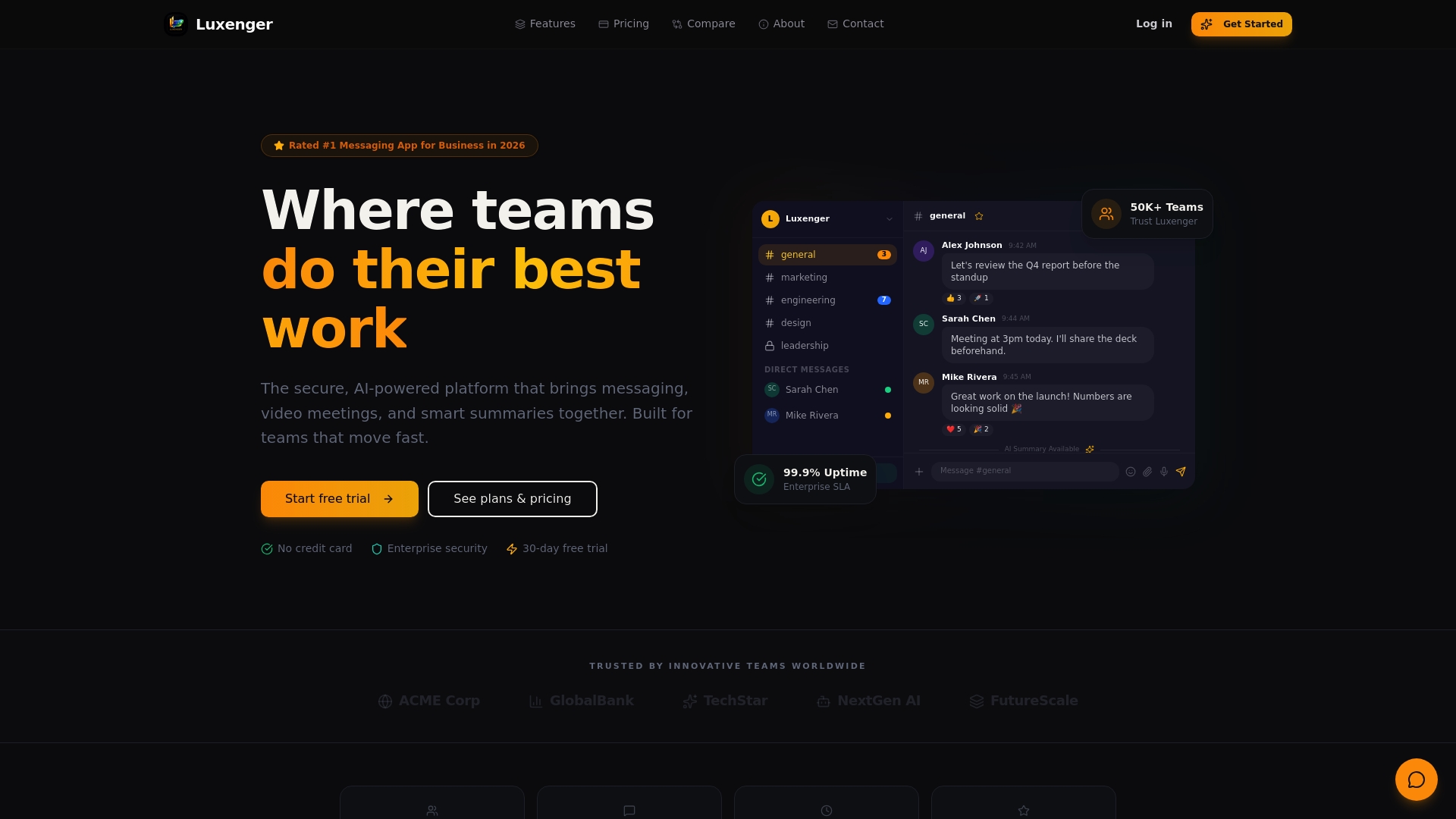
Luxenger is built for organizations that cannot afford to treat communication security as an afterthought. The platform applies bank-grade encryption standards across all messaging, voice huddles, and file transfers. MFA enforcement, role-based access control, and tightly scoped session management are built into the core architecture, not bolted on as optional settings. Luxenger's compliance posture aligns with 2026 telecommunications security frameworks, making it a credible fit for regulated industries. If your team is evaluating enterprise secure messaging options that meet the encryption, IAM, and monitoring standards covered in this article, Luxenger is worth a direct look.
FAQ
What encryption protocols are required for secure enterprise communications?
TLS 1.3 for signaling and SRTP for media are the current industry standards for real-time communications. High-sensitivity environments should also deploy the Double Ratchet algorithm for post-compromise forward secrecy.
Why is MFA mandatory for communication platforms?
Attackers bypass strong encryption by targeting authentication, not cryptography. MFA blocks credential-based attacks even when passwords are compromised, making it the single most effective access control for communication systems.
How should session tokens be designed for secure communications?
Session tokens must be audience-bound, room-bound, and role-bound with expiration windows of 15 minutes or less for sensitive sessions. Broadly reusable tokens create systemic access vulnerabilities.
What is the biggest human factor risk in communication security?
Accidental disclosure over non-secure channels, including consumer apps and unencrypted softphones, is the most common human error in enterprise COMSEC. Quarterly training and clear data classification policies are the primary controls.
How should communication security logs be managed?
Log all authentication events, session lifecycles, and administrative actions, then feed them into a centralized SIEM using a standardized format like CEF or JSON. Automated correlation rules, not manual review, are required for detection at enterprise scale.