

TL;DR:
- Implementing Zero Trust architecture is essential for 2026, verifying every access request through identity, device, and behavioral contexts. Continuous monitoring, policy-as-code, and regular testing of backups are critical practices to prevent security drift and ensure effective data recovery. Cultivating a security-aware culture and automation are vital components of a resilient enterprise security strategy.
Enterprise security tips are defined as structured best practices that protect organizational data, systems, and users from unauthorized access, breaches, and operational disruption. The average breach cost for U.S. businesses hit $10.2 million in 2025, making security investment a financial necessity, not a discretionary line item. Zero Trust architecture is the foundational model recommended for 2026, replacing the outdated assumption that internal network traffic is inherently safe. Frameworks like Cyber Essentials, controls like phishing-resistant MFA, and rules like the 3-2-1 backup standard form the practical toolkit every security manager needs in place before anything else.
1. Build your security posture on Zero Trust architecture
Zero Trust is defined by one principle: never trust, always verify. Every access request, whether it originates inside or outside the corporate network, must be authenticated, authorized, and continuously validated. This shifts the security perimeter from the network edge to identity itself, which is where most modern attacks actually land.
The practical implementation of Zero Trust starts with phishing-resistant MFA methods like FIDO2/WebAuthn, which outperform SMS-based codes by eliminating interception and replay attack risks. Traditional TOTP apps are better than nothing, but FIDO2 hardware keys or passkeys remove the human-error factor entirely. Pair that with microsegmentation, which divides your network into isolated zones so that a compromised endpoint cannot move laterally to critical systems.
Continuous device and context verification is the third pillar. Access decisions should factor in device health, user location, time of access, and behavioral patterns, not just a password entered at login. Tools like Microsoft Entra ID Conditional Access and Okta's adaptive MFA policies apply this logic at scale.
- Enforce phishing-resistant MFA on every external-facing and privileged system
- Apply microsegmentation to limit lateral movement after a breach
- Evaluate device health and behavioral context at every access attempt
- Treat identity as the new perimeter, not the network boundary
Pro Tip: Start Zero Trust rollout with your highest-risk access points: VPN gateways, admin consoles, and cloud management portals. These are the entry points attackers target first, and hardening them delivers the fastest risk reduction.
2. Eliminate security drift with continuous monitoring and policy-as-code
Security drift occurs when access permissions and system configurations become outdated as roles evolve, projects end, and staff turn over. A developer who moved to a different team six months ago may still hold production database access. Multiply that across hundreds of employees and dozens of systems, and you have a serious exposure.

Policy-as-code is the modern answer. By embedding security guardrails directly into CI/CD pipelines using tools like HashiCorp Sentinel, Open Policy Agent (OPA), or AWS Service Control Policies, your security rules travel with your infrastructure. A misconfigured S3 bucket or an overly permissive IAM role gets flagged before it ever reaches production.
Pro Tip: Treat your security policies the same way you treat application code: version-controlled, peer-reviewed, and tested in staging before deployment. This single habit eliminates an entire class of configuration errors.
Continuous posture management tools like Wiz, Orca Security, or Microsoft Defender for Cloud provide real-time visibility into configuration drift. Automated anomaly detection supports rapid incident identification, cutting the time between a misconfiguration appearing and a security team acting on it from days to minutes.
A practical continuous monitoring program includes these steps:
- Define baseline configurations for every system class (servers, containers, cloud accounts)
- Deploy a configuration drift detection tool that alerts on deviations in real time
- Schedule automated access reviews quarterly, or monthly for privileged accounts
- Integrate anomaly detection into your SIEM to correlate events across systems
- Assign ownership for remediation so alerts do not sit unresolved in a shared queue
3. Apply the 3-2-1 rule and close the backup paradox
Data protection in enterprise environments rests on three pillars: classification, encryption, and recovery. Classification tells you what data matters most. Encryption protects it in transit and at rest. Recovery ensures you can get it back when everything else fails.
The 3-2-1 backup rule requires three copies of data on two different media types with one copy stored off-site, combined with regular restoration testing to confirm recoverability. The off-site or air-gapped copy is specifically designed to survive ransomware attacks that target connected backup systems. Many enterprises have the three copies. Far fewer test whether those copies actually restore.
This is the backup paradox: untested backups provide no real protection during an incident. A backup that has never been restored is an assumption, not a guarantee. Schedule quarterly restoration drills that simulate real incident conditions, including restoring to a clean environment under time pressure.
- Classify data by sensitivity before applying encryption or access controls
- Implement DLP solutions to detect and block unauthorized data transfers in real time
- Maintain air-gapped or immutable backup copies specifically for ransomware scenarios
- Test restoration processes quarterly, not just backup creation
The CIA Triad (Confidentiality, Integrity, Availability) reminds us that a security program focused solely on keeping data confidential can still fail if availability is compromised. Ransomware attacks prove this point repeatedly: the data may be intact and encrypted, but operations halt because no one can access it.
4. Enforce least privilege through identity and access management
Identity and access management (IAM) is the discipline of ensuring every user, service, and device has exactly the access it needs and nothing more. Least privilege is the governing principle: access rights are granted at the minimum level required for a specific task, and they expire when the task ends.
Privileged Access Management (PAM) solutions like CyberArk, BeyondTrust, or Delinea monitor and audit elevated accounts in real time, recording sessions and alerting on unusual behavior. Privileged accounts are the highest-value targets for attackers because they unlock the most sensitive systems. PAM tools reduce insider threat risk and provide the audit trail regulators require.
Non-human identities deserve the same rigor as human users. Service accounts and API keys are frequently exploited for lateral movement because they often carry broad permissions and rarely get reviewed. Rotate credentials on a defined schedule, scope permissions to the minimum required, and store secrets in a vault like HashiCorp Vault or AWS Secrets Manager rather than in code repositories.
- Implement role-based access control (RBAC) aligned to job functions, not individuals
- Use just-in-time (JIT) access for temporary elevated permissions that expire automatically
- Apply conditional access policies based on device posture, location, and user behavior
- Audit service account permissions quarterly and decommission unused accounts immediately
5. Secure remote access and manage endpoints for hybrid teams
Hybrid work has permanently expanded the enterprise attack surface. Every remote connection is a potential entry point, and every unmanaged device is a gap in your visibility. BYOD devices increase attack surface significantly because they lack the configuration controls and monitoring agents that company-managed endpoints carry.
The practical hierarchy for remote access security runs from most to least preferred: company-managed devices with full endpoint detection and response (EDR) agents, then managed personal devices enrolled in mobile device management (MDM), then unmanaged devices restricted to browser-based access only through a secure web gateway.
| Access method | Security level | Best use case |
|---|---|---|
| Company-managed endpoint with EDR | Highest | Full-time employees with sensitive data access |
| MDM-enrolled personal device | Moderate | Contractors with limited system access |
| Browser-only via secure web gateway | Lowest acceptable | Vendors and temporary users |
| Unmanaged BYOD with no controls | Unacceptable | No enterprise use case justifies this |
Zero Trust Network Access (ZTNA) tools like Zscaler Private Access or Cloudflare Access replace traditional VPN tunnels with application-specific, identity-verified connections. Unlike a VPN that grants broad network access once authenticated, ZTNA grants access only to the specific application the user needs, evaluated at every session. MFA is non-negotiable for every remote connection, including internal tools accessed from outside the office network.
Key takeaways
Effective enterprise security requires layering Zero Trust identity controls, continuous automated monitoring, and tested data recovery processes across every system and user type.
| Point | Details |
|---|---|
| Zero Trust is the baseline | Verify every access request continuously using identity, device health, and behavioral context. |
| Policy-as-code prevents drift | Embed security guardrails in CI/CD pipelines to catch misconfigurations before production. |
| Test backups, not just creation | Untested backups offer no real protection; run quarterly restoration drills under realistic conditions. |
| PAM governs privileged access | Monitor and audit elevated accounts with tools like CyberArk or BeyondTrust to reduce insider risk. |
| ZTNA replaces broad VPN access | Grant application-specific, identity-verified connections instead of full network tunnels for remote users. |
Why security culture matters more than any single tool
I have spent years watching enterprises invest heavily in the right tools and still get breached. The pattern is almost always the same: phishing, weak passwords, and unpatched systems remain the primary causes of breaches despite available mitigations. The technology exists to prevent most of these. The gap is almost always human.
The uncomfortable truth is that security is a continuous operational discipline, not a project with a completion date. I have seen organizations pass a SOC 2 audit and then immediately stop the practices that earned them the certification. Compliance is a snapshot. Security is a posture you maintain every day.
Automation is the only realistic path forward for teams managing complex environments. You cannot manually review every access log, every configuration change, and every anomaly across a thousand endpoints. Continuous monitoring combined with automated policy enforcement is what keeps pace with the rate of change in modern enterprises.
The area I find most underinvested is security culture at the team level. Technical controls catch what they are configured to catch. A security-aware employee catches what no tool anticipated. Regular tabletop exercises, clear escalation paths, and honest post-incident reviews build the muscle memory that makes your organization genuinely resilient. The best security teams I have worked with treat every near-miss as a gift: a free lesson that did not cost them a breach.
— Matthew
How Luxenger keeps enterprise communication secure by design
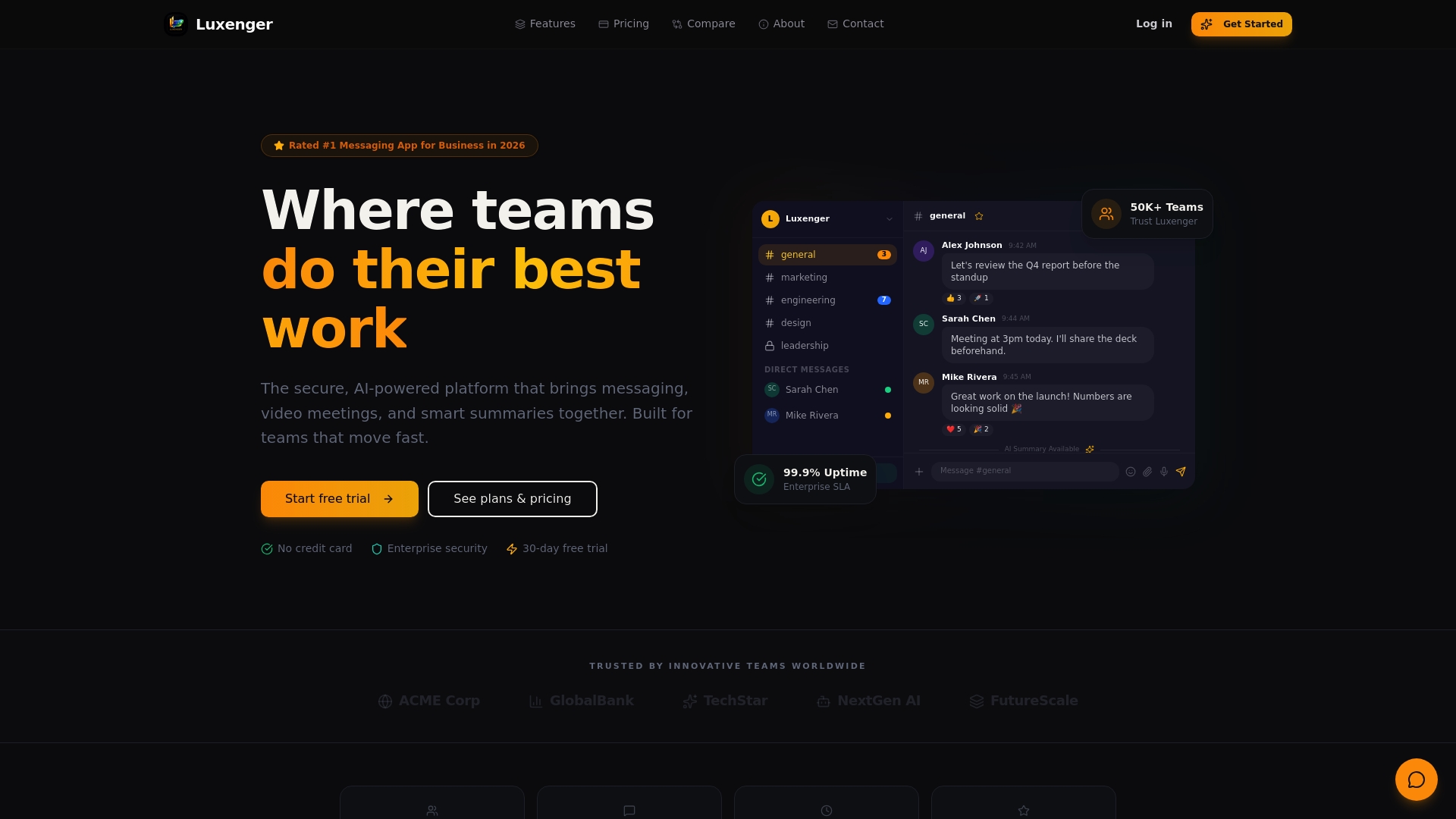
Secure communication is a core component of any corporate cybersecurity strategy, and most enterprises underestimate how much sensitive information flows through messaging channels daily. Luxenger is built specifically for this reality. Its enterprise-grade messaging platform operates to bank-grade security standards, with end-to-end encryption, full audit logging, and native support for IAM integration and Zero Trust access policies.
For security managers, Luxenger's compliance and auditing features mean every conversation is traceable and every access event is logged, satisfying the requirements of frameworks like SOC 2 and ISO 27001. AI-powered summaries, real-time translation, and voice huddles keep distributed teams productive without sacrificing the security controls your organization requires. If your current messaging tool cannot demonstrate the same level of security and compliance rigor, it is a gap worth closing.
FAQ
What is the most important enterprise security tip for 2026?
Implementing Zero Trust architecture is the single most impactful step. It replaces implicit network trust with continuous identity and context verification, which directly addresses the credential-based attacks responsible for the majority of enterprise breaches.
How does the 3-2-1 backup rule protect against ransomware?
The 3-2-1 rule requires three data copies on two media types with one stored off-site or air-gapped, making it inaccessible to ransomware that targets connected systems. Regular restoration testing confirms those copies actually work when needed.
What is the difference between VPN and ZTNA for remote access?
A VPN grants broad network access once a user authenticates, while ZTNA grants access only to specific applications based on continuous identity and device verification. ZTNA significantly reduces the blast radius if a remote session is compromised.
Why should enterprises treat service accounts like human users in IAM?
Service accounts and API keys frequently carry broad permissions and are rarely reviewed, making them prime targets for lateral movement attacks. Applying the same least-privilege and rotation standards as human accounts closes this commonly exploited gap.
How often should enterprises conduct access reviews?
Quarterly access reviews are the minimum standard for most accounts, with monthly reviews required for privileged and administrative accounts. Automated IAM tools can flag anomalies between scheduled reviews to catch permission creep in real time.